
The most popular wedding entertainment advice is also the least useful: choose a DJ with a great playlist and let them handle the rest. A playlist can't decide whether guests need dinner, dancing, a clear announcement, or a few quiet minutes to talk. It can't notice that the photographer is ready for the first dance while the catering team is still clearing plates.
A wedding DJ and MC does far more than press play and speak into a microphone. The combined role manages the reception's energy, timing, transitions, and room awareness. Music creates the atmosphere, while the microphone gives guests a clear path through the evening. When those jobs work together, the reception feels natural. When they don't, even beautiful music can leave the room feeling disconnected.
Why Your Wedding DJ and MC Role Actually Matters More Than You Think
A technically capable DJ can still weaken a reception if they don't understand pacing. They might play every requested song, use clean audio, and operate reliable equipment, yet place a long speech immediately after dinner, announce a dance before guests have found their seats, or push high-energy music before the room is ready.
The problem usually isn't one dramatic mistake. It's a series of small decisions. A song ends too abruptly. A speaker talks without a working microphone. The DJ fills a quiet moment with unnecessary commentary. Guests sit through several formalities without a musical reset, then hesitate when the dance floor finally opens.
Practical rule: The person controlling the music and microphone should know what the next moment needs before announcing it.
The reception has an emotional arc
A well-paced reception generally moves through distinct moods. Guests arrive and settle in. They listen during introductions and speeches. They eat, reconnect, watch the couple's formal moments, and eventually decide whether to dance. The DJ/MC shapes those changes without making the schedule feel like a series of instructions.
That means reading the room rather than obeying a playlist blindly. If dinner is taking longer than planned, the DJ may keep the background music comfortable instead of rushing guests toward the next announcement. If the dance floor fills quickly, they may extend that energy before introducing another formal moment. If older relatives and younger friends respond to different genres, they can create a sequence that gives each group a reason to stay involved.
The role also protects the couple from dozens of small questions. Vendors can confirm timing through one point of contact. Speakers know when to approach the microphone. Guests hear what's happening without the couple interrupting dinner to explain it. A clear overview of the technical and entertainment side appears in this wedding sound and DJ service guide.
Why “background fixture” is the wrong mental model
A DJ/MC isn't supposed to dominate the reception. The strongest professionals often speak less than couples expect, then make their most important decisions from behind the booth. One industry guide estimates that an emcee may speak for about 8 to 12 minutes across an entire reception, with individual announcements lasting 30 to 90 seconds according to this wedding emcee guidance.
That brevity matters. Announcements should clarify the next step, not compete with the celebration. The craft is connecting one moment to another so guests feel guided, not managed.
DJ vs MC Roles on a Wedding Day
The simplest distinction is this: the DJ manages sound and music, while the MC manages communication and attention. At many weddings, one person performs both jobs. That can work extremely well, but only if the professional has the skill and focus to switch between technical control and public hosting without neglecting either.
A DJ prepares music, organizes playlists, blends tracks, controls volume, adjusts equalization, and manages microphones and speakers. They also watch the dance floor. Their decisions affect whether the room feels lively, relaxed, elegant, playful, or abruptly unsettled.
An MC gives guests information. They welcome the room, introduce the couple and wedding party, invite speakers forward, explain formalities, and announce transitions. A good MC doesn't need to be theatrical. Clear timing, an easy speaking voice, and confidence under pressure matter more than constant jokes.
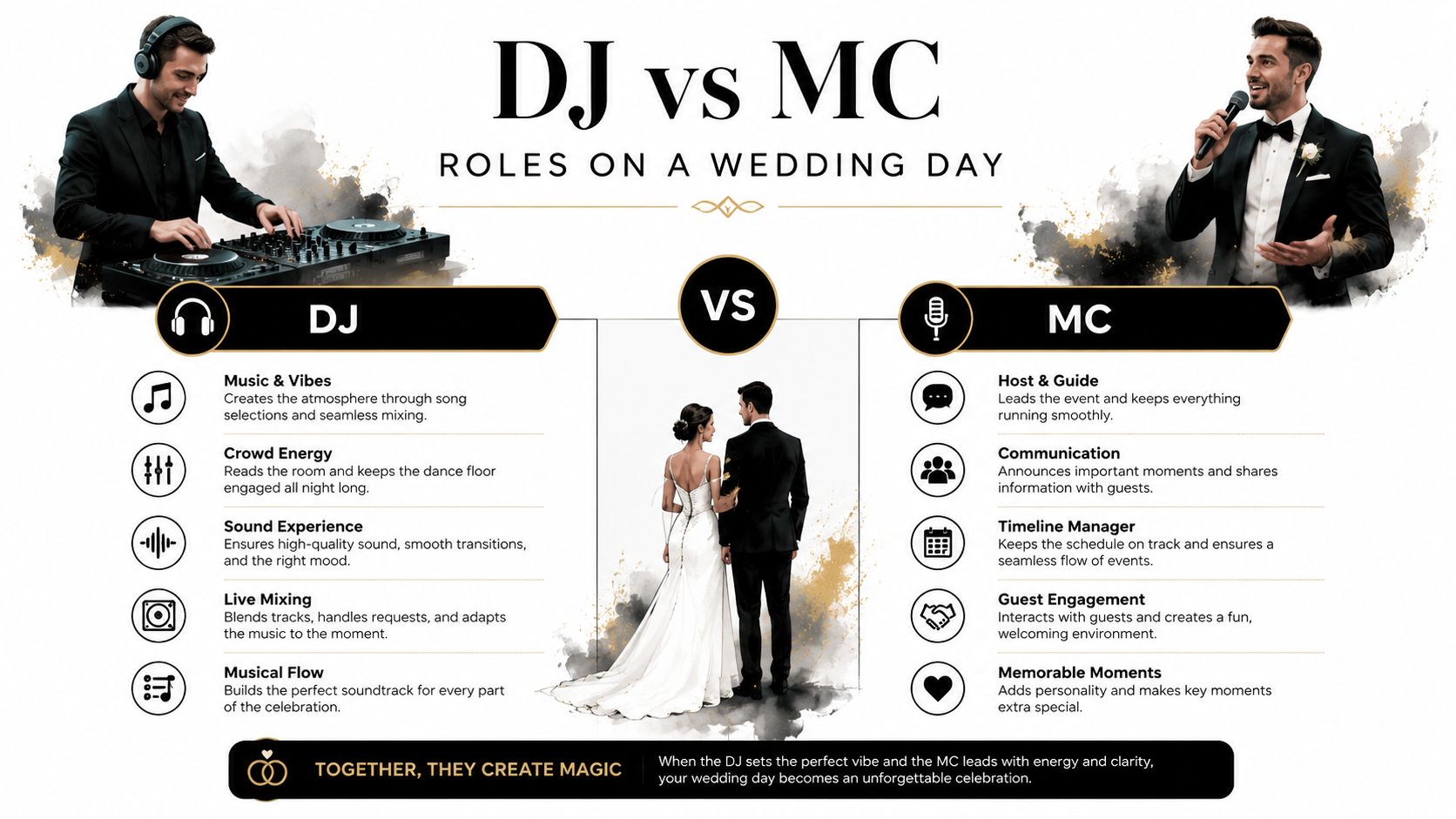
The overlap creates the modern wedding DJ and MC service. The same professional can lower the music, announce dinner, cue a toast, play a walk-up track, and return the room to a comfortable atmosphere. You can also read this practical explanation of what a wedding MC does before comparing providers.
A practical comparison
| Aspect | Wedding DJ | Wedding MC |
|---|---|---|
| Core responsibility | Selects, mixes, and controls music | Announces and guides reception moments |
| Main tools | Music library, mixer, speakers, microphones, lighting controls | Microphone, timeline, cue sheet, vendor contacts |
| Primary skill | Musical judgment and sound management | Clear communication and timing |
| Guest impact | Shapes mood and dance-floor energy | Explains what's happening and where attention should go |
| Behind-the-scenes focus | Track preparation, levels, transitions, equipment | Speaker order, entrances, formalities, vendor cues |
| Common overlap | Plays music under announcements and between events | Uses music cues to support introductions and transitions |
The roles can be separated when a couple wants a dedicated host, a band needs a separate announcer, or the reception has unusually complex production. For most standard receptions, the key question isn't whether one person can technically do both. It's whether that person has a clear process for handling both at once.
Benefits of Hiring a Combined DJ and MC Service
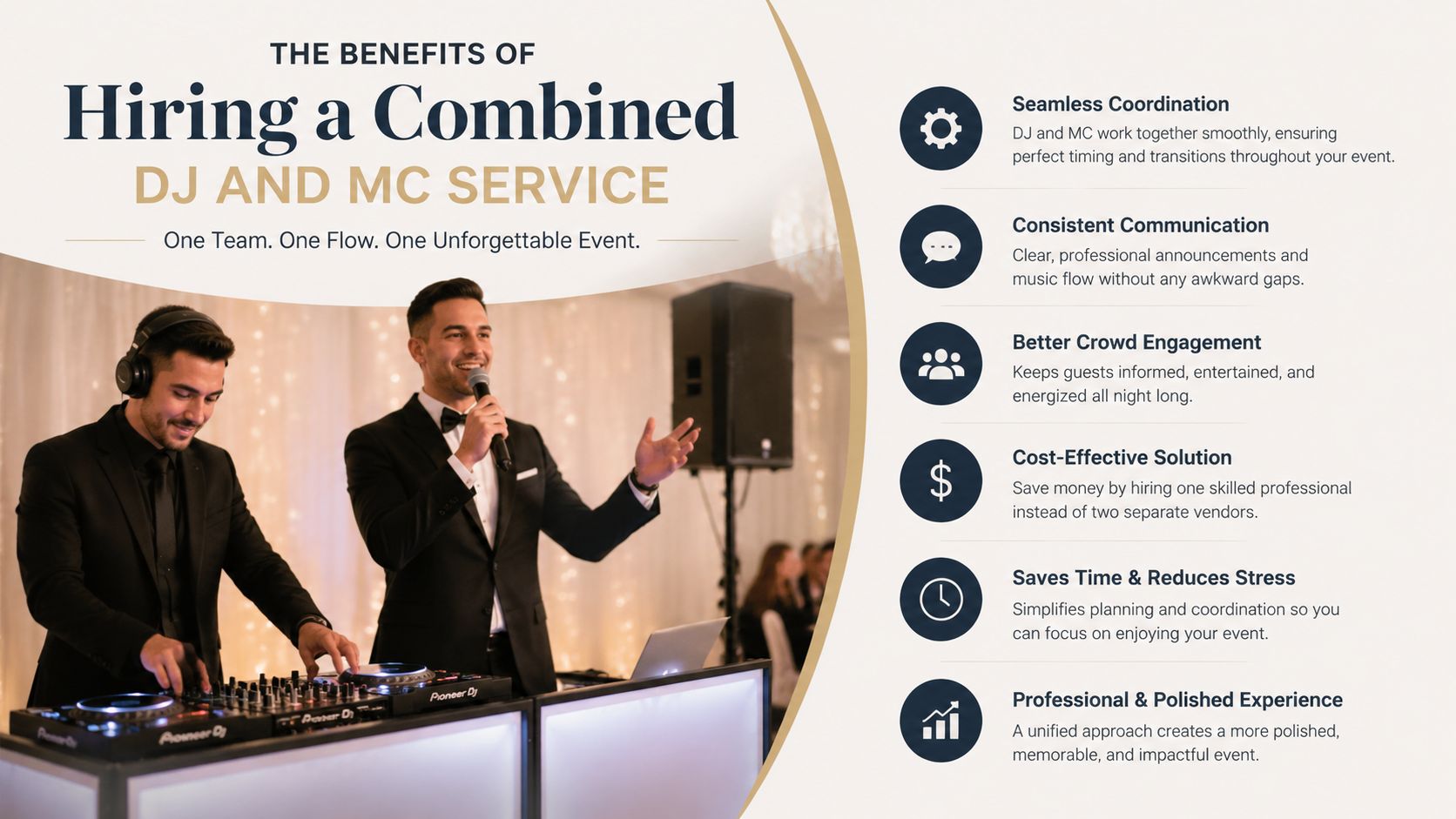
A combined DJ and MC service manages the reception's energy as one continuous arc. The professional is not switching between a playlist and a microphone. They are judging when the room needs focus, when it needs breathing space, and when it is ready for more momentum. For couples exploring combined DJ and MC services, that shared responsibility can make the evening feel more coherent.
The same person may lower the music for dinner, announce a toast, cue a walk-up track, and rebuild the atmosphere afterward. Because they heard the toast and watched the guests' response, they can choose a follow-up song and volume that fit the moment. That continuity helps the reception move naturally from one activity to the next.
Fewer handoffs create fewer gaps
Separate specialists can deliver excellent work, but they need a dependable communication system. They must agree on who gives cues, who speaks first, how music begins after an announcement, and what happens if dinner or photos run late. Each handoff adds another point where timing can stall.
A combined professional gives you one primary entertainment contact for:
- Timeline decisions: The same person can help shape the order and pacing of reception moments.
- Music and microphone control: Announcements, speech levels, background music, and walk-up cues remain connected.
- Guest-facing direction: Guests hear one consistent voice instead of competing instructions.
- Real-time adjustments: The DJ/MC can respond immediately when dinner, photos, or formalities fall behind schedule.
This arrangement also simplifies communication for the couple and other vendors. There is one person to brief about priorities, sensitive announcements, song requests, and timing preferences.
Cost and coordination deserve equal attention
A combined service may cost less than hiring two separate specialists, although the quote still depends on the package, location, duration, equipment, and additions. The wider market context helps explain the format's popularity. Research cited in wedding market coverage indicates that 71% of U.S. couples choose a DJ for their wedding.
A live band can create a distinctive performance atmosphere, and a separate MC may suit a highly produced event. For most standard receptions, the deciding factor is whether the professional has a clear process for handling both roles at once.
How a Wedding DJ and MC Coordinate Your Reception Timeline
A reception timeline is useful only when someone can execute it flexibly. The DJ/MC turns the written plan into a sequence of cues, pauses, announcements, songs, volume changes, and check-ins with other vendors.
Before guests focus on the dance floor
The work starts with sound placement and atmosphere. During guest arrival or cocktail hour, music should support conversation rather than demand attention. If the DJ is also covering ceremony audio, they'll need to manage microphones, processional cues, and speaker coverage before the reception begins.
The equipment plan matters here. A wedding setup usually includes at least two microphones, including at least one wireless microphone for announcements and speeches as recommended in this wedding PA guidance. Speaker placement should suit the room, not just sit beside the booth. Distributed speakers can reduce dead spots, while subwoofer support can preserve low-frequency impact as attendance grows.
Connecting the formal moments
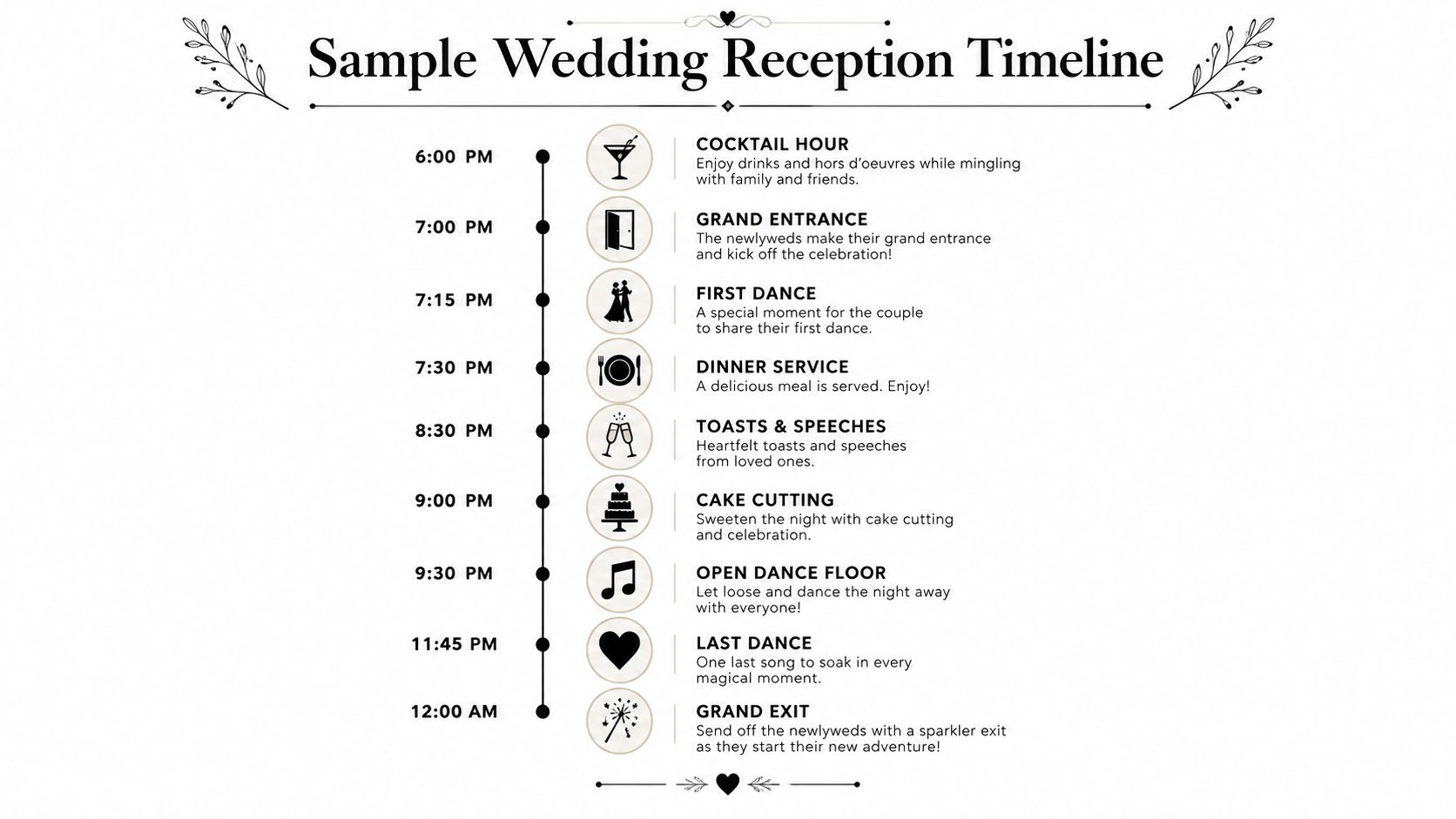
For the grand entrance, the DJ confirms that the wedding party is in position, starts the selected track, and lowers it at the right moment. The MC introduces the people entering, then hands attention back to the couple without adding unnecessary commentary.
The same pattern applies to first dances, parent dances, dinner, toasts, cake cutting, and other formalities. The DJ/MC checks whether guests are ready, makes one clear announcement, cues the moment, and prepares the next transition. If a photographer needs a few seconds to move into position, the professional can hold the music instead of forcing the event forward.
Reading the room after the formalities
Once open dancing begins, the timeline becomes less rigid. The DJ watches who is dancing, which songs bring people closer to the floor, and when the room needs a change. The MC may speak only when guests need direction, such as announcing a final dance or guiding everyone toward an exit.
A detailed wedding DJ timeline resource can help you discuss this sequence with prospective vendors. Ask them how they handle delays, requests, meal service changes, and venue sound restrictions. Their answers will reveal whether they see the timeline as a fixed document or as a working tool.
Sample Wedding Day Timeline and Playlist Flow
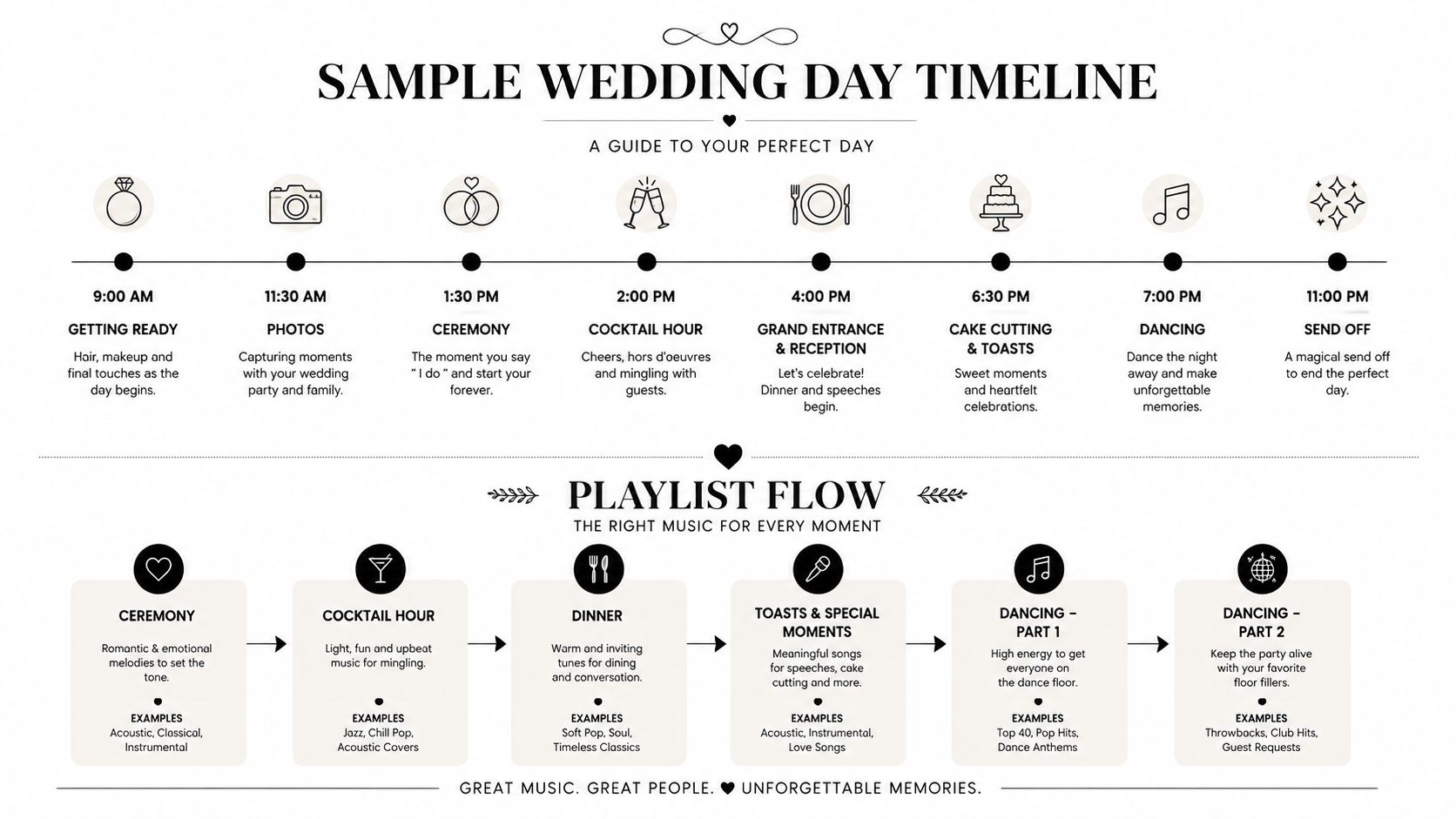
Consider a reception that begins with a relaxed cocktail hour and gradually builds toward a late dance-floor peak. The exact clock times will vary, but the logic remains useful because each segment gives guests a different job, listening, eating, watching, or dancing.
A reception flow guests can feel
During cocktail hour, the DJ chooses familiar, moderate-volume music that leaves room for conversation. The MC usually stays quiet unless guests need a practical instruction. As the room settles, the DJ checks that the wedding party and photographer are ready for the entrance.
The grand entrance receives a clear announcement and a decisive musical cue. The couple moves into the first dance while the room's attention is already gathered. Dinner follows with softer music, and the DJ keeps the volume low enough for conversation. If service runs behind, the professional can extend the dinner atmosphere without making guests feel that something has gone wrong.
Toasts come after the meal or at another point chosen by the couple. The MC introduces each speaker briefly, confirms that the microphone is ready, and keeps the sequence moving. After the final toast, the DJ can use a familiar, welcoming track to shift the room from listening mode into celebration mode.
Building a playlist arc
A strong playlist isn't a random collection of favorites. It often begins with broad, recognizable songs, adds genre variety as more guests join the floor, and creates peaks without exhausting the room too early. Later selections can become more personal or intimate, depending on the couple and the remaining guests.
For example, a DJ might begin open dancing with accessible crowd-pleasers, follow with a short run that reflects the couple's cultural or family preferences, then blend into current dance music and established classics. If one style empties the floor, the DJ changes direction rather than stubbornly finishing a prewritten block.
The couple's must-play and do-not-play lists still matter. They provide boundaries, while the DJ makes the moment-to-moment choices. Use this wedding music playlist guidance to organize preferences by ceremony, dinner, formal dances, open dancing, and final songs.
Wedding DJ and MC Pricing Considerations
A DJ and MC quote reflects more than time spent playing songs. It covers preparation, equipment, reception pacing, announcements, and the judgment required to adjust the room's energy. Recent U.S. wedding-industry pricing reports place an average wedding DJ at $1,700 to $1,800, while a live wedding band averages about $4,500, making the band roughly 2.5 times more expensive based on documented wedding entertainment pricing.
Couples typically allocate about 5% of their total wedding budget to DJ entertainment, according to The Knot's 2025 Real Weddings Study, a useful reference point when you compare entertainment with catering, photography, and other major costs. Use planning tips for a destination wedding to account for broader travel and venue expenses before setting your entertainment budget.
A quote can sit above or below that range for practical reasons. Longer coverage means more performance, preparation, setup, and breakdown time. Ceremony sound may need separate equipment or staffing, while travel, lighting, special effects, extra microphones, and venue restrictions can change the package.
| Pricing Factor | What It Covers | Typical Impact on Cost |
|---|---|---|
| Package scope | Reception, ceremony audio, MC duties, planning support | Broader service generally increases the quote |
| Equipment | Speakers, microphones, mixers, lighting, backup equipment | More production adds preparation and setup requirements |
| Event duration | Performance time, load-in, strike, and overtime | Longer coverage usually costs more |
| Travel and venue | Distance, access, parking, power, sound restrictions | Complex logistics can raise the total |
| Add-ons | Uplighting, photo booths, special effects, extra sound zones | Optional features increase the package price |
| Market location | Local demand and operating costs | Quotes vary by region |
Compare value rather than package glitter
Ask each provider to itemize the same services. Confirm who will perform, how many hours are included, which microphones and speakers are supplied, whether ceremony coverage is separate, and how overtime is charged. Attractive lighting cannot make up for poor microphone technique or weak timeline communication.
The most useful comparison is operational. A combined DJ and MC should explain how announcements, music changes, vendor cues, and schedule adjustments fit together. That coordination is what keeps the reception moving when dinner takes longer, a toast changes order, or guests need time before joining the dance floor.
Negotiation works best by adjusting scope rather than requesting an arbitrary discount. You could remove an add-on, shorten coverage, or use venue-provided ceremony audio. Protect reliable sound, clear hosting, preparation, and a credible backup plan.
How to Choose and Brief Your Wedding DJ and MC Professional
Start with the person, not the package. Ask who will perform, how they handle a changing timeline, whether they coordinate with your planner and photographer, what happens if equipment fails, and how they manage requests and do-not-play songs.
Your written brief should include:
- Timeline: Ceremony cues, entrances, meal service, speeches, dances, cake cutting, and exit plans.
- Music direction: Must-play songs, prohibited songs, genres, cultural traditions, and preferred energy.
- Voice and style: Whether you want warm and conversational hosting, formal announcements, or minimal microphone use.
- Room details: Venue restrictions, floor plan, power access, sound limits, and separate ceremony locations.
- Non-negotiables: Names, pronunciations, surprise moments, and any announcements that must happen in a specific order.
Be cautious if a provider avoids naming the actual performer, gives vague equipment details, or treats the timeline as your responsibility alone. A professional should explain the handoffs, not just promise a full dance floor.
Planning a wedding in Fort Atkinson, Southern Wisconsin, or Northern Illinois? Explore 1021 Events DJ and MC services, then check your date through our inquiry form.