
For most weddings, wedding uplighting cost lands around $400 to $2,000, with smaller setups starting near $300 and full ballroom coverage reaching $1,500 to $3,000+ once labor and add-ons enter the quote. The number isn't pulled from a magic average. It comes from fixtures, quantity, control, access, and the work required to make the room look intentional.
You're probably looking at a venue brochure, a few reception photos, and vendor quotes that seem wildly far apart. One company says $400. Another says $1,400. A third sends over a proposal near $3,000 without explaining what changed. That gap feels unreasonable until you break the package into its actual parts.
I've quoted enough wedding lighting to know the first question shouldn't be, “What's your uplighting price?” Ask instead, “How many fixtures are included, what type are they, and what does the labor cover?” That question turns a vague package into math you can check.
What Wedding Uplighting Costs in 2026
For a 2026 wedding, plan on $400 to $2,000 for a standard uplighting package. Broader ballroom benchmarks run about $400 to $1,800, while full-ballroom planning ranges reach roughly $600 to $2,000, according to Zola's wedding lighting cost guide and Paperlust's wedding lighting pricing overview. A small room or accent-only design may start near $300. Extensive coverage, programming, and managed service can push a large ballroom to $1,500 to $3,000+, as outlined in Pro Lighting Rental's uplighting cost guide.
The quote comes from a package calculation, not from the word “wedding”:
Total package = fixture rate × fixture quantity + labor + delivery + programming + add-ons
Start with the fixture count. Basic LED uplights commonly cost $25 to $50 each, while broader event-rental benchmarks place them around $25 to $60 each, according to The Knot's wedding uplighting guide. A simple design might use 8 lights, a stronger room wash 16, and a large ballroom 24 or more.
That creates an equipment-only estimate:
- 8 fixtures: about $200 to $480.
- 16 fixtures: about $400 to $960, before labor and delivery.
- 24 fixtures: about $600 to $1,440, before additional services.
These figures are starting points, not complete quotes. Wireless fixtures, color control, premium lenses, battery management, and technician coverage raise the final price. Custom color control alone can add $100 to $200, according to the Pro Lighting Rental guide.
The room determines how many fixtures the package needs. A narrow restaurant may require only a handful, while a hotel ballroom with long perimeter walls, columns, and draping may need many more. Guest count helps describe the event, but it does not set the uplighting quantity.
A credible proposal should connect every charge to equipment, labor, access, or design. If a vendor cannot explain a line item in those terms, request a revised breakdown before signing.
How Uplighting Works and Why That Affects Price
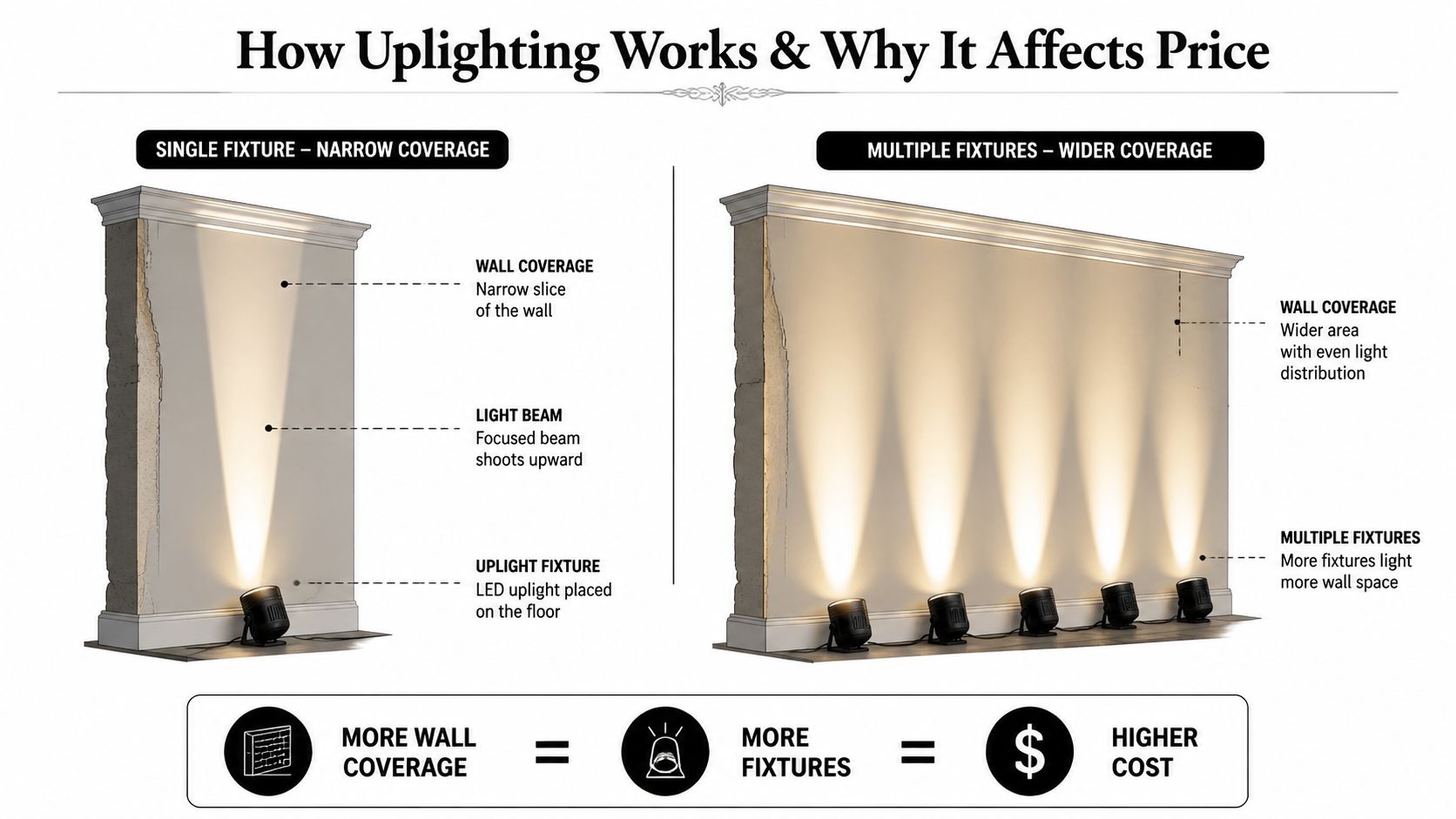
An uplight sits on the floor and aims at a wall, column, drape, or architectural feature. Each fixture covers a narrow slice of surface, so a longer perimeter needs proportionally more fixtures for a continuous wash. That coverage requirement is the first practical step in estimating the package.
Perimeter length matters more than guest count. A crowded room may need fewer lights if its walls are short. A sparsely occupied ballroom can require many fixtures when usable wall space extends around the room. Count the sections you want lit, then price the fixture quantity, control system, add-ons, and labor as separate parts of the quote.
The four pieces behind the price
Every professional uplighting quote reflects four equipment and setup components:
- The fixture. An LED par, lens, housing, brightness level, battery, and wireless capability affect the equipment rate.
- The mounting position. Most wedding uplights sit on the floor, though some designs use a floor plate, clamp, truss, or another approved method.
- The connection system. Wired fixtures require cable runs and distribution. Wireless fixtures require receivers and reliable control.
- The power and control. A static color is simpler to manage than a system running DMX scenes or timed cues.
A $30 wired par and a more expensive wireless DMX fixture can produce a similar wall wash. Their installation demands differ. Wired fixtures require cable placement, power planning, and cleanup. Wireless fixtures cost more to own, but they can reduce visible cabling and speed placement.
For a closer look at the floor-mounted equipment used for venue washes, LED uplights for events explains the fixture type and its common applications.
A practical demonstration also shows how placement changes the final effect before you compare packages.
Every quote line should connect to fixture equipment, mounting, connections, power and control, or the labor to transport, place, focus, operate, and remove the system. That breakdown lets you estimate your own total package instead of relying on one average figure.
The Cost Drivers Behind Every Quote
A quote reflects a small production, not just a bag of colored lights. Fixture quantity usually takes the largest share, but the total comes from per-fixture rate × quantity, then add-ons and labor.
What changes the number
| Cost Driver | Typical Added Cost | When It Applies |
|---|---|---|
| Fixture quantity | $25 to $150 per added fixture, depending on tier | Longer walls, columns, draping, and fuller coverage |
| Wireless equipment | Higher per-fixture pricing, often around $20 more per fixture than wired examples | Venues where cable runs are difficult or unattractive |
| Custom color control | About $100 to $200 | Multiple colors, scene changes, or customized control |
| Programming and managed operation | Varies by production scope | DJ cues, DMX scenes, and an onsite operator |
| Labor and access | Varies by setup complexity | Load-in, placement, focusing, strike, restricted access, and room flips |
| Add-on lighting | Varies by item and package | Pin spots, monograms, gobos, cake lighting, and other effects |
The math moves quickly. More fixtures increase equipment cost. Wireless hardware can raise the per-fixture rate. Custom control adds programming, and a short venue access window can increase labor even when the fixture count stays unchanged.
A quote example
Start with 16 fixtures at $60 each. The equipment portion is $960. Add labor, access, programming, and a modest lighting add-on, and the proposal can approach $1,400.
That is a calculation, not a universal package price. Use it to test your own quote: multiply the fixture rate by the quantity, then add each service line separately. The extra cost should produce visible coverage, solve a venue restriction, or provide a lighting feature you want.
Wireless equipment can justify a higher fixture rate in a ballroom with strict cable rules. Wired units can work well in a compact room with accessible outlets and a straightforward perimeter. Choose the system around the venue, not the label on the package.
Practical rule: Ask the vendor to separate equipment, labor, delivery, programming, and add-ons. A single bundled number hides the decisions that control your total.
For a reception-specific planning reference, review uplighting at a wedding reception and compare the proposed coverage with your actual room layout. Then ask whether the quoted quantity covers the walls, columns, draping, and focal areas you want illuminated, rather than assuming guest count determines the package.
Three Realistic Uplighting Quotes by Venue Size
Guest count helps describe the event, but the room shape determines the lighting workload. These scenarios use the fixture quantities and package ranges supplied in current planning guidance, then apply the total-package logic vendors use when building a proposal.
| Venue Type | Guest Count | Fixture Count | Included Features | Typical Total |
|---|---|---|---|---|
| Restaurant or private dining room | 60 to 80 guests | 8 to 12 | Static color wash, basic placement, limited perimeter coverage | $400 to $700 |
| Mid-size ballroom or banquet hall | 120 to 180 guests | 16 to 24 | Perimeter coverage, simple scene options, head-table pin spot | $900 to $1,600 |
| Large hotel ballroom or tent | 200+ guests | 30 to 40 | DMX control, custom scenes, DJ cues, full setup and strike | $1,800 to $3,200 |
The intimate room
The small package works when the room has a compact perimeter and a clear focal area. You might light the wall behind the couple, the dining-room edges, or a small set of architectural details. The line couples forget here is often teardown, especially when the rental ends after the reception and the venue won't allow next-day collection.
The mid-size ballroom
Many couples receive a quote close to four figures. Sixteen fixtures can create a deliberate wash in a moderate room, while 24 fixtures may be needed when the perimeter includes several usable walls or columns. A head-table pin spot is separate from uplighting because it focuses on a surface or person rather than washing the wall.
The large room
A large hotel ballroom or tent creates more work in every direction. The vendor must place more fixtures, manage more power or battery equipment, coordinate scenes, and complete a larger strike. The forgotten line item is usually access, particularly when the crew has a limited load-in window or must move equipment through a freight route.
The ranges above should help you identify an unreasonable mismatch. A small room quoted like a full production deserves a detailed explanation. A large ballroom quoted at the low end may have too few fixtures or no onsite technical coverage.
Rental Versus Full-Service Vendor Packages
Rental-only looks cheaper because the equipment price is visible and the labor is yours. You or your planner typically handle pickup, transport, charging, placement, aiming, operation, removal, and return.
A rental can suit a small venue with a simple static color. It also works when a hands-on planner already has a reliable setup crew and the venue approves the equipment plan.
What rental-only really transfers to you
The gear still has to arrive in working condition. Someone must place each fixture where it won't obstruct guests, aim it correctly, protect cables if cables are used, check power, and remove everything after the reception. If a light fails, the person responsible for the setup becomes the troubleshooting technician.
Damage exposure matters too. A rental agreement may place responsibility for missing or damaged equipment on the renter. The lower base price doesn't remove that responsibility.
When full service earns its fee
Full-service packages include the vendor's crew for load-in, placement, focusing, operation, and teardown. They're the safer choice when the venue has restrictive access, the timeline is tight, the room changes between ceremony and reception, or the DJ needs lighting cues built into the evening.
A full-service proposal may cost more upfront, but it removes the most stressful responsibilities from the couple and wedding party. It also gives you one person accountable for the visual result.
A cheap rental is only cheap if someone else isn't quietly donating their wedding-day labor.
The hidden middle deserves scrutiny. Some companies rent the fixtures but charge setup and teardown separately. That model isn't automatically bad, but you need the complete number before comparing it with a staffed package. Ask whether delivery, placement, programming, monitoring, and return are separate.
For a broader look at equipment logistics, event lighting rental can help you distinguish a gear-only arrangement from a managed production service.
How to Get Accurate Quotes Without Wasting Time
Send vendors the information that determines fixture quantity before asking for a final price. A vague request produces a vague range. A floor plan produces a proposal someone can defend.
Send the venue layout. Include the floor plan, room dimensions, ceiling height, current photos, and any walls blocked by doors, catering stations, or draping. A vendor can't calculate perimeter coverage from guest count alone.
Describe the color plan. State whether you want one static color, several programmed scenes, or changes coordinated with the DJ. “Warm amber for dinner, deeper color for dancing” gives the vendor a usable design direction.
List must-have areas. Identify the wall behind the couple, head table, cake, bar, entry, columns, or tent perimeter. A focused plan often beats an indiscriminate ring of fixtures.
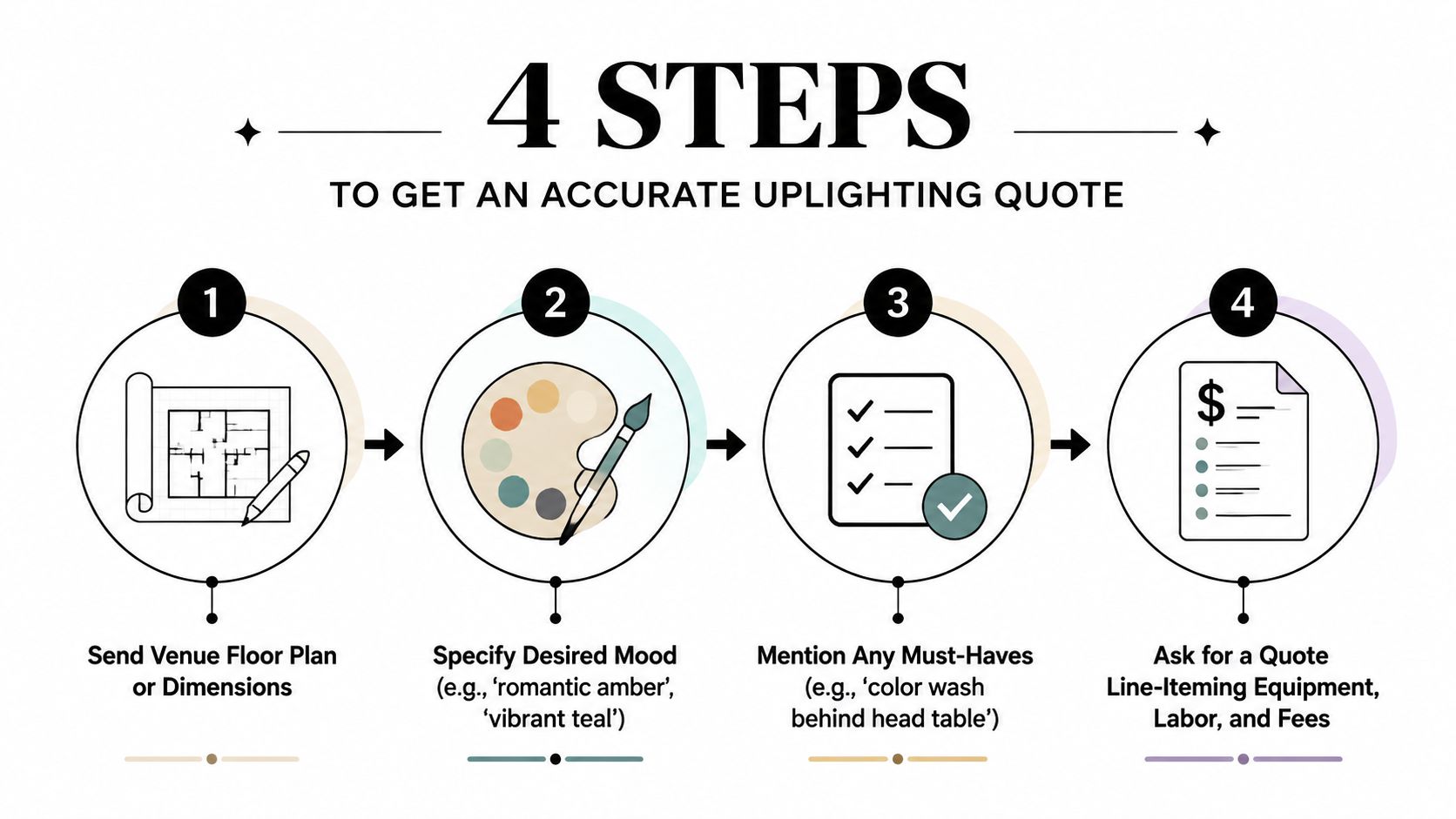
- Request itemized pricing. Ask for separate lines for fixtures, labor, delivery, programming, power, rigging, technician coverage, and teardown. This is the only reliable way to compare two quotes that use different package names.
Then confirm the venue's access rules. Ask about load-in windows, freight elevators, outlet locations, approved cable paths, insurance certificates, and union requirements. Those details can change labor even when the lighting design stays the same.
Finally, ask every vendor the same three operational questions:
- What fixture model or type is included?
- What's the backup plan if a unit fails during the reception?
- What happens if the event runs beyond the contracted service window?
The lowest quote often reflects fewer fixtures, basic wired hardware, no custom programming, or no onsite technician. That may be exactly what you need, but you should know which compromise created the lower number.
Where Couples Overspend on Wedding Uplighting
A couple can spend more and still get a worse-looking room. Too many fixtures in a compact venue create harsh spots, uneven color, and visual clutter instead of an even wash. Build the quote from the room outward: fixture quantity, add-ons, delivery, labor, and teardown.
The common waste points
Fixture overkill is the first place to cut. Full-perimeter coverage is often unnecessary when the head table wall, columns, and entrance carry the visual focus. Extra units increase the rental and setup total without improving the areas guests see.
Custom control is another frequent overspend. A single color for the entire reception does not require an elaborate DMX sequence. If the DJ is not sending cues, synchronized scene changes add equipment and programming work that many guests will barely notice.
Gobos and pattern lenses can also miss the mark. A projection may look crisp beside the wall but disappear from the dance floor once other lighting is active. Use pin spots instead when the goal is to make the cake, florals, or centerpieces visible.
For broader planning ideas, these wedding cost-cutting strategies from EasyRegistry can help you decide which lighting upgrades deserve room in the budget.
Spend on placement before features
Put the money into walls guests face, architectural details that add depth to photographs, and focal points that define the reception layout. A smaller design with deliberate placement usually produces more impact than a large package aimed at surfaces nobody notices.
DIY can work for a compact setup approved by the venue, but do-it-yourself uplighting for weddings still means transporting, positioning, operating, and removing the equipment. If a relative handles those jobs, count that time and responsibility as part of the cost.
Ask the vendor for a basic design and a premium design using the same room plan. Choose the upgrade only when the visual difference is clear, not merely technical.
Your Uplighting Budget Checklist and Final Questions
Before you sign a lighting contract, run through the items that control the quote. You don't need to become a lighting technician. You need enough detail to confirm that the proposed equipment matches the room and the service matches the schedule.
| Checklist Item | What to Confirm | Common Mistake |
|---|---|---|
| Room size | Floor plan, wall perimeter, ceiling height, blocked areas | Choosing fixture quantity from guest count alone |
| Coverage plan | Exact walls, columns, drape, and focal points | Paying for a full perimeter you won't see |
| Color design | Static color, scene changes, or DJ-synced control | Buying programming you won't use |
| Service model | Rental-only or full-service setup and strike | Assuming labor is included |
| Power and access | Outlets, cable rules, load-in, freight access | Discovering venue restrictions on event day |
| Failure plan | Backup fixtures and onsite support | Having no response if a unit stops working |
| Contract timing | Setup, operating window, and teardown | Forgetting late-night removal or overtime |
Keep a contingency in your planning budget for setup surprises. The exact amount depends on the venue and contract, but access restrictions, room changes, and power issues deserve attention before the proposal becomes final.
Use a broader wedding vendor checklist template to record the lighting details alongside your other supplier questions.
Questions couples usually ask
Does uplighting work outdoors? It can work around a tent, building, trees, or other surfaces that reflect the beam. An open field has fewer vertical surfaces, so the effect may be limited.
How early should setup happen? Ask the vendor to match setup to the venue's access window and room-flip schedule. The answer depends on how many fixtures must be placed and whether other vendors occupy the same perimeter.
Can the DJ run the lights? A DJ may operate programmed scenes when the equipment and control system support it. Confirm who owns the programming and who responds if the system needs adjustment.
What happens if a fixture fails? Your contract should state whether the vendor carries backup equipment and whether someone will be available to replace or troubleshoot a failed unit.
The fair quote is the one you can explain. You should know how many fixtures are included, where they go, which colors or scenes are programmed, who handles setup and teardown, and which venue fees remain outside the package.
1021 Events provides professional wedding uplighting, sound, DJ and MC services, videography, photography, and related event production support. If you want a room-specific lighting plan instead of a vague package price, visit 1021 Events with your venue layout and reception goals.
Wedding Uplighting in Southern Wisconsin and Northern Illinois
Based in Fort Atkinson, 1021 Events provides professional uplighting and special effects for weddings, company parties, fundraisers and private events throughout Southern Wisconsin and Northern Illinois.
Explore our lighting and event services or check availability for your event.