
You've booked the venue, chosen the booth, and approved the event layout. Then someone asks, “What backdrop are we using?” That question often arrives too late. A backdrop can make the booth look polished and intentional, or create glare, wrinkles, cramped queues, awkward framing, and branding that disappears in the final images.
A smart photo booth backdrop rental decision starts with operations, not Pinterest. You need to match the format to the booth, venue, lighting, guest flow, and event objective. Sometimes bundling the backdrop with the booth is the cleanest choice. Sometimes a separate rental gives you better control and a stronger visual result.
Why Your Backdrop Choice Matters More Than You Think
At a corporate gala, the booth looked perfect in the vendor's studio photos. The team chose a glossy metallic wall because it matched the company's silver-and-black palette. On event night, the finish bounced the booth's light directly into the camera. Guests appeared washed out, the logo was difficult to read, and the queue spilled into a nearby walkway because the backdrop needed more clearance than the planner expected.
The booth itself wasn't the problem. The backdrop was treated as decoration instead of production equipment.
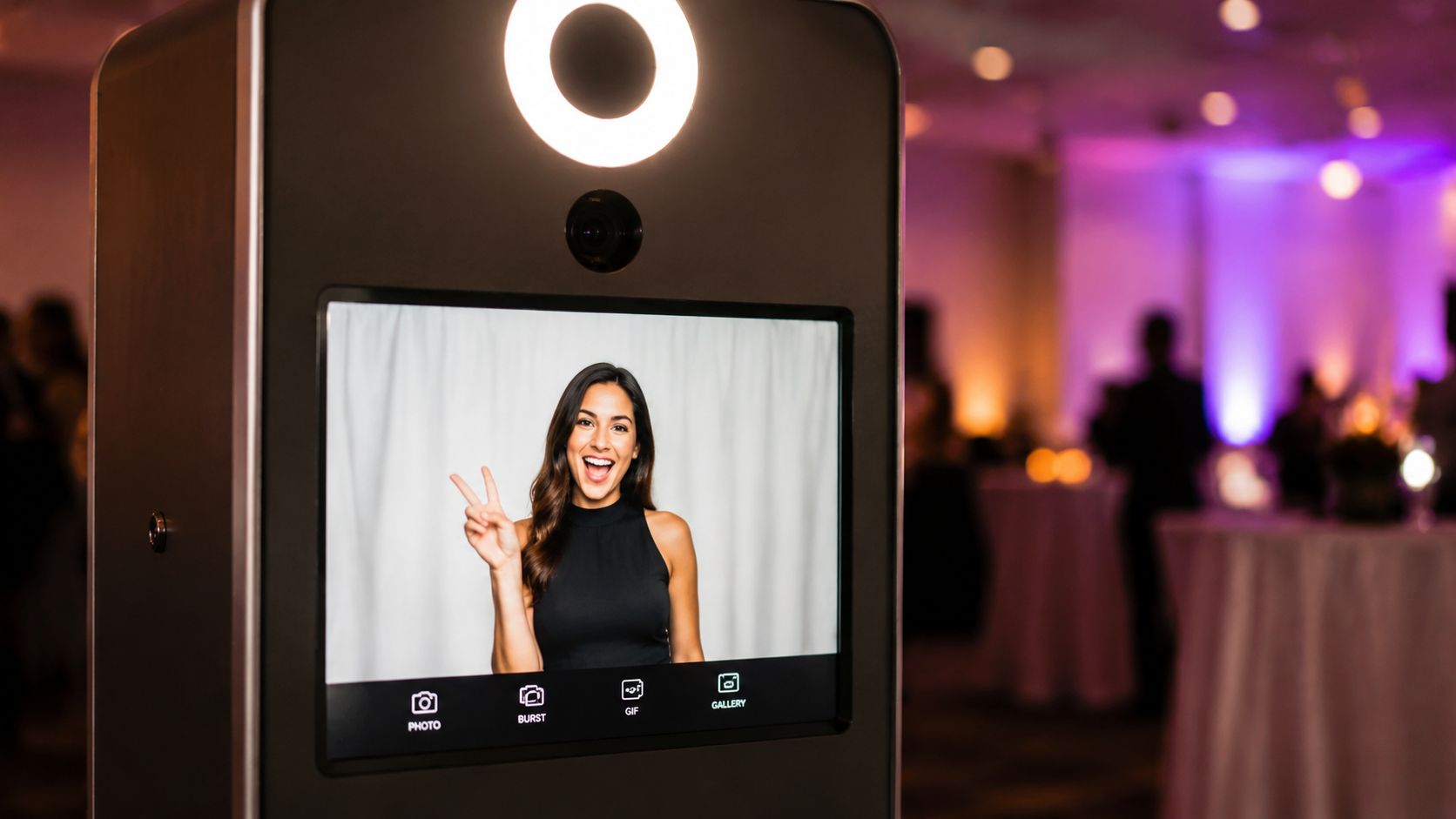
A backdrop affects four practical outcomes:
- Photo quality: Reflective surfaces create hotspots, while wrinkled fabric can look untidy behind every guest.
- Guest flow: The booth, backdrop, lighting, and queue need to work as one footprint.
- Brand visibility: A logo positioned too low or too close to the frame edge may vanish behind people.
- Labor requirements: Heavy panels, complex frames, and slow installation can change delivery and setup needs.
The wider photo booth category gives useful context. One 2026 market estimate values the global photo booth market at about $652.24 million, compared with $377.325 million in 2021, and projects $1,403.43 million by 2033 at an 11.568% CAGR. A separate estimate places the market at $639.1 million in 2026 and forecasts $1,555.1 million by 2036, implying a 9.3% CAGR. These are market proxies, not backdrop-specific figures, but backdrop packages are commonly sold within photo booth experiences for weddings, corporate events, and private celebrations. (Cognitive Market Research's photo booth market estimate)
Producer's rule: If the backdrop changes the camera angle, lighting plan, queue footprint, or setup labor, it belongs in the production conversation from the beginning.
Before you sign, ask whether the vendor has real-event photos, a scaled layout, and a clear plan for delivery and setup. You can browse our photo booth options to compare booth formats, then use this photo booth backdrop guide to judge the visual and operational fit.
Choosing the Right Backdrop Style and Material
Choose the material based on the room and the camera, not just the theme. A backdrop that looks dramatic in person can photograph poorly under flash, while a simple matte fabric wall may produce cleaner images and faster turnover.
Compare the main formats
| Backdrop format | What it does well | Main concern | Best fit |
|---|---|---|---|
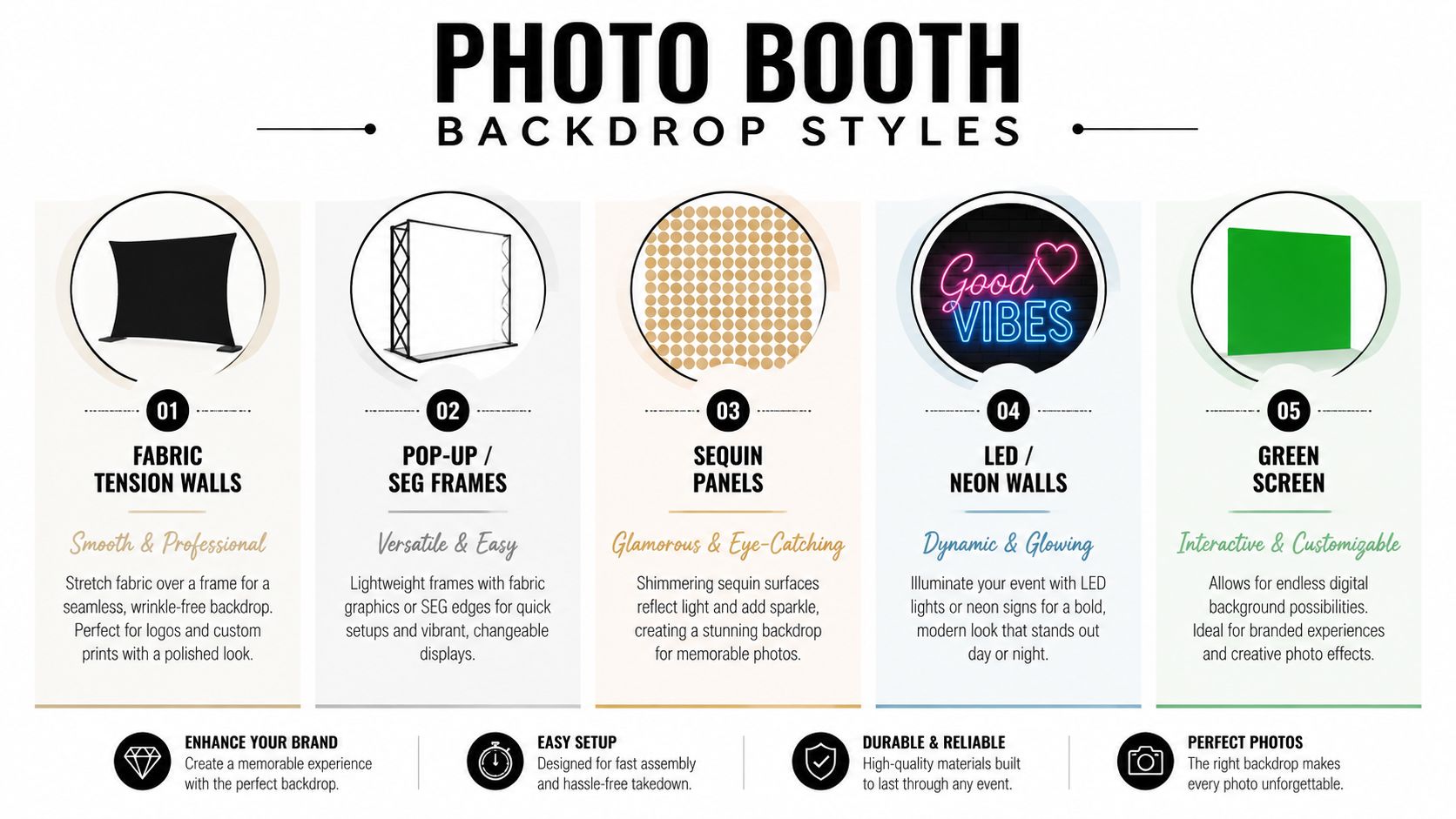
| Fabric tension wall | Creates a smooth, professional surface with minimal visual distraction | Needs careful transport and tensioning | Weddings, galas, clean corporate branding |
| Pop-up or SEG frame | Supports large graphics and a structured presentation | Frame assembly and venue access matter | Trade shows, branded activations, larger installations |
| Sequin or metallic panels | Adds texture and celebration energy | Glare, reflections, and loose pieces can affect images | Parties, receptions, nightlife events |
| LED or neon wall | Builds a glowing, immersive focal point | Requires power, lighting coordination, and careful exposure | Modern celebrations and high-energy brand events |
| Green screen | Allows digital scenes and themed environments | Needs controlled lighting and a clean, unobstructed surface | Branded campaigns and creative activations |
For fabric and printed systems, ask for a wrinkle-resistant, fire-retardant material. Industry guidance cites 200 to 300 denier polyester for durable stage and backdrop use, while public venues may reference fire standards such as NFPA 701 or BS 5867. Confirm the venue's requirements rather than assuming the rental company's standard material will qualify. (Stage background material guidance)
Storage changes the final appearance too. Roll fabric when possible. Folding creates creases that may remain visible under direct lighting, even after the backdrop has been hung.
Match the format to the event conditions
For an outdoor wedding, avoid a lightweight decorative wall that can shift in wind. For a dark ballroom, a black sequin wall may absorb too much detail, while an LED surface can compete with the booth flash. For a corporate activation, a matte tension wall or SEG graphic usually gives the camera a more dependable background than a reflective panel.
Setup time also belongs in the decision. Trade-show backdrop sources report that modern pop-up and SEG systems can assemble in roughly 30 to 40 minutes, while some lightweight systems are rated as fast as 2 to 3 minutes. Treat those figures as planning benchmarks, not promises. Confirm the vendor's actual crew, access route, and teardown process before assigning a room turnover window.
For a closer look at made-to-order options, review this resource on a custom photoshoot backdrop. The right custom format should support the booth and lighting rather than force both systems to work around the backdrop.
Measuring Your Space and Matching Backdrop Dimensions
A backdrop can fit the venue and still fail the photo. The frame may be wide enough for the booth but too narrow for group shots, or tall enough for the ceiling but positioned where it blocks a service corridor. Measure the full operating area, not only the wall where the backdrop will stand.
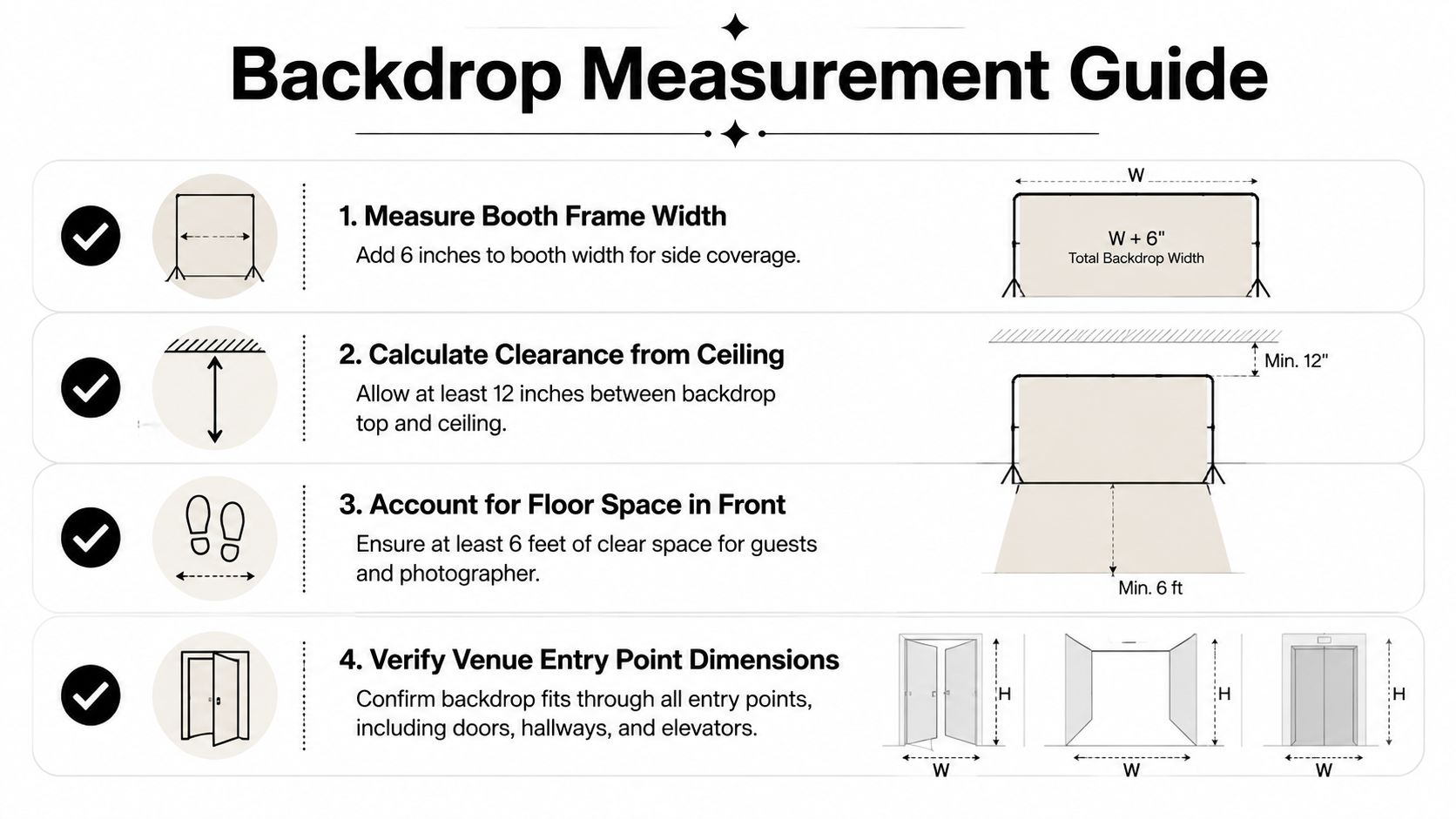
Use a four-part measurement check
- Measure the booth frame. Record the actual width and height of the booth, camera, side supports, and any printer stand. Ask whether the backdrop needs side coverage beyond the frame.
- Measure ceiling clearance. Include light fixtures, sprinklers, rigging, drapery, and decorative installations. A backdrop that technically reaches the ceiling may still interfere with venue equipment.
- Measure the guest area. Leave room in front of the camera for people to pose, step onto a 360 platform, or enter and exit without crossing the queue.
- Measure the access route. Check doorways, elevators, loading docks, stairwells, and turning points. A large frame that fits the ballroom may not fit the route into it.
The booth type changes the footprint. An enclosed booth needs clearance for its shell and entry point. An open-air booth needs enough depth for groups to stand comfortably in front of the background. A 360 setup needs clear circulation around the platform, camera arm, and operator position. Don't approve a backdrop based on width alone.
Request a scaled proof
Send the vendor a venue diagram with booth placement, nearby walls, outlets, entrances, and the guest queue. Request a scaled proof showing the backdrop, booth, light positions, and any branded area. For a custom print, the proof should make clear where faces and bodies will appear, not just how the artwork looks as a flat rectangle.
This is the same discipline used for custom exhibition stands, where access, footprint, sightlines, and assembly all affect the result. A photo booth deserves the same level of planning, especially in a compact wedding venue or a corporate space with multiple activation zones.
Before event day, confirm the installation sequence and the finished dimensions in writing. This photo booth setup guide can help you build the layout around the equipment rather than trying to squeeze the equipment into the remaining space.
Custom Branding and Personalization Options
Customization earns its keep when it improves recognition, consistency, or the shareability of the experience. It becomes wasted spend when guests stand in front of a logo they can't see, a busy pattern that distracts from faces, or artwork that doesn't match the event's other materials.
Corporate events need controlled repetition
A branded step-and-repeat works well when guests, partners, or speakers will be photographed repeatedly. Use a restrained logo pattern, strong contrast, and enough negative space for faces. If the backdrop is also supporting lead generation or social sharing, coordinate the physical design with the booth overlay, digital gallery, hashtag, and printed template.
A green screen can offer more creative flexibility for a product launch or themed activation, but it demands controlled lighting and disciplined guest positioning. Projection-based branding, including a monogram Gobo, can create atmosphere without adding a large printed wall, though the venue's surfaces, ambient light, and projector position become critical.
Weddings need restraint
A wedding monogram, date, floral graphic, or subtle pattern can make the booth feel connected to the reception design. It doesn't need to dominate every image. Place the strongest design elements where they'll remain visible above shoulder height and around the group rather than directly behind the faces.
Printed vinyl offers a firm, graphic surface but can reflect light depending on its finish. Dye-sublimated fabric usually gives a softer, more photographic appearance and can travel more easily when rolled. Ask the vendor which surface they recommend for the actual lighting package, not just the artwork.

Approve files like a production asset
Supply vector artwork when available, and confirm color references before printing. Colors can shift between a screen, fabric, vinyl, and event lighting. Ask for a scaled proof that shows the logo at guest height and includes a sample photo crop.
Branding can extend beyond the wall. If the event team is coordinating physical promotional items, DTF apparel for trade show branding offers another way to keep the visual system consistent without forcing every message onto the backdrop.
For a coordinated booth experience, review this guide to a branded photo booth. The practical test is simple: does the customization make the event easier to recognize and the photos more useful, or does it merely add another decorative layer?
Coordinating with Your Photo Booth Vendor
The vendor conversation should produce a written operating plan, not a vague promise that “everything is included.” Backdrop rental involves the wall, frame, booth, lights, power, venue access, labor, and responsibility for damage. If those pieces aren't assigned, the client usually ends up solving the problem onsite.
Confirm the physical specification
Ask the vendor to list the exact size, material, finish, and weight of the backdrop. For a custom print, request a scaled proof before production. Confirm whether the listed dimensions describe the visible surface, the frame, or the complete installed footprint. Those aren't always the same.
Then ask who owns each task:
- Delivery: Who brings the backdrop, booth, lighting, and accessories?
- Setup: Is installation performed by the vendor, venue staff, or the client?
- Teardown: Does the rental window include removal and packing?
- Venue access: Does the crew need a loading dock, elevator, parking access, or an early entry window?
- Damage: What happens if fabric stains, sequins detach, or a frame is damaged during the event?
Independent backdrop guidance recommends reviewing real-event photos and the damage policy because studio images can hide wrinkles, glare, and color shifts. Use the vendor's live examples to judge how the material behaves under actual event lighting. (Photo booth backdrop planning guidance)
Decide whether to bundle or separate
Bundling makes sense when the booth vendor already understands the camera, lighting, setup sequence, and venue requirements. One contract can reduce coordination gaps, and the vendor can select a backdrop that works with the equipment.
A separate backdrop rental makes sense when you need a specific custom wall, the venue designer is supplying a larger scenic installation, or a corporate brand team requires control over artwork and materials. The trade-off is additional coordination. You'll need both suppliers to agree on dimensions, delivery timing, power, placement, and who remains responsible if the booth and backdrop don't align.
The U.S. photo booth rental market is estimated at $101.4 million in 2026, and a separate industry summary reports approximately 28,000 independent operators and 4.2 million event activations per year. The same summary reports that weddings with a photo booth increased from 52% in 2020 to 68% in 2026, while average revenue per event rose 18% since 2023 as operators moved toward premium booths and add-ons. These figures describe the broader rental ecosystem, but they reinforce a useful point: backdrop decisions now sit inside a more developed event-production purchase, not an incidental accessory. (U.S. photo booth rental market summary)
Ask this before signing: “Who is responsible for making the booth, backdrop, and lighting photograph correctly together?”
Protect the lighting plan
Reflective sequins, metallic vinyl, and LED surfaces need a lighting test or at least a clear placement plan. Ask where the key light will sit, whether the booth uses flash or continuous light, and whether the backdrop will cast shadows onto guests. A vendor who can't explain the lighting approach hasn't finished planning the installation.
Your Backdrop Rental Booking Checklist
A good booking decision should survive three tests: it looks right, fits the venue, and earns its place in the event budget. The broader U.S. market offers a useful pricing frame, with typical photo booth rentals cited around $400 to $1,000 per event, standard packages often lasting 4 hours, and premium formats such as glam or 360 booths costing substantially more. Those figures vary by market and format, so use them as context rather than a quote. (Photo booth industry pricing context)
Use this checklist before paying a deposit:
- Choose for the camera: Select matte, wrinkle-resistant material when clean portraits matter more than visual sparkle.
- Match the booth: Confirm the backdrop works with an enclosed, open-air, mirror, or 360 configuration.
- Measure the whole footprint: Include the booth, lighting, queue, guest movement, ceiling clearance, and delivery route.
- Approve the proof: Review custom artwork at the installed scale, with likely guest positions marked.
- Price the labor: Confirm delivery, setup, teardown, venue access, and overtime responsibilities.
- Review the policy: Read the damage, cancellation, rescheduling, and replacement terms.
- Check real photos: Look for wrinkles, glare, shadowing, color shifts, and visible frame edges.
- Choose sustainability deliberately: Ask about reusable frames, rolled fabric, recyclable props, and digital-only delivery.
Sustainability and format choice deserve more attention than they usually receive. Independent event coverage describes growing interest in eco-friendly, minimalist booths, recyclable props, digital-only delivery, and reusable materials. One market report says digital-only delivery packages grew from 8% of bookings in 2021 to 19% in 2025, with projections above 30% by 2030. That is a projection, not a current outcome, but it points toward a practical choice for planners who want less physical waste. (2025 photo booth rental trend coverage)
For a closer look at the broader budget decision, review this guide to photo booth rental cost. Bundle the backdrop when the booth vendor can manage the complete setup cleanly. Source it separately when the design is central to the event, the scenic supplier has stronger capabilities, or the brand team needs direct approval control.
Need a photo booth setup in Fort Atkinson, Southern Wisconsin, or Northern Illinois that fits your venue? Explore 1021 Events photo booth and event services across Southern Wisconsin and Northern Illinois, then check availability.