
Being a good MC isn't just about being an announcer; it's about being the event's anchor. You’re there to master the timeline, manage the room's energy, and genuinely connect with the audience to create a seamless, unforgettable experience.
The Foundation of an Unforgettable MC
Ever been to an event where the host made everything feel effortless and fun? That’s what separates a forgettable announcer from a legendary Master of Ceremonies. The secret isn't having the loudest voice or the fanciest suit—it’s about understanding your core mission: you are the director of the audience's experience.
A great MC always does their homework. This means getting to the heart of the client's vision, learning the key players' names, and knowing the event timeline like the back of your hand. Your job is to be the calm, confident hub of the event, connecting all the moving pieces so everything flows perfectly.
The Three Pillars of MC Success
To become that reliable anchor for any event, you need to nail three things: the vision, the flow, and the energy. Get these right, and you'll command any room with confidence and skill.
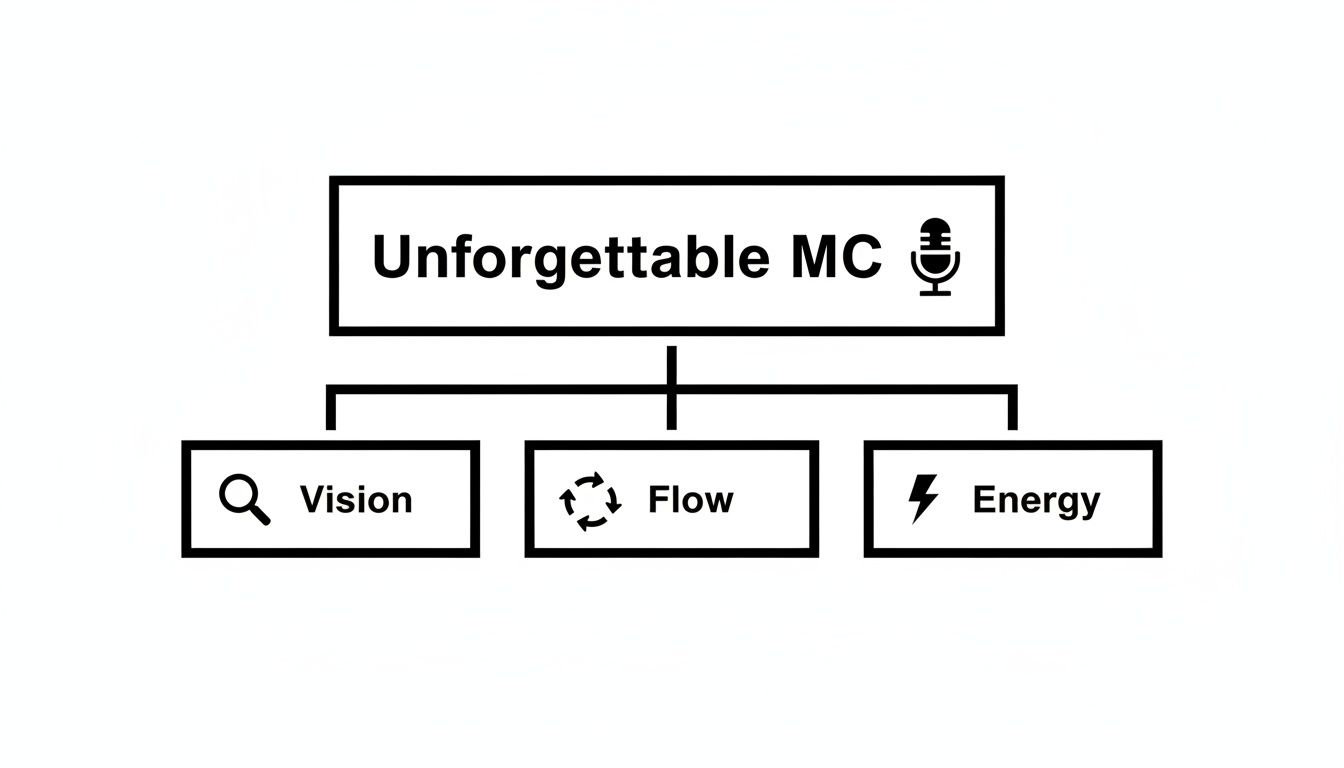
As you can see, it all starts with understanding the client's vision. Once you have that locked down, you can use it to expertly guide the event's flow and shape the room's energy.
The demand for a truly skilled MC has never been higher. Recent event industry studies found that 78% of organizers believe in-person events are their single most impactful marketing channel. That puts you, the MC, in a critical position to guide the brand message and shape that all-important audience experience.
An exceptional MC doesn't just read a script; they read the room. They are part conductor, part storyteller, and part problem-solver, all rolled into one. Your ability to connect with a diverse crowd and think on your feet is what transforms a good event into a truly great one.
As you can see, your role is absolutely central. For a deeper look into event leadership, this practical guide to hosting an event is a fantastic resource for understanding the bigger picture. And if you're still curious about the nitty-gritty of the job, we've got a whole article explaining https://1021events.com/what-is-a-master-of-ceremonies/.
The demands on an MC can shift dramatically depending on the event you're hosting. A wedding requires a personal touch and emotional intelligence, while a corporate conference demands professionalism and precise timing.
Here’s a quick breakdown of how your core responsibilities adapt across different types of events.
MC Core Responsibilities at a Glance
| Responsibility | Wedding Focus | Corporate Event Focus | Private Party Focus |
|---|---|---|---|
| Tone Setting | Warm, personal, celebratory | Professional, engaging, on-brand | Fun, high-energy, casual |
| Timeline Management | Keeping events (toasts, dances) on a relaxed schedule | Adhering strictly to a packed agenda | Maintaining momentum and energy flow |
| Audience Engagement | Personal stories, encouraging participation in traditions | Facilitating Q&As, networking, keeping focus | Icebreakers, games, getting people on the dance floor |
| Vendor Coordination | Working closely with DJ, caterer, photographer | Liaising with A/V team, speakers, event planners | Syncing with DJ and entertainment for key moments |
Understanding these nuances is key. It's what allows you to pivot your style and deliver exactly what the client and their guests need, no matter the occasion.
Your Pre-Event Preparation Playbook
A killer performance doesn’t just happen. It's built long before you ever touch a microphone. The cool, calm confidence you see from a great MC is a direct result of the legwork they put in days and weeks before the event. Let's walk through how to master that prep so you can walk into any venue feeling completely in charge.

It all starts with getting inside your client's head. A quick chat isn't enough; you need to truly understand the vision for their big day.
Mastering the Client Consultation
Think of your first meeting with the client as a fact-finding mission. Your job is to dig deeper than the basic schedule and figure out the feeling they want to create. How do they want their guests to feel when they walk out the door at the end of the night?
Instead of just asking, "What time are the speeches?" try these kinds of questions to get to the heart of it:
- "Tell me about the vibe you're going for. Are we talking a high-energy dance party, or something more intimate and classic?"
- "Who are the must-know people in the room? Give me a fun, quick story about the best man or the company’s MVP."
- "What's the one moment you're most excited about? What would make it absolutely perfect for you?"
These questions give you the gold—the personal details you need to craft introductions and transitions that actually mean something. You're not just a talking clock; you're the storyteller for the event, and this is where you get your material.
Pro Tip: I can't stress this enough: get the phonetic spellings for every single name you have to say. Nothing kills the mood faster than butchering the name of the groom's grandma or the CEO. Write them down, say them out loud, and then say them again.
Once you’ve got the vibe down, it's time to build the roadmap for the event.
Building a Bulletproof Run of Show
The "run of show" is your bible for the day. A generic template won’t do. You need to build this timeline with the client or their planner, making sure it reflects the unique flow of their event. This document should be more than a list of times; it’s your strategic game plan.
Get detailed. For every item, you need the who, what, where, and why. For instance, don't just write "7:30 PM – Toasts." That’s useless.
Break it down like this:
- 7:30 PM – Toasts (Location: Head Table)
- MC: Introduce first speaker.
- Speaker 1: John Smith, Father of the Bride (will use handheld mic).
- Speaker 2: Jessica Davis, Maid of Honor (will use lectern mic).
- DJ Cue: Play soft background music ("Perfect" by Ed Sheeran) underneath the toasts.
This level of detail gets everyone on the same page. It also gives you a solid framework for scripting your key moments. If you're looking for a great place to start, checking out a solid wedding MC script template can give you some fantastic ideas on how to structure your announcements.
And about that script—don't write out every single word. You'll sound like a robot. Instead, create powerful bullet points for each announcement. This lets you sound natural and conversational while making sure you hit all your key info. It gives you the freedom to improvise and play off the crowd's energy because you know your foundation is solid.
Connecting with the Vendor Team
Remember, you’re not a one-person show. A great MC is part of a whole team of pros working to make the event amazing. Connecting with them beforehand is one of the most overlooked—and most important—steps you can take.
Before the event, make sure you connect with the other key players:
- The DJ or Band Leader: You and the DJ are the co-pilots of the party's energy. Get in sync on music cues for entrances, announcements, and transitions. Double-check that you’re both working off the exact same timeline.
- The Event Planner/Coordinator: This person is mission control. They are your main point of contact. Confirm the final run of show with them and figure out how you’ll communicate during the event if things need to change on the fly.
- The Photographer & Videographer: Give them a heads-up before key moments. A simple, "Hey, we're doing the cake cutting in five," is a game-changer for them and ensures they don't miss the shot.
This coordination turns a bunch of separate vendors into a powerhouse team. When everyone's on the same page, the event flows effortlessly, and you look like the pro who made it all happen. This is the groundwork that lets you step on stage ready for anything.
Nailing Your Tech and Timing
Nothing kills the energy at an event faster than a screeching microphone or an awkward, dead silence. These are the moments that make an entire room cringe, and they’re completely avoidable. Getting a handle on the tech and the timeline is the invisible work that separates a good MC from a great one, making the whole event feel effortless.
This isn't about you becoming a sound engineer overnight. It's about being prepared. Your real job is to spot problems and solve them before they can blow up in front of a live audience. Think of a full tech rehearsal as your secret weapon.
The Non-Negotiable Tech Rehearsal
Seriously, walking onto a stage without a proper soundcheck is like trying to fly a plane without checking the fuel. You might get lucky once, but it's a disaster waiting to happen. You absolutely have to get your hands on the real equipment you'll be using for the event.
My advice? Show up early. Way earlier than you think you need to. Find the A/V tech or DJ and run through this checklist together:
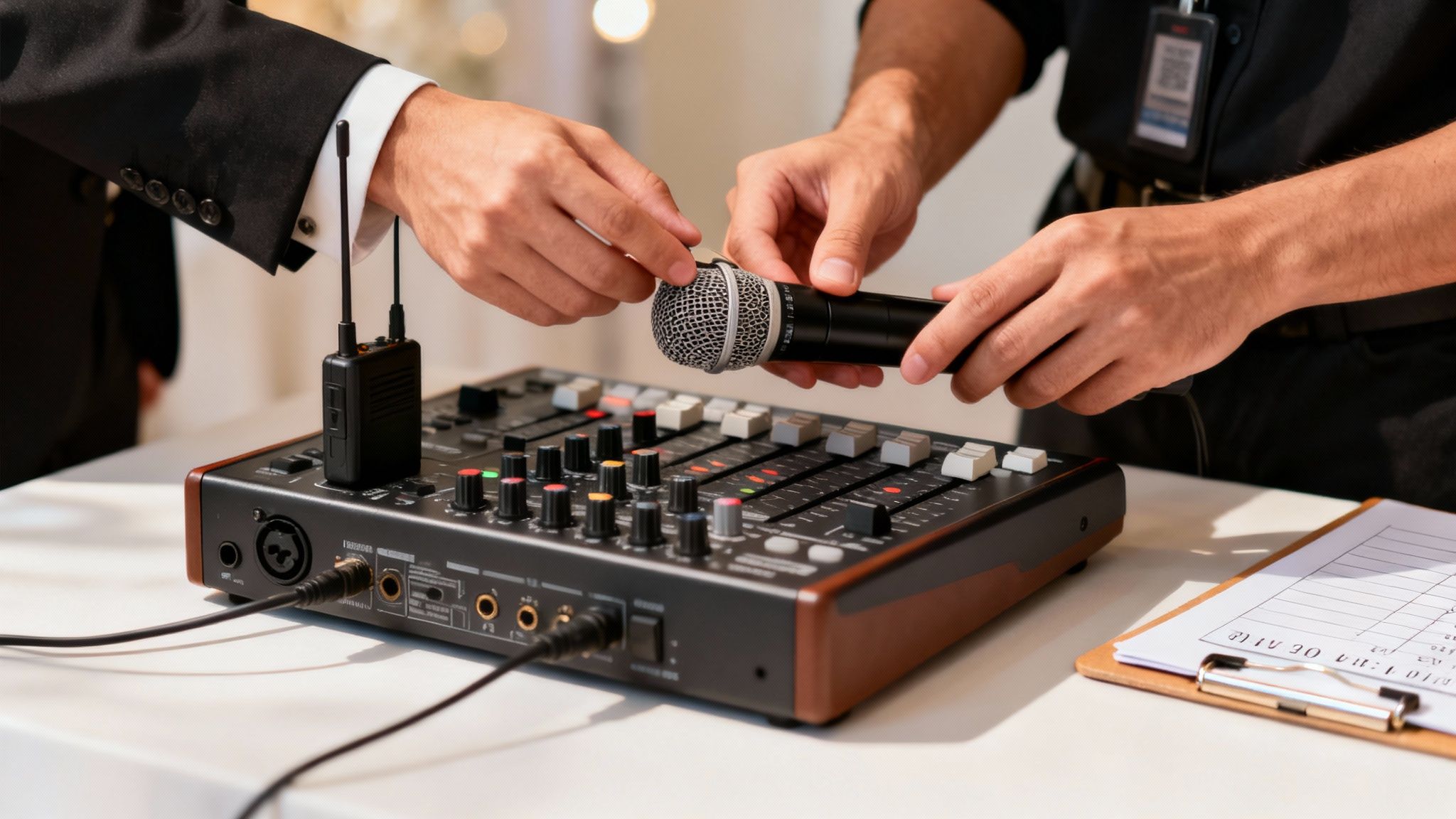
- Microphone Check: Test every single mic. Don't just tap it and say "check one, two." Walk around the stage, wander into the crowd area. Find the feedback zones and dead spots now, not during the best man's speech.
- Sound System Test: Ask the DJ to play music at different volumes. How does it sound during the quiet cocktail hour? How does it sound when it’s cranked up for the dance floor? You want it crisp and clear, not like a blown-out speaker in a high school gym.
- Lighting Cues: Find the lighting person and make friends. Know where your spotlights are so you’re not delivering a killer line from the shadows. Confirm the cues for the big moments—the grand entrance, the keynote speaker, the first dance.
This isn't just me being picky. The whole industry is built on tech now, with somewhere between 74-79% of professional organizers making it a top priority. Event planners who demand at least one full tech rehearsal see day-of failures drop by an estimated 50-70%. That’s a massive difference.
Don’t just ask, "Does the mic work?" Give it a real-world test. Say a few of your opening lines. Get a feel for it. Does it catch your voice when you speak softly? Does it start to distort when you get loud and energetic? You need to know exactly how that piece of equipment will respond to you.
Ultimately, it all starts with quality gear. If you're involved in the early planning stages, knowing the basics of a professional wedding sound system rental can help you push for the right equipment from the get-go.
Mastering the Event Clock
Once your tech is dialed in, your next biggest job is managing the clock. As the MC, you are the timekeeper. You have to keep the event flowing smoothly without ever making guests feel like they're being herded from one thing to the next. It’s a delicate dance.
This means you need to be gently assertive. You're keeping one eye on the run-of-show and the other on the room's vibe. Are people getting bored during a rambling speech? Is the energy dipping before the main act?
You're the one who has to subtly steer the ship. For instance, you can't just snatch the mic from a speaker who's gone way over time. Instead, you can position yourself in their line of sight and give a warm, friendly signal that it’s time to wrap up. A simple nod and a smile go a long way.
Here’s how I tactfully keep things on schedule:
- Give Time Warnings: Before someone gets up to speak, give them a friendly heads-up. "John, we can't wait to hear from you! We've got about five minutes for your toast right before we cut the cake."
- Use Musical Cues: This is a classic move. Work with your DJ to use music as a transition. Fading in a background track is a polite, non-verbal hint that a segment is coming to a close.
- Prepare "Filler" Material: Always have a few short, fun anecdotes or quick announcements in your back pocket. If the caterer is running ten minutes late, you can fill that gap seamlessly instead of letting the room fall into an awkward silence.
Your ability to manage the logistics with a calm, confident demeanor is what makes you a true Master of Ceremonies. It’s all this behind-the-scenes stuff that makes the entire event feel polished and perfect for everyone else.
Connecting with the Crowd and Owning the Room
All the prep work and tech checks are the foundation, but this is where the real magic happens. This is the fun part. A great MC doesn't just talk at an audience; they connect with them, turning a room of strangers into a shared experience. Your ability to grab their attention, read the room, and keep the energy high is what everyone will remember long after the last song plays.
Think about it: your very first words set the tone for the entire event. So, forget those weak, cliché openings like, "Okay, is this thing on?" Step up to that mic with confidence, a real smile, and an opening line that immediately pulls everyone in. If you start with energy, the crowd will give it right back to you.
Reading the Room and Adapting on the Fly
One of the most crucial skills you'll ever develop as an MC is what I call your "event radar." You have to be constantly scanning the audience, taking their temperature, and adjusting your approach in real-time.
Is the crowd looking a little sluggish after a long presentation? That’s your cue to jump in with a quick, high-energy interactive moment. Are guests laughing and mingling easily? Lean into that positive vibe. Don't ever be afraid to go off-script to comment on something happening in the moment. Pointing out a shared experience makes you feel less like an announcer and more like you're part of the group.
The best MCs are chameleons. They can be heartfelt and sincere for a wedding toast one minute, then whip up excitement for the grand entrance the next. This flexibility comes from paying close attention and genuinely caring about the audience's experience.
This skill is a lot like what makes someone a great party host—you’re always focused on making sure your guests are having a good time. We actually have a whole guide on https://1021events.com/how-to-be-a-good-party-host/ that digs into how these skills overlap.
Creating Interactive Moments That Engage
Let's be honest, passive listening gets old, fast. Your job is to make the audience feel like active participants, not just spectators. This means weaving in little interactive bits that get people moving, talking, and laughing together.
The key is to match the activity to the event's vibe. A rowdy party game might be a huge hit at a 21st birthday but would totally bomb at a formal corporate gala.
A Few Ideas to Get You Started:
- For Weddings: The "Shoe Game" is a classic for a reason—it's hilarious and personal. Another great one is a table-based trivia game about the couple; it's a perfect icebreaker for guests who don't know each other.
- For Corporate Events: Instead of a dry Q&A, try a simple "polling" question with a show of hands. Something like, "Show of hands, who traveled more than three hours to be here today?" It instantly creates a sense of connection.
- For Private Parties: A quick, fun "dance-off" can release some energy, or you can simply ask for song requests to make everyone feel more involved.
When you're trying to get people talking, especially during networking sessions, you need to be ready to spark engaging discussions to keep things from fizzling out.
The Art of the Powerful Introduction
Introducing a speaker is one of your most important jobs, and it’s about so much more than just reading their name and title off a notecard. A great intro builds their credibility, creates a buzz of anticipation, and makes the audience genuinely want to listen.
Never, ever just read a bio. Find the one or two most interesting, impressive, or relevant facts about the speaker and frame them as a mini-story.
Here’s the difference:
- Weak: "Next up is Jane Doe, the Vice President of Sales." (Snooze.)
- Strong: "Our next speaker knows a thing or two about building connections. In just three years, she took her division from last place to number one, and she did it by focusing on one simple idea. Please join me in giving a huge welcome to the incredible Jane Doe!"
See? The second one creates intrigue. It positions Jane as an expert you need to hear from. That’s your goal.
This kind of personalization is proven to work. Event surveys show that 96% of marketers report that personalized touches directly boost their results. When you, as the MC, personalize anecdotes and interact with people in the audience, you're directly contributing to the event's success. It’s these small things that make a huge impact.
Handling Unexpected Problems Like a Pro
Let's be real: no matter how meticulously you plan, something will go sideways. It’s the nature of live events. A microphone will inevitably die mid-sentence, a key speaker will vanish right before their toast, or the cake will arrive looking… different.
How you navigate these little moments of chaos is what separates the amateurs from the pros. This is your chance to be the calm, confident anchor in the storm and show everyone why you were hired. Your grace under pressure is what people will remember.
This is your playbook for turning a potential disaster into a minor hiccup nobody will even talk about later.

Common Problems and Calm Solutions
The secret to solving problems on the fly? Have a plan before they even happen. Let’s walk through some classic event curveballs and how to handle them without breaking a sweat.
Scenario 1: The Dead Microphone
It’s the most common tech gremlin. You step up, ready to deliver a killer line, and… silence. The worst thing you can do is look flustered or start tapping the mic like a woodpecker, asking, "Is this thing on?"
- Your Move: Flash a quick smile to the audience. Lean in and say, "Well, it seems this microphone is feeling a little shy. Let me go grab its more outgoing friend!" Then, confidently walk over to the backup mic you already confirmed was working during your sound check. Your calm confidence tells the room it's no big deal.
Scenario 2: The Major Schedule Delay
The caterer is running 20 minutes behind, and dinner is officially late. Guests are getting hangry, and you’ve got a massive gap in the timeline. This is where you truly earn your money.
- Your Move: Time to engage. Use one of your pre-planned "filler" bits. Announce something like, "Folks, it looks like our amazing chefs are putting the final, perfect touches on a meal worth waiting for! While they do, let's find out which table here knows our happy couple the best?" Launch right into a fun, quick trivia game. You've just turned dead air into a memorable, interactive moment.
The goal isn't just to fill time; it's to redirect the audience's focus. A great MC sees a delay not as a problem, but as an opportunity to create another moment of connection. You control the room's energy, not the clock.
The Power of Improvisation
Knowing how to improvise is your ultimate safety net. It’s not about pulling things out of thin air; it’s about having a mental toolkit of ideas, stories, and one-liners ready to deploy at a moment's notice. Good improv is built on a foundation of solid prep.
Think of it like being a chef with a well-stocked pantry. You might not have a specific recipe in mind, but you know you have all the right ingredients to whip up something delicious. Your ingredients are short stories about the guests of honor, fun facts you gathered, or simple questions that get the crowd involved.
Sometimes the unexpected is a bit more serious, like a torn dress or a sudden headache. Being prepared for anything makes you a true hero, which is why so many pros carry a wedding day emergency kit packed with solutions.
Phrases to Keep in Your Back Pocket
Having a few go-to lines memorized can smooth over any awkward moment. They buy you a few crucial seconds to think while keeping the audience on your side.
Handy Go-To Lines
- For a tech glitch: "Ah, it seems the technology just needs a moment to catch up to all the fun we're having!"
- For an unexpected delay: "And now for a brief, unscheduled intermission! Let's take this moment to charge our glasses and get to know someone new at our table."
- For an unresponsive crowd: "Alright, I see a few of you are still warming up! Let’s get some energy in here—on the count of three, I want to hear a huge cheer for our newlyweds!"
Ultimately, your confidence is contagious. When you handle a hiccup with a calm smile and a smooth transition, the audience instantly feels secure. They trust you to guide them, which lets them relax and have a great time, no matter what’s happening behind the scenes.
Your Day-Of Game Plan
All the prep work is done. Showtime is here. This isn't the time to cram or second-guess yourself; it’s about running through your pre-flight checks so you can walk on stage with total confidence. Think of this as your final mental walkthrough before the curtain goes up.
First things first: get there early. Find the event planner or coordinator the second you walk in the door. Go over the run-of-show together, one last time, just to catch any last-minute tweaks. Honestly, this quick huddle is what prevents 99% of the little fires that can pop up later.
Once you’re synced up, hunt down your tech crew. Find the DJ, find the A/V lead. Get your hands on the mic you'll be using—and the backup. Test them both. Run through the audio cues for the big moments, like the walk-in music or the sting for an award winner. Don't assume it'll work; know it will.
Your Final Pre-Show Ritual
Before the first guest even thinks about arriving, carve out a few minutes for yourself. This little pocket of time is your secret weapon for staying grounded and delivering a killer performance.
- Scan Your Notes: Give your script or key points one last look. I always focus on my opening and closing lines for each segment. If you nail the landing, the middle takes care of itself.
- Do a Name Check… Out Loud: Seriously, say every important name out loud. The bride and groom, the company president, the honorees. Don't just glance at the spelling—let your mouth practice the sounds.
- Stash Your Water: Find a sneaky spot for your water bottle. A dry mouth can sneak up on you mid-sentence, and having water within reach is a lifesaver.
This final run-through isn't about chasing perfection. It's about giving yourself peace of mind. When you've checked these boxes, you can step into the spotlight without a single "what if" nagging at you, ready to be fully present for the audience.
Got Questions About Being an MC? We've Got Answers
Every MC, even the pros, had a first gig. And with that first gig came a ton of questions. Let's tackle some of the most common ones I hear from people just starting out. Getting these down will save you a world of headaches.
How Much Talking is Too Much Talking?
This is a big one. My simple rule? Less is more. Way more.
Think of yourself as the event's friendly tour guide, not the main act. Your job is to keep things moving, make people feel welcome, and shine the spotlight on the important moments. Keep your announcements tight, energetic, and to the point. Get in, build some excitement, and get out of the way.
The focus should always be on why everyone is there—the couple getting married, the person getting an award, you name it. Before you grab the mic, ask yourself: "Does what I'm about to say actually help the guests or the flow of the night?" If the answer is no, skip it.
What's the Best Way to Handle a Heckler or a Disruptive Guest?
First, take a breath. Don't let them rattle you. The absolute worst thing you can do is get into a public back-and-forth. It derails the whole event and makes everyone uncomfortable.
Often, a quick, lighthearted redirect is all you need. Something like, "I love the energy in the back! We'll put that to good use on the dance floor in just a few minutes!" can work wonders. It acknowledges them without giving them the stage.
Your job is to be the conductor of the vibe, not the bouncer. If someone is genuinely causing a problem, don't try to be a hero. Discreetly flag down the event planner or the venue's security staff. They’re the ones paid to handle it, and you can keep the good times rolling for everyone else.
This way, you stay in control of the room without becoming part of the drama.
How Can I Use a Script Without Sounding Like a Robot?
Never, ever read a script word-for-word. It’s the fastest way to lose the room. Your script should be your safety net, not a teleprompter.
I recommend using a bullet-point system. Jot down only the must-know, can't-mess-up info.
- Names: Get the phonetic spelling. Seriously. Always. (e.g., Siobhan = shiv-AWN)
- Key Times: The absolute critical moments in the timeline.
- The Main Point: The one thing you must communicate in each announcement.
This simple framework gives you the key details while letting you be yourself. You can speak naturally, make eye contact, and connect with the audience. The secret is to practice your main points out loud—not to memorize them, but to get comfortable with the words. Say them in the car, in the shower, wherever. Make them sound like you.
At 1021 Events, we know that a skilled, professional MC is what separates a good event from a truly unforgettable one. If you’re looking for an expert to bring that seamless energy to your wedding, corporate event, or private party, check out our Pro DJ/MC services. We'd love to help make your celebration one for the books.
Looking for a professional MC in Fort Atkinson, Southern Wisconsin, or Northern Illinois? 1021 Events provides polished MC and DJ service with planning support, introductions, announcements, music, sound, lighting, and coordinated event enhancements. Explore our DJ and MC services, then send an inquiry through EMP DJ to check availability.