
Ever wondered what separates a good event from an unforgettable one? It’s not just luck. It’s a strategy built on proven event management best practices. Whether you're a couple orchestrating your dream wedding, a corporate manager planning a high-stakes product launch, or a non-profit coordinator organizing a heartfelt charity fundraiser, the secret ingredient is always meticulous execution. The path from a great idea to a flawlessly executed event is paved with details, from seamless tech integration and vendor coordination to creating genuine 'wow' moments for every guest.
This guide is your blueprint. We're cutting through the noise to bring you the essential strategies that professional planners at 1021 Events use to turn potential chaos into a round of cheers. Forget vague tips and generic advice. We’re delivering a comprehensive roundup of actionable steps, real-world examples, and the insider knowledge you need to transform your vision into a stunning reality. You'll learn how to master everything from budget and contingency planning to mapping the perfect guest journey.
We’ve structured this listicle to give you a clear, step-by-step framework you can apply to any occasion. Each point is designed to be a cornerstone of your planning process, ensuring no detail is overlooked and every opportunity for excellence is seized. Ready to plan an event that people will be talking about for years to come? Let’s dive into the ten best practices that guarantee a memorable, seamless, and impactful experience.
1. Comprehensive Event Planning Timeline & Checklist
Ever feel like you're trying to juggle a dozen flaming torches while riding a unicycle? That's event planning without a solid timeline. One of the most critical event management best practices is establishing a comprehensive timeline and checklist from day one. This isn't just a simple to-do list; it's your strategic roadmap, breaking down a massive project into bite-sized, manageable phases.
Think of it as reverse-engineering your event. You start with the event date and work backward, assigning deadlines for every single task, from booking a venue to sending out thank-you notes. This structured approach prevents last-minute chaos and ensures no detail, big or small, falls through the cracks.
Why It Works So Well
A detailed timeline gives you clarity and control. It helps you see what needs to be done and when, making it easier to delegate tasks, manage vendor communications, and stay on budget. It’s the foundational document that keeps your entire team, including external partners like us at 1021 Events, perfectly synchronized.
For example:
- Weddings: A typical 18-month timeline ensures you can book in-demand photographers or DJs at least six months out, avoiding disappointment.
- Corporate Galas: A six-month plan allows for crucial milestones, like finalizing the presentation tech and conducting equipment tests two weeks prior.
- Charity Fundraisers: A focused four-month timeline includes checkpoints for securing sponsorships and coordinating donor outreach efforts.
Actionable Tips for Implementation
Pro Tip: Your timeline is a living document. Use a digital project management tool like Asana, Trello, or Monday.com to easily adjust deadlines, assign tasks, and track progress with your team in real-time.
- Build in Buffers: Add a two-week buffer before major deadlines and the event itself. This cushion is invaluable for handling unexpected delays without derailing your entire plan.
- Create a Shared Master Doc: Give all key stakeholders, from your caterer to your A/V technicians, access to a shared timeline. This transparency minimizes miscommunication, especially for critical logistics like coordinating equipment delivery with venue access schedules. For a deeper dive into creating one, you can get more details on building your event plan here.
- Schedule Check-in Calls: Starting six weeks out, schedule weekly standing meetings with your core team and vendors to review progress, tackle roadblocks, and confirm next steps.
2. Integrated Technology & AV Coordination Strategy
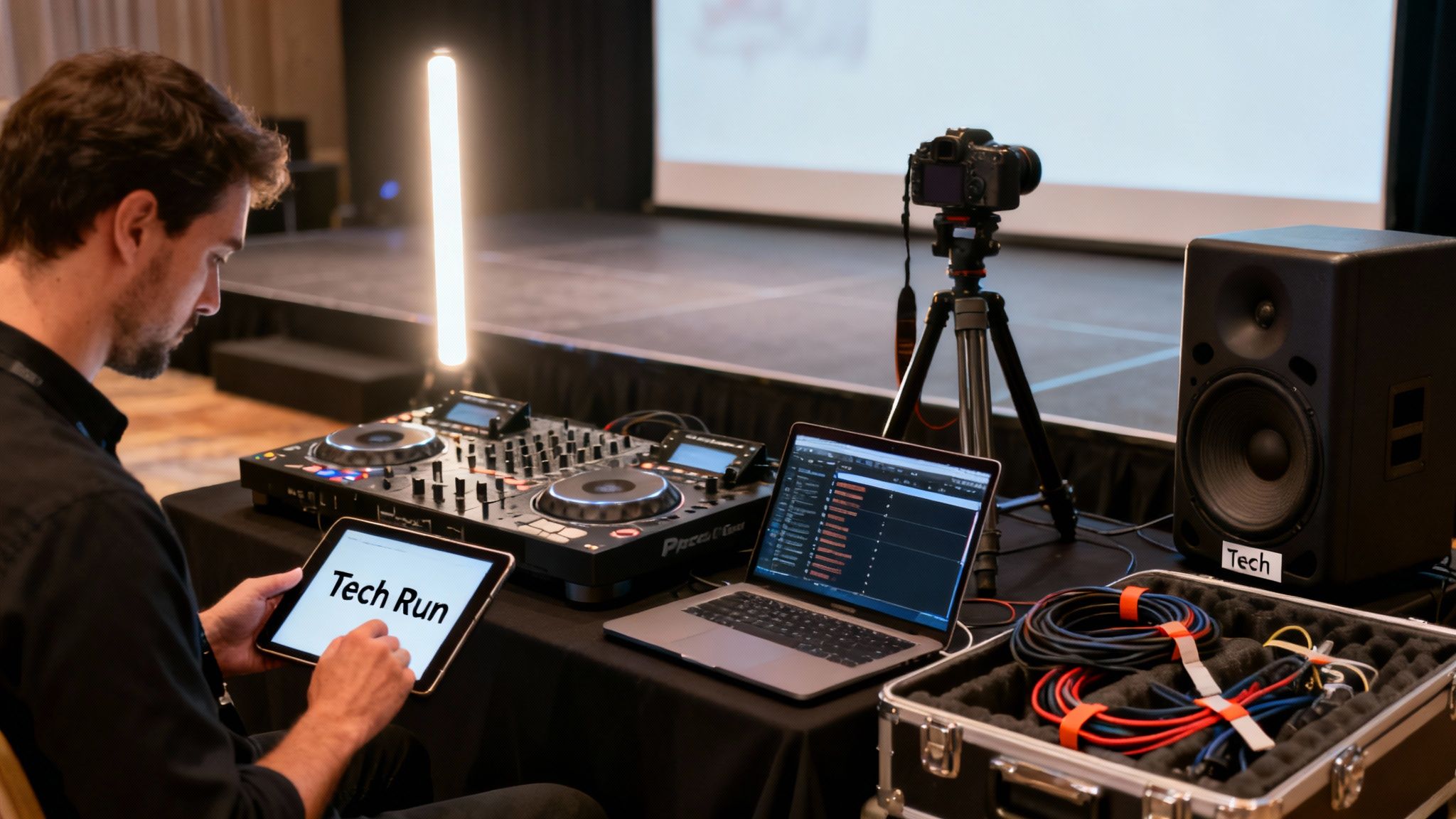
Ever seen an amazing presentation fall flat because the mic kept cutting out, or a wedding's first dance ruined by a lighting cue that never came? These mishaps are why a unified technology and AV strategy is one of the most vital event management best practices. This isn't just about renting good equipment; it's about creating a systematic plan where every technical element, from sound and lighting to special effects, works in perfect harmony.
It’s the behind-the-scenes magic that ensures the DJ’s set seamlessly syncs with the videographer’s shots and the lighting designer’s cues. This integrated approach turns a collection of individual tech components into a single, immersive experience, preventing technical glitches and elevating the entire event atmosphere.
Why It Works So Well
A coordinated AV strategy eliminates the "who's in charge of what?" confusion that leads to on-site disasters. It establishes a clear hierarchy and communication plan, ensuring every vendor knows their cues and responsibilities. At 1021 Events, we treat AV as a core part of the event's narrative, not an afterthought.
For example:
- Weddings: We can test a custom Gobo monogram projection to ensure its timing aligns perfectly with DJ transitions and the dance floor lighting for the big reveal.
- Corporate Events: For a product launch, we can synchronize dramatic cold spark effects to fire at the exact moment a key feature appears on the presentation slides.
- Charity Galas: We coordinate drone videography to capture sweeping aerial shots just as the uplighting sequence hits its peak, creating a stunning visual for future promotional materials.
Actionable Tips for Implementation
Pro Tip: Create a detailed "Technical Run-of-Show" document separate from the main event timeline. This script should include every single AV cue, from a presenter's walk-up music to specific lighting changes, timed down to the second.
- Conduct a Full Tech Rehearsal: Schedule a complete run-through with all technical vendors on-site 48 to 72 hours before the event. This is non-negotiable for identifying and fixing issues before guests arrive.
- Establish a Communication Protocol: Use a dedicated channel (like walkie-talkies) for the on-site technical director, DJ, videographer, and lighting tech. This allows for instant, discreet adjustments during the live event. Beyond technology, ensuring a safe setup requires attention to detail, including effective cable management to prevent trip hazards.
- Have a Dedicated Tech Director: Assign one person as the point-of-contact for all things AV. This person is responsible for calling cues and troubleshooting, preventing the event coordinator from being pulled in multiple directions. To master this, you can learn more about event production here.
3. Detailed Vendor Management & Communication Protocol
Your event’s success often hinges on a symphony of vendors working in perfect harmony, from the caterer to the A/V technician. A cornerstone of event management best practices is establishing a formal vendor management and communication protocol. This isn't about micromanaging; it's a structured system for setting clear expectations, maintaining open dialogue, and ensuring every service provider is aligned with your vision.
This protocol acts as your central nervous system for vendor relations. It defines roles, deliverables, timelines, and contingency plans in writing, transforming a loose collection of contractors into a cohesive, accountable team. This systematic approach prevents misunderstandings and ensures every detail is executed flawlessly.
Why It Works So Well
A strong communication protocol eliminates assumptions and creates a single source of truth for all partners. It ensures that everyone, from your florist to the venue manager, knows their specific responsibilities and how they fit into the bigger picture. When we at 1021 Events manage an event, this protocol is what guarantees a seamless experience, with every vendor working in sync.
For example:
- Weddings: A detailed agreement specifies DJ song selections, photo booth operational hours, drone shot locations, and crucial rain-day backup plans.
- Corporate Events: The protocol clearly states the uplighting color scheme, the exact timing for stage haze effects, and the deadline for final video file delivery.
- Charity Galas: A communication plan designates a single point-of-contact for each vendor and schedules mandatory weekly check-ins starting six weeks before the gala.
Actionable Tips for Implementation
Pro Tip: Treat your service agreements as communication blueprints, not just legal documents. Use them to outline the "who, what, when, and where" for every single deliverable to prevent any day-of surprises.
- Establish Communication Channels: Define your preferred communication methods from the start. Use email for documentation and official sign-offs, and reserve phone calls or texts for urgent, time-sensitive issues.
- Create a Shared Hub: Set up a shared Google Drive or Dropbox folder containing the event timeline, floor plans, vendor contact list, and technical specs. Giving all vendors access ensures everyone is working from the most current information. For more on this, check out our essential event coordinator tips here.
- Confirm, Confirm, Confirm: Send a final confirmation email to every vendor two weeks before the event. This email should summarize all key logistics, timelines, and deliverables, and require a written sign-off to ensure complete alignment.
4. Strategic Venue Site Assessment & Space Planning
Think of your venue as more than just a backdrop; it's the canvas for your entire event experience. Choosing a beautiful space is one thing, but understanding its every nuance is what separates a good event from a spectacular one. This is why a strategic site assessment is one of the most crucial event management best practices. It’s a deep dive into the venue's layout, functionality, and hidden limitations to optimize flow, aesthetics, and technical execution.
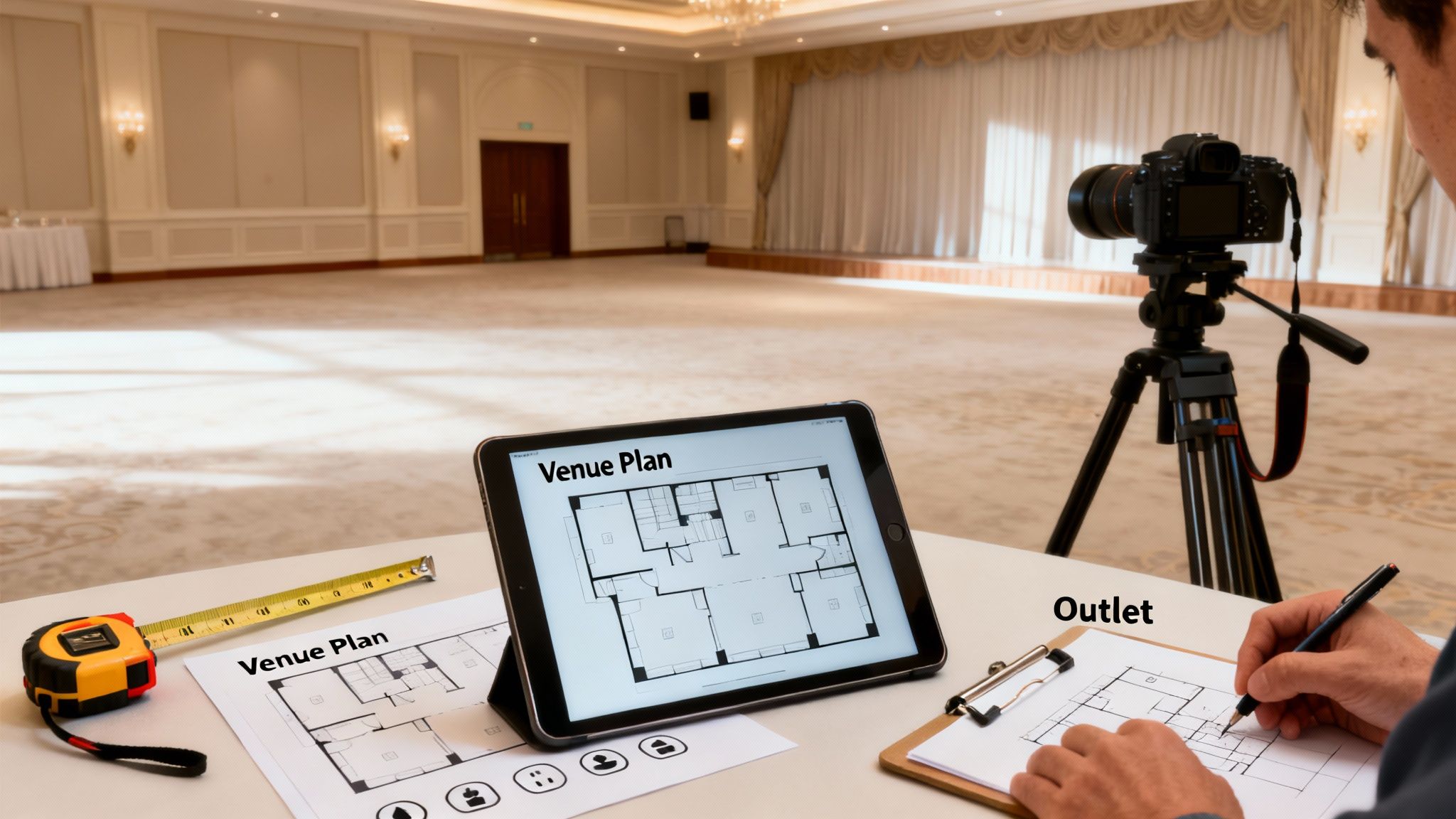
This process involves meticulously mapping out guest flow, identifying the best spots for key elements like a DJ booth or photo booth, and assessing technical factors like power sources, acoustics, and lighting. It’s about ensuring every piece of equipment has a home and every guest has a great view, long before the first person arrives.
Why It Works So Well
A thorough site visit prevents day-of disasters and unlocks creative potential. You can identify potential problems, like a lack of power outlets near the stage or poor Wi-Fi in a critical area, and solve them ahead of time. It allows our team at 1021 Events to pre-plan every technical and visual detail with surgical precision, ensuring a seamless experience.
For example:
- Outdoor Wedding: A site assessment reveals uneven ground that affects drone positioning, tree shadows that dictate lighting placement, and wind patterns that impact haze dispersion for a magical atmosphere.
- Corporate Ballroom: An assessment identifies a low ceiling that requires adjusting Gobo projection height, dark ambient lighting that calls for a strategic uplighting plan, and weak Wi-Fi that necessitates a hardwired connection for equipment.
- Charity Gala: A walkthrough shows a small stage that influences DJ positioning, multiple rooms requiring a thoughtful audio distribution plan, and limited power circuits that demand careful equipment load management.
Actionable Tips for Implementation
Pro Tip: Always visit the venue at the same time of day as your event. This allows you to experience the natural lighting, ambient noise levels, and overall atmosphere firsthand, which photos can never fully capture.
- Come Prepared with Tools: Don't just rely on your eyes. Bring a measuring tape, a camera to take photos from multiple angles, and a wireless signal detector to test cellular and Wi-Fi coverage in all key areas.
- Create a Detailed Floor Plan: Sketch a rough layout on-site, marking power sources, entrances, windows, and potential placements for A/V equipment, seating, and the dance floor. This visual guide is invaluable for all vendors. You can find more ideas for optimizing your event space here.
- Document Everything in Writing: Get any venue restrictions, like limits on sound levels or approved vendors, in writing from the venue manager. This documentation prevents future misunderstandings and ensures everyone is on the same page.
5. Guest Experience Design & Journey Mapping
Have you ever left an event feeling truly captivated, where every moment felt intentional and magical? That doesn't happen by accident. It’s the result of guest experience design, a crucial component of modern event management best practices. This approach involves mapping out every single touchpoint a guest has with your event, from the moment they arrive to their final departure.
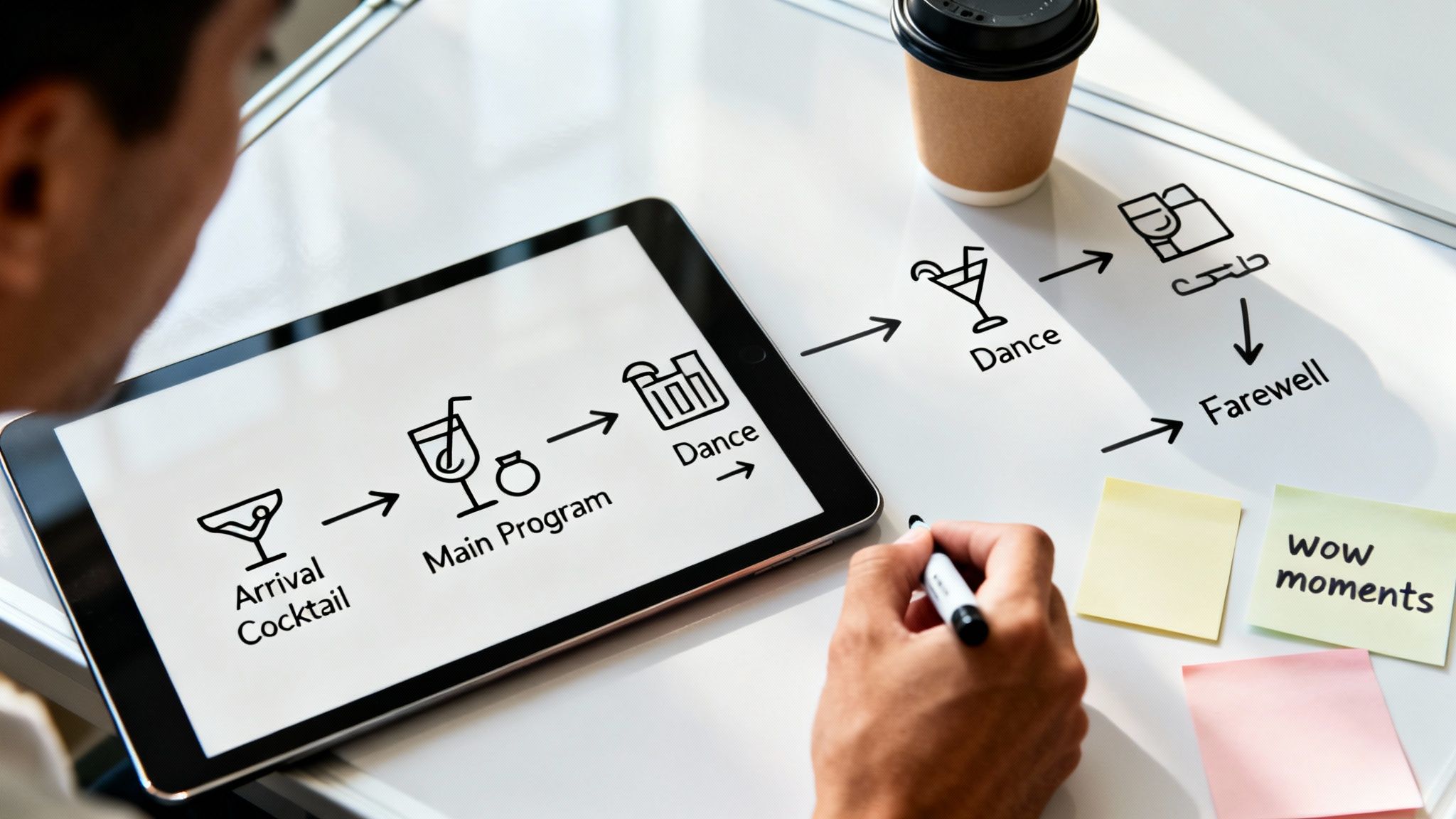
By thinking like a guest, you can craft an emotional journey, identify key moments for maximum impact, and weave in sensory and technological elements that create a cohesive and unforgettable narrative. It’s about transforming a simple gathering into an immersive experience.
Why It Works So Well
Guest journey mapping allows you to be a director rather than just a planner. You're not just checking boxes; you're orchestrating feelings and creating lasting memories. This intentional design ensures guests feel considered and engaged, which dramatically increases their enjoyment and the event's overall success.
For example:
- Weddings: A guest arrives to see a custom monogram projected on the wall, walks through an uplighting corridor, and later witnesses the couple's grand entrance with dazzling cold spark effects.
- Corporate Galas: The experience begins with a branded photo booth for networking, transitions to a main program with dynamic video screen content, and concludes with a finale of synchronized lighting and music.
- Charity Fundraisers: The journey builds emotion with progressive uplighting changes, spotlights key speakers with dramatic lighting, and uses video showcases during a live auction to drive donations.
Actionable Tips for Implementation
Pro Tip: Identify three to five "peak moments" in your event timeline. This is where you should concentrate your most impactful visual and technical elements, like cold sparks or drone coverage, to create unforgettable highlights.
- Create a Sensory Timeline: Map your event hour-by-hour, detailing not just what happens, but what guests will see, hear, and feel. Note when specific equipment like uplighting, a photo booth, or a drone will be activated to create a specific mood.
- Build in 'Instagrammable Moments': Strategically place elements like a branded photo backdrop or a unique lighting installation to encourage social sharing. This not only delights guests but also extends your event's reach organically.
- Coordinate Music with Pacing: Work with your DJ to curate a playlist that matches the energy of each phase of the event, from ambient cocktail hour music to high-energy dance sets. You can explore more interactive ideas to enhance your guest journey here.
6. Post-Event Deliverables, Social Media & Follow-up Strategy
The party’s over, but the work isn’t. A common misstep is thinking the job is done when the last guest leaves. One of the most impactful event management best practices is executing a robust post-event strategy that extends the life and impact of your gathering. This involves everything from delivering professional photo and video content to leveraging social media and gathering crucial feedback.
This follow-up phase transforms a one-time event into a lasting memory and a powerful marketing asset. It’s your opportunity to thank attendees, showcase success, and build momentum for the future, ensuring your event’s value continues to grow long after the lights go out.
Why It Works So Well
A structured follow-up and content delivery plan keeps the excitement alive and demonstrates professionalism. It ensures attendees feel valued, sponsors see their investment's impact, and you gather the data needed to improve future events. This is where you convert event attendees into a long-term community.
For example:
- Weddings: Delivering a stunning, searchable online photo gallery within three weeks and a highlight video shortly after allows the couple to relive and share their day while the memories are fresh.
- Corporate Events: A professionally edited highlight reel delivered within two weeks is perfect for internal communications, while curated photo galleries can be used for PR and future marketing.
- Charity Galas: Creating a thank-you video for sponsors and a donor recognition reel provides tangible proof of their impact, encouraging future support and engagement.
Actionable Tips for Implementation
Pro Tip: To truly maximize an event's reach and engagement, integrate a robust modern video content marketing strategy for both pre and post-event promotion. A compelling highlight video can become your most powerful tool.
- Set Clear Timelines: Define content delivery deadlines in your initial contracts. Promise a few "sneak peek" photos within 48 hours to maintain social media buzz, followed by the full gallery and video on a clear schedule.
- Curate User-Generated Content: Actively monitor your event hashtag and curate the best guest photos and posts. Share this content on your own channels (with credit) to create a powerful, authentic narrative of the event experience.
- Request Feedback Strategically: A week after the event, send a short, simple feedback survey to attendees, sponsors, and vendors. Asking specific questions helps you gather actionable insights rather than generic compliments.
7. Budget Management & Financial Contingency Planning
Let's talk about the elephant in the room: the budget. Without a firm grip on your finances, even the most creative event concept can spiral into a stressful mess. Effective event management best practices demand meticulous budget creation, disciplined expense tracking, and a smart financial safety net. This is your financial command center, ensuring every dollar is allocated purposefully and preventing surprise costs from derailing your vision.
Think of your budget as a blueprint for success. It’s not about limiting your creativity; it's about channeling it wisely. A well-managed budget empowers you to make informed decisions, negotiate effectively with vendors, and allocate funds toward the elements that matter most to your guests, all while protecting you from unexpected financial strain.
Why It Works So Well
A detailed budget provides financial clarity and prevents overspending. It allows you to see exactly where your money is going, identify potential savings, and confidently book vendors knowing you can afford their services. This structured financial plan is what allows us at 1021 Events to provide transparent, all-inclusive packages that fit seamlessly into our clients' bigger financial picture.
For example:
- Weddings: A couple with a $25,000 budget can allocate $4,000 for a comprehensive package from 1021 Events covering DJ, uplighting, videography, and a photo booth, while still holding a $2,500 contingency.
- Corporate Galas: A $15,000 budget might include a $4,000 allocation for essential AV and tech services and $2,250 (15%) for a contingency fund to cover last-minute presentation needs.
- Charity Fundraisers: An $8,000 budget can be maximized by securing sponsorships to offset costs and negotiating favorable rates with vendors who support the cause.
Actionable Tips for Implementation
Pro Tip: Create a master budget spreadsheet from day one. List every potential expense category, with columns for estimated cost, actual cost, deposit paid, and final payment due date. Update it religiously.
- Build in a Contingency Fund: Always allocate 10-20% of your total budget to a contingency reserve. This buffer is your secret weapon against unexpected costs like rush shipping fees or needing extra security.
- Request Itemized Quotes: Ask vendors to break down their costs. A quote that lists DJ services separately from uplighting gives you the flexibility to adjust your package. This is a core part of how we build proposals, ensuring total transparency.
- Track Everything: Starting three months out, review your actual spending against your budget on a weekly basis. This habit helps you catch any discrepancies early and make necessary adjustments before they become major problems.
8. Risk Management & Contingency Planning (Weather, Technical, Staffing)
Hope for the best, plan for the worst. It’s a classic for a reason, and in event management, it’s a non-negotiable rule. A robust contingency plan is what separates a minor hiccup from a full-blown catastrophe. This critical event management best practice involves proactively identifying potential risks and creating a detailed "Plan B" (and even a "Plan C") for each one.
This isn’t about being pessimistic; it's about being prepared. By anticipating issues like sudden downpours, equipment failures, or a key vendor calling in sick, you build resilience into your event. The goal is to have solutions ready to deploy so seamlessly that your guests never even notice something went wrong.
Why It Works So Well
A solid risk management strategy gives you peace of mind and the agility to handle the unexpected with confidence. Instead of panicking when a problem arises, your team knows exactly what to do, who to call, and how to communicate changes. It's the ultimate safety net that protects your investment, your reputation, and the overall guest experience.
For example:
- Outdoor Weddings: A rain contingency isn't just a tent. It's having pre-arranged tent rental contracts, waterproof covers for audio equipment, and a communication plan to inform guests of a venue shift.
- Corporate Events: For a power failure, a plan includes a backup generator, uninterruptible power supply (UPS) units for critical tech like projectors, and a mobile hotspot for internet redundancy.
- Charity Galas: A staffing contingency might involve cross-training volunteers or having a backup DJ and videographer on standby, ensuring the show goes on even if a key person is unavailable.
Actionable Tips for Implementation
Pro Tip: Create a "Risk Matrix" that lists potential risks, their likelihood, their potential impact, and your specific response protocol. Share this document with all key vendors and your core team.
- Establish a Decision Deadline: For weather-related decisions, set a firm "go/no-go" point, typically 48 hours before the event. This prevents last-minute scrambling and gives vendors enough time to implement the backup plan.
- Build in Redundancy: Don’t just have one of anything critical. At 1021 Events, we recommend having backup microphones, extra cables, and even a secondary music playback device ready to go at a moment's notice.
- Verify Vendor Insurance: One week before the event, confirm that all your vendors have provided proof of liability insurance. This protects you from unforeseen accidents or damages.
9. Interactive Guest Engagement & Entertainment Programming
Ever been to an event where the energy just… fizzles out? A silent dance floor or guests checking their watches is an event planner’s nightmare. That’s why a core tenet of event management best practices is designing interactive entertainment and programming that actively involves your guests, transforming them from passive observers into enthusiastic participants.
This is about more than just booking a band. It's the art of strategically weaving entertainment, technology, and hosting duties together to create a lively, engaging atmosphere from start to finish. A well-programmed event guides the guest's emotional journey, ensuring there are no lulls and plenty of memorable, shareable moments.
Why It Works So Well
Interactive elements turn a standard gathering into a dynamic experience. When guests are engaged, they stay longer, have more fun, and leave with a stronger connection to your event's purpose. It’s the difference between an event people attend and an event people talk about for weeks. For us at 1021 Events, this is where a skilled DJ, MC, and interactive features like a photo booth become invaluable assets.
For example:
- Weddings: A great DJ/MC doesn't just play music; they facilitate the first dance with dramatic lighting, get guests hyped for the bouquet toss, and keep the photo booth line moving and fun.
- Corporate Galas: A photo booth with a branded backdrop encourages social sharing, while a charismatic MC can announce key speakers and drive participation in a silent auction by offering prizes for engagement.
- Charity Fundraisers: An MC works with the live auctioneer to build bidding excitement, a photo booth can be a direct fundraising element, and celebration moments are amplified with effects like cold sparks.
Actionable Tips for Implementation
Pro Tip: Your MC is your on-site energy director. Hire an experienced professional who can read the room, adapt the flow on the fly, and seamlessly transition between different parts of the event without losing momentum.
- Schedule for Maximum Impact: Open the photo booth during cocktail hour to capture guest excitement early, then keep it running during the reception. Time high-energy entertainment, like a packed dance floor set, during peak guest attention periods.
- Create Participation Incentives: Run a contest for the "best photo" shared on social media from your custom-branded photo booth. This not only boosts engagement but also amplifies your event's reach online.
- Use Visuals as Cues: Work with your A/V and lighting team to use effects to mark key moments. A change in lighting can signal the start of speeches, while a blast of haze can build anticipation for a big reveal or kick off dancing.
10. Personal Brand Integration & Customization Strategy
Ever been to an event that felt… generic? Like a copy-and-paste template? The most memorable events are the ones that feel deeply personal and unique to the host. One of the most impactful event management best practices is weaving the client's personal brand, style, and story into every single detail. This goes beyond just picking a color scheme; it’s about creating an immersive experience that shouts, "This is SO them!"
Think of the event as a physical manifestation of the host's identity. From the moment guests arrive, every element should reflect their personality, values, and vision. This strategic customization is what transforms a standard gathering into a bespoke, unforgettable experience that guests will talk about long after it's over.
Why It Works So Well
A strong brand integration strategy creates an emotional connection. It makes guests feel like they are part of something authentic and special, not just attending another function. It’s the difference between an event that is simply well-executed and one that is truly meaningful. At 1021 Events, we specialize in translating your unique vision into tangible, stunning details that tell your story.
For example:
- Weddings: A couple’s custom monogram is projected onto the dance floor using a Gobo, while their signature cocktails are served with personalized labels telling the story of how they met.
- Corporate Events: The company’s logo and brand colors are tastefully integrated into everything from the uplighting scheme to a branded photo booth backdrop, reinforcing corporate identity.
- Charity Fundraisers: The nonprofit’s mission is highlighted with a custom photo booth backdrop featuring impactful stories, and the color scheme reflects the organization's official branding.
Actionable Tips for Implementation
Pro Tip: Your mood board is your North Star. Create a shared visual document using Pinterest or a similar tool to establish the desired aesthetic. This becomes an invaluable reference for you, your client, and every vendor involved.
- Conduct a Deep-Dive Discovery Session: Dedicate at least one to two hours to a detailed conversation with your client. Ask about their style, values, passions, and the feeling they want to evoke. This is the foundation of your entire customization strategy.
- Curate the Soundtrack: Work with the client to create a "must-play" and a "do-not-play" list for the DJ. Music is a powerful tool for personalization, and these lists ensure the vibe perfectly matches their taste. For more ideas on using music and visuals, get more details on our AV & lighting services here.
- Offer Tiered Personalization: Present customization options at different investment levels. This allows clients to choose elements that are most important to them while staying within their budget, whether it's a simple custom Gobo or a fully branded interactive experience.
10-Point Comparison of Event Management Best Practices
| Item | Implementation Complexity 🔄 | Resource Requirements ⚡ | Expected Outcomes ⭐ / 📊 | Ideal Use Cases | Key Advantages 💡 |
|---|---|---|---|---|---|
| Comprehensive Event Planning Timeline & Checklist | 🔄 Medium‑High — multi‑phase scheduling and accountability | ⚡ Moderate — PM tools, regular team time | ⭐ High — fewer last‑minute issues; 📊 predictable milestones | Long‑lead weddings, large galas, fundraisers | 💡 Prevents scrambling; enables budget adjustments; vendor clarity |
| Integrated Technology & AV Coordination Strategy | 🔄 High — technical rehearsals and sync of systems | ⚡ High — AV gear, redundancy, skilled techs | ⭐ Very High — reliable show execution; 📊 minimized technical failures | Tech‑heavy events, AV‑centric corporate presentations, productions | 💡 Ensures equipment harmony; real‑time monitoring and backups |
| Detailed Vendor Management & Communication Protocol | 🔄 Medium — contracts and communication cadence | ⚡ Low‑Moderate — documentation tools, time for meetings | ⭐ High — accountability and clearer deliverables; 📊 fewer disputes | Any multi‑vendor event; client/vendor coordination required | 💡 Reduces misunderstandings; single points of contact; legal clarity |
| Strategic Venue Site Assessment & Space Planning | 🔄 Medium — in‑person surveys and measurements | ⚡ Moderate — site visits, measurement tools, photos | ⭐ High — optimized layout and technical placement; 📊 fewer day‑of changes | Outdoor venues, sites with drone/Gobo/complex rigging needs | 💡 Identifies constraints early; improves acoustics and sightlines |
| Guest Experience Design & Journey Mapping | 🔄 Medium‑High — cross‑discipline design and timing | ⚡ Moderate — creative/tech resources for sensory moments | ⭐ Very High — memorable guest experiences; 📊 increased engagement | Brand events, weddings, fundraisers aiming for impact | 💡 Focuses peak moments; boosts social sharing and perceived value |
| Post‑Event Deliverables, Social Media & Follow‑up Strategy | 🔄 Medium — editing pipelines and analytics workflows | ⚡ Moderate‑High — editors, storage, social manager | ⭐ High — extended reach and measurable ROI; 📊 content performance metrics | Events seeking PR, post‑event marketing, sponsor reporting | 💡 Prolongs impact; generates testimonials and reusable content |
| Budget Management & Financial Contingency Planning | 🔄 Medium — itemized tracking and negotiations | ⚡ Low‑Moderate — spreadsheets, quotes, financial oversight | ⭐ High — cost control and prioritized spending; 📊 clearer ROI | All events, essential when budgets are constrained | 💡 Prevents overspend; builds contingency reserves; clarifies payments |
| Risk Management & Contingency Planning | 🔄 High — risk matrices and redundancy protocols | ⚡ High — backup equipment, insurance, extra staff | ⭐ High — minimized disruption; 📊 reduced downtime and liability | Outdoor/high‑stake corporate or charity events | 💡 Enables calm responses; protects investment with predefined plans |
| Interactive Guest Engagement & Entertainment Programming | 🔄 Medium — programming, pacing, and moderation | ⚡ Moderate — DJ/MC talent, photo booth, staffing | ⭐ High — sustained engagement; 📊 higher participation and shares | Social events, weddings, fundraisers focused on interaction | 💡 Keeps energy high; encourages participation and social content |
| Personal Brand Integration & Customization Strategy | 🔄 Medium‑High — bespoke elements and vendor alignment | ⚡ Moderate — design resources, custom materials | ⭐ High — distinctive branded experience; 📊 stronger brand recall | Corporate branding events, bespoke weddings, signature fundraisers | 💡 Creates unique identity; cohesive visuals and authentic guest moments |
Turn Your Vision into an Extraordinary Experience
And there you have it, the full playbook for taking your event from an idea on a napkin to a show-stopping, unforgettable experience. We've navigated the intricate labyrinth of event management best practices, from building an iron-clad planning timeline and mastering your budget to designing an immersive guest journey and planning for every conceivable contingency. It’s a lot, we know. But the difference between a good event and an extraordinary one lies precisely in these details.
It’s about more than just checking boxes; it’s about a mindset. It's about seeing your event not as a single date on the calendar, but as a complete narrative with a beginning, middle, and end. It’s about anticipating needs before they arise, communicating with your vendors like they’re part of your own team, and using technology not just for flash, but for creating genuine connection.
The Real Secret to Flawless Execution
The most critical takeaway from all these points is integration. No single best practice exists in a vacuum.
- Your budget management directly impacts your vendor selection and AV capabilities.
- Your guest journey map informs your entertainment programming and venue layout.
- Your post-event strategy is only as strong as the brand integration you achieved during the event itself.
Think of it like conducting an orchestra. Each section, from the strings of vendor management to the percussion of risk planning, must play in perfect harmony. When you master these event management best practices, you’re not just a planner; you're a conductor, seamlessly weaving every element together to create a symphony of success. The result is an event that feels effortless, cohesive, and deeply personal to every single attendee, whether it's a bride seeing her dream wedding come to life or a CEO launching a game-changing product.
From Blueprint to Standing Ovation
The journey from a detailed plan to a flawlessly executed event is where the magic truly happens. It’s that moment when the custom uplighting perfectly matches the brand’s colors as the keynote speaker takes the stage, or when the perfectly timed music from a professional DJ cues a heartfelt moment at a wedding reception. It’s seeing guests light up with laughter in a photo booth, creating memories that will be shared for weeks to come.
This is the reward for all the meticulous planning. It’s the validation that every checklist, every contingency plan, and every creative decision was worth it. Mastering these concepts empowers you to move beyond simply hosting an event and start architecting an experience. You gain the confidence to handle any curveball, the foresight to elevate every moment, and the skill to ensure your vision is not just realized, but amplified. So take these strategies, adapt them to your unique occasion, and get ready to create something truly memorable. The stage is set for you to shine.
Feeling inspired but a little overwhelmed by the details? That’s where we come in. At 1021 Events, we live and breathe these best practices every day, providing the professional DJ/MC, videography, and photo booth services that bring the technical and entertainment elements of your event to life. Let us handle the complex coordination so you can focus on your guests by visiting 1021 Events to see how we can help you build an extraordinary experience.
Planning an event in Fort Atkinson, Southern Wisconsin, or Northern Illinois? 1021 Events can put proven event-management practices into action with planning, DJ/MC entertainment, sound, lighting, photography, videography, photo booths, and coordinated production. Explore our event services, then send an inquiry through EMP DJ to discuss your event.