
A good speaker for a wedding ceremony is one of those behind-the-scenes heroes. It's what guarantees every single guest—from your teary-eyed grandma in the front row to your college buddies in the back—can actually hear your vows, the readings, and the music. The right sound system doesn't just make things louder; it shapes the whole vibe, making sure the emotion of the moment truly connects with everyone.
Why Your Ceremony Audio Matters More Than You Think
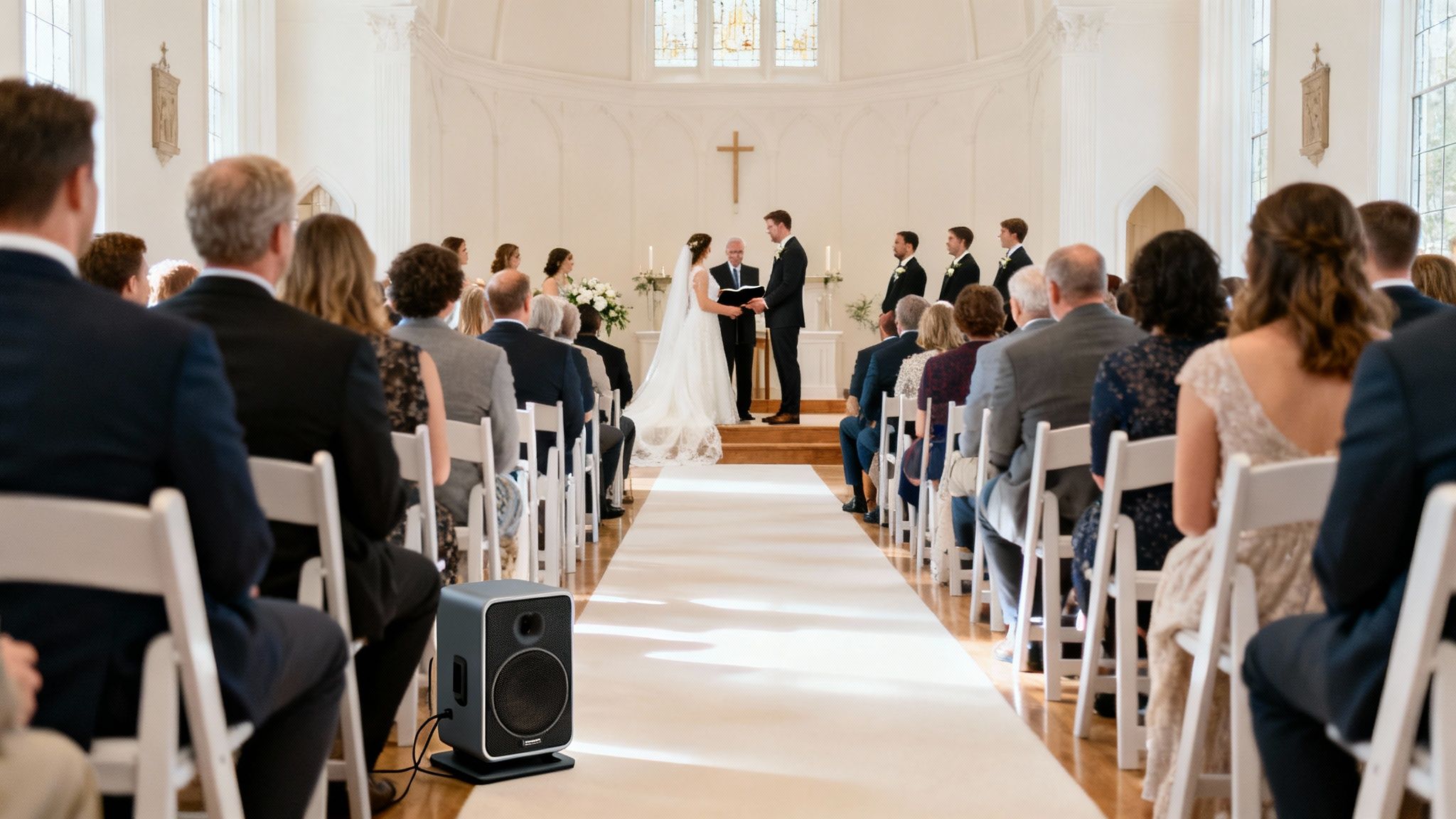
Think about it. You've planned the perfect ceremony. The venue is stunning, your vows are written from the heart, and you've picked music that tells your story. Now, imagine half your guests can't hear a thing. They're craning their necks, missing the punchline of your personal story or the tremble in your voice as you say "I do." It's a surprisingly common problem, but thankfully, it's also an easy one to fix.
Great audio isn't just about cranking up the volume. It's about creating a connection. When every word comes through clearly, your guests are right there with you, sharing in every laugh and happy tear. It’s what turns the ceremony from something people just watch into an experience they genuinely feel.
Creating an Emotional Connection
Having a professional sound setup adds a layer of polish that you can't get otherwise. It’s all about making sure the little details land with the impact they deserve.
- Vow Clarity: Let’s be real, your promises to each other are the main event. A decent sound system means nobody has to wonder what you just said. Every word will be heard.
- Musical Impact: The songs you choose for the processional and recessional are huge emotional cues. Crisp, clear audio is what gives you those goosebumps and sets the perfect mood. For more on this, check out our guide to picking the https://1021events.com/best-music-for-wedding-ceremony/.
- Guest Engagement: When friends or family do a reading, you want everyone to feel its significance. Clear sound makes your loved ones feel heard and helps your guests feel more connected to the moment.
The Modern Wedding Experience
Weddings aren't what they used to be, and guest expectations have changed, too. Couples are throwing bigger, more elaborate events. A recent report even noted that Gen Z couples are planning larger celebrations, with the average U.S. wedding now hosting 131 guests. Once you have a crowd that size, a quality audio setup isn't a luxury—it's a necessity to keep everyone tuned in.
A great sound system is the invisible thread that ties every element of your ceremony together. It ensures that the most important words you'll ever say are not just spoken, but are truly heard and felt by every person you've invited to witness your union.
At the end of the day, investing in good audio is really an investment in your guests' experience. It's why bringing in professional Wedding DJs and Music services can be a total game-changer. They have the gear and the know-how to make sure every moment sounds absolutely perfect.
Getting to Grips with Wedding Sound Gear
Let's be honest, diving into audio equipment can feel like learning a new language. But you don't need to be a sound engineer to understand the basics. The goal for your ceremony is simple: take a voice or a song, make it louder, and send it out clearly so everyone can hear every word.
Think of the whole setup as a team, with each piece of gear playing a specific position. You'll often hear this whole team referred to as a PA (Public Address) system. It's not just one box; it's a collection of equipment working together to make sure the sound gets to every single guest, from the front row to the back of the lawn.
Once you understand the three core players on this team, you'll feel much more confident chatting with a DJ or audio pro. You'll know exactly what you're asking for.
The Three Musketeers of Wedding Audio
Every sound system, whether it’s a simple portable speaker or a massive concert rig, boils down to three key parts working in perfect sync. Let's use a simple analogy to break it down.
- Microphones (The Ears): This is where it all begins. Microphones act like ears, capturing the sound of your officiant, your vows, or a friend's reading. They take that sound and turn it into a tiny electrical signal.
- The Mixer (The Brain): That little signal then zips over to the mixer. The mixer is the command center. It's where a technician can blend the different sounds—turning up the officiant's mic, fading in the processional music, and making sure nothing is painfully loud or frustratingly quiet. It’s the brain deciding what everyone hears.
- Speakers (The Mouth): Finally, the mixer sends that perfectly balanced signal out to the speakers. The speakers are the "mouth" of the operation. Their job is to take the electrical signal and turn it back into the sound waves that your guests actually hear, projecting them loud and clear across the space.
This simple "Ears -> Brain -> Mouth" flow is the secret behind any event's sound. Grasping this takes all the mystery out of what’s happening behind the tech table. For a closer look at all the pieces that go into a professional setup, you can find great info about audio-visual equipment for events and how it all fits together.
Powered vs. Passive Speakers: An Easy Choice
When you start talking about a speaker for a wedding ceremony, you'll probably hear the words "powered" and "passive." The difference is actually really simple and makes a big difference in how easy your setup will be.
Think of a powered speaker like a modern lamp you just plug into the wall. The power source is built right in. These are awesome all-in-one units where the amplifier (the part that provides the power) is tucked away inside the speaker cabinet. They are incredibly convenient and are the default choice for most weddings today.
A powered speaker is the ultimate plug-and-play solution. Because everything is self-contained, you have fewer cables, a faster setup, and less that can go wrong. It's the most reliable choice for a day where you can't afford technical glitches.
A passive speaker, on the other hand, is like a bare lightbulb. It needs a separate lamp (an external amplifier) to get power and light up. This approach gives audio pros more control for really complex setups, but for a wedding, it just means more gear, more cables, and more complexity.
For pretty much any wedding ceremony, powered speakers are the way to go. They deliver fantastic sound in a super user-friendly package.
Here's a quick rundown of why they're the clear winner:
- Simplicity: Less equipment means a quicker, cleaner setup. No one wants to see a mess of cables.
- Reliability: The built-in amplifier is perfectly matched to its speaker, which cuts down the risk of blown speakers or poor sound.
- Portability: All-in-one speakers are a breeze to transport and place, which is a lifesaver for outdoor ceremonies or venues with tricky layouts.
Unless you're planning on having a full orchestra play your ceremony, any good vendor will use powered speakers to make sure your audio is flawless and completely stress-free.
Finding the Perfect Sound for Your Wedding Venue
Your wedding venue is more than just a beautiful backdrop; it's the single biggest factor determining your audio needs. A grand, high-ceilinged ballroom and a breezy beachfront ceremony are worlds apart when it comes to sound, and the right speaker setup has to match the space perfectly.
This isn't just about cranking up the volume. It's about being smart. A single, powerful speaker might sound incredible in an open field, but put it in a stone chapel and you’ll get a garbled mess of echoes. Conversely, that same speaker outdoors might have its sound completely whisked away by the wind. The first step to getting flawless audio is to truly understand your venue's acoustic personality.
At its core, a wedding PA (Public Address) system is pretty simple: a microphone picks up the sound, a mixer balances it, and a speaker projects it. But making that simple chain work flawlessly in any given environment is where the magic happens.
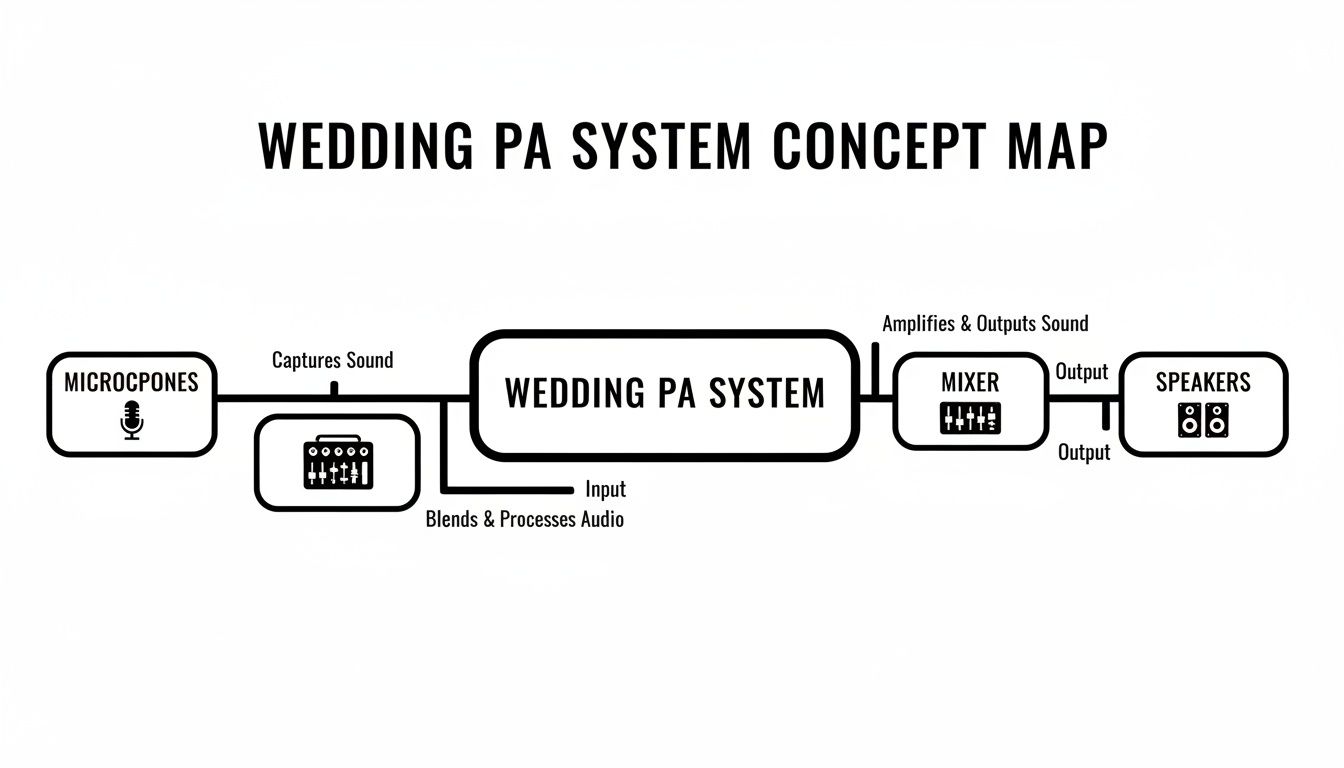
This diagram shows the basic path sound takes, but whether you're indoors or out, the approach has to be completely different.
Tackling Indoor Ceremony Acoustics
Indoor spaces like chapels, ballrooms, or historic manors seem easy because they're controlled environments. But they have a sneaky audio villain: reverberation. You probably know it better as echo. Hard surfaces—think stone walls, tile floors, and tall ceilings—are basically trampolines for sound waves.
If you try to brute-force it with one giant speaker, the sound bounces around so much that it becomes muddy and hard to understand. The direct sound from the speaker smashes into its own echoes just milliseconds later, turning heartfelt vows into gibberish. It’s a classic mistake.
The goal indoors isn't raw power; it's clarity. You have to tame the sound, making sure it goes straight to your guests without turning the room into an echo chamber.
The best way to do this is with what we call a distributed audio approach. It sounds technical, but it just means using multiple smaller speakers placed thoughtfully around the room. This lets you run each speaker at a much lower volume, giving everyone clear, even coverage without exciting the room's natural echo.
Conquering the Great Outdoors
An outdoor ceremony is a dream, but from an audio perspective, it's a real challenge. You have no walls to hold the sound in, so it just… leaves. It dissipates into the open air almost instantly, which calls for a whole new game plan.
Your biggest opponent out here is wind. A light breeze is all it takes to literally blow your vows away from your guests. Then you’ve got ambient noise to compete with—crashing waves, distant traffic, even chirping birds. Your sound system needs enough muscle to cut through all of it without sounding shrill. For more great insights on handling these variables, check out our guide on how to get the best sound for your wedding.
The name of the game for outdoor audio is sound dispersion, which is just a fancy way of saying "how a speaker spreads its sound." You need speakers that can throw sound in a controlled pattern, aiming it right at your guests.
- Higher Power: You’ll definitely need more wattage outdoors just to push the sound far enough.
- Strategic Placement: Get those speakers up on stands! This helps project the sound over the heads of people in the front row so the folks in the back can hear.
- Directional Control: Good speakers have a specific coverage angle. This focuses the sound on the audience instead of losing it to the trees and sky.
Indoor vs Outdoor Ceremony Speaker Setup
So, how do these different environments really stack up? This table breaks down the core challenges and solutions for each.
| Consideration | Indoor Ceremony Solution | Outdoor Ceremony Solution |
|---|---|---|
| Main Challenge | Echo and reverberation | Sound dissipation, wind, and ambient noise |
| Ideal Speaker Setup | Multiple smaller speakers at a low volume | Two or more powerful speakers on stands |
| Volume Strategy | Keep it lower to prevent echo | Go louder to overcome the environment |
| Placement Goal | Achieve even coverage and vocal clarity | Project sound directly toward the guest seating area |
In the end, choosing the right speaker for a wedding ceremony is all about adapting to your surroundings. A good audio pro won't just bring gear; they'll assess the venue and design a system that makes sure every single guest feels like they have the best seat in the house.
Choosing the Right Microphone for Your Vows
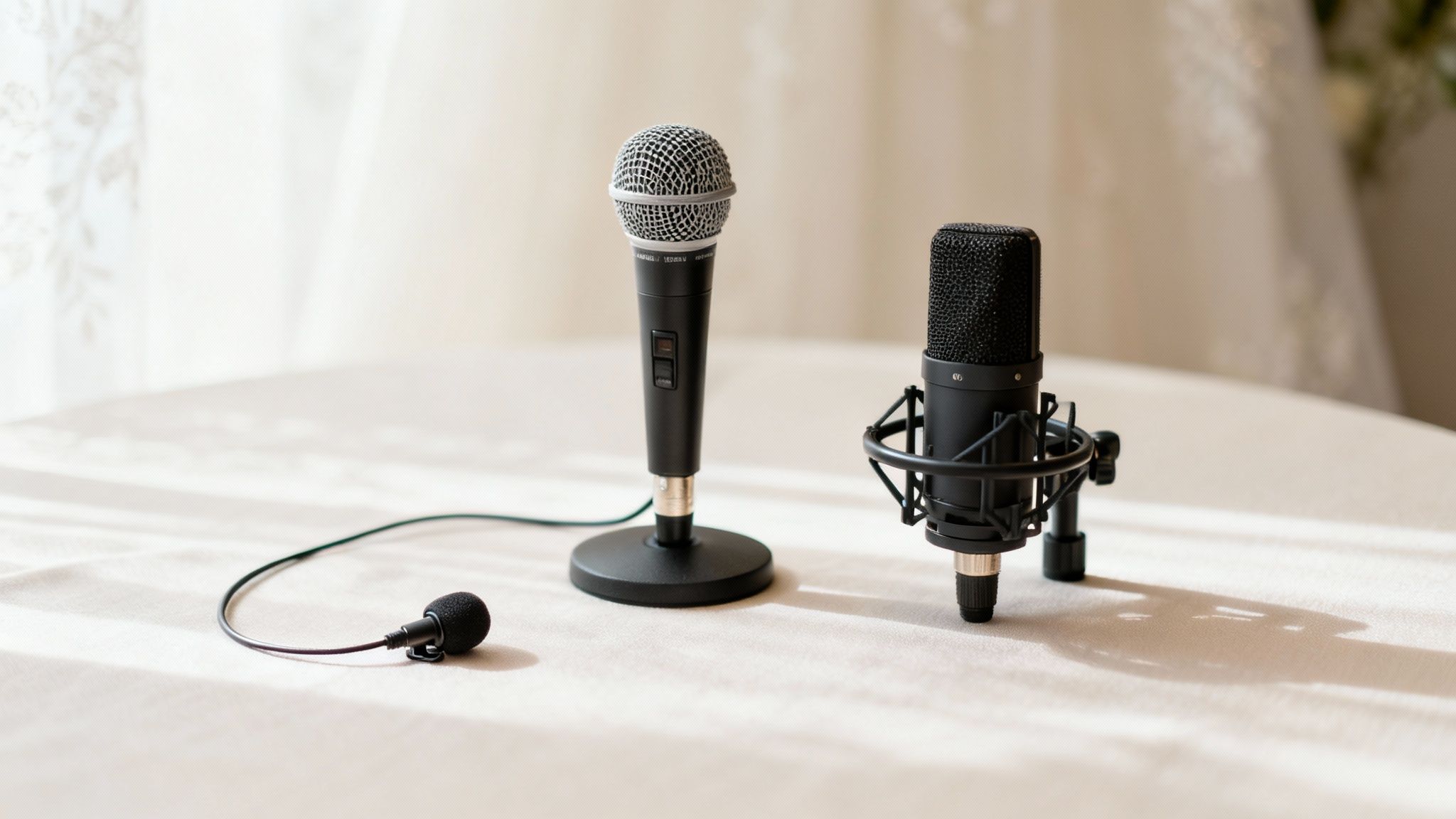
If your speakers are the mouth of your sound system, then the microphones are its ears. They're the critical first step in capturing every whispered vow and tearful reading, and picking the right one is just as important as choosing the speakers themselves. The wrong mic can introduce distracting rustling sounds from a dress or fail to pick up a soft-spoken officiant.
Think of it like a camera lens. A great lens captures a sharp, vibrant image, while a cheap one gives you a blurry, washed-out photo. It’s the same with audio. A good microphone ensures the sound going into the system is clean and clear, ready to be amplified for all your guests to hear.
Let’s break down the three main types you'll run into and figure out which one is the perfect match for your big day.
The Discreet Lavalier Mic
You've definitely seen these before. A lavalier mic—often called a lapel mic—is that tiny little microphone that clips right onto clothing. This is the go-to choice for keeping things hands-free, which makes it absolutely ideal for the couple and the officiant.
- Pros: They are incredibly subtle and let you move around naturally. You won't have to worry about holding anything, so you can just focus on the moment.
- Cons: Because they’re so small, they're also pretty sensitive. They can easily pick up the rustle of a wedding dress, a dangling necklace, or a gust of wind at an outdoor ceremony.
The hands-free convenience is a huge part of why lavs are so popular, especially as weddings become more personalized. We're seeing a massive trend of couples wanting their ceremony to feel uniquely theirs, and great audio is a cornerstone of that experience. In fact, there's been a 156% surge in searches for 'custom wedding design' since 2023, with 73% of couples ditching old traditions for more authentic touches.
The Classic Handheld Mic
A handheld mic is exactly what it sounds like—the classic microphone you see singers and presenters holding on stage. It's a super versatile and reliable workhorse, and it really shines when multiple people need to speak.
These are fantastic for guest readers or a soloist because they can be passed easily from one person to the next. They do require a little bit of technique, though. Whoever is speaking needs to hold it a consistent distance from their mouth, otherwise the volume will jump all over the place. Don’t worry, a good audio tech can give your readers a quick 30-second tutorial before everything starts. You can find out more about equipment options in our full guide to wedding sound system rentals.
The Sensitive Condenser Mic
Condenser mics are a bit different. You’ll usually see them on a stationary stand, and they’re designed to pick up sound from a wider area with incredible detail and clarity. They’re less common for vows, but they have a very specific, powerful role they can play.
A condenser mic is perfect for capturing the ambient sound of the ceremony or amplifying a small musical ensemble, like a string duo. It adds a rich, full-bodied quality to the overall audio feed that other mics might miss.
Because they are so sensitive, placement is everything. You have to be careful to aim it away from the crowd to avoid picking up coughs and chatter. For a really deep dive into the technical side of things, this professional microphone guide is a great resource.
Ultimately, the best setup is often a combination of all three: lavalier mics for you and your officiant, with a handheld or condenser mic at the ready for any readers or musicians.
Your Essential Wedding Ceremony Audio Checklist
Let's be honest, figuring out the audio for your wedding can feel like a huge headache. But it doesn’t have to be. A simple checklist can cut through the noise and make sure every word is heard. Think of it as your roadmap, breaking everything down into small, manageable steps so nothing gets missed.
This isn't just about checking off boxes. It’s about being proactive. Great sound is the invisible thread connecting your guests to the heart of the moment, and with this guide, we'll walk through exactly how to make sure your "I do's" come through loud and clear.
The Planning Phase: Before You Book Anything
Long before the big day, you need to ask some foundational questions. Nailing these down early with your venue and any potential sound vendors will save you from last-minute scrambles and a whole lot of stress.
- Got Power? First things first, does your ceremony spot have easy access to power outlets? If you're outdoors or in a remote location, you'll probably need a generator. Pro tip: insist on a quiet "inverter" generator so you don't have a distracting engine humming through your vows.
- Venue Rules: Are there any noise restrictions? Some venues, especially those near residential areas, have strict rules about volume and when the music has to stop. You need to know this upfront.
- Who's in Charge? Figure out who is actually running the sound. Is your DJ handling the ceremony, or do you need a separate audio technician? Whoever it is, make sure they're insured and have experience with a setup like yours.
- What's Plan B? What happens if it rains? If your outdoor ceremony suddenly has to move inside, can the audio equipment be moved and adapted quickly? A solid backup plan is a must.
The Pre-Ceremony Phase: A Week Out
Okay, you've got a plan. Now, in the week leading up to the wedding, it's time to lock in the details and run some tests. This is your chance to iron out any kinks and make sure everything is truly ready to go. I always recommend a quick site visit with your audio tech during this time—it's invaluable.
The wedding industry is bigger than ever, and couples are planning more elaborate events. With 25% of weddings now being destination events and guest lists averaging 145 people, a great speaker for a wedding ceremony is no longer a luxury, it's a necessity. You can see how the industry is evolving by checking out these insights from the experts at the Celebrant Institute. This is precisely why a thorough check-in a week before is non-negotiable.
A full sound check isn't just a "nice-to-have." It's a mandatory dress rehearsal for your audio. It's the single best way to catch problems like microphone feedback or dead spots in the audience before your guests are in their seats.
The Day-Of Checklist: Before Guests Arrive
On the wedding day, a final run-through is your last line of defense. This should happen about an hour before the ceremony starts, which gives you plenty of breathing room to fix any surprises without adding to the day's stress.
- Final Sound Check: Test every single microphone. Have the officiant, your readers, and even you and your partner say a few words into the mics from the exact spots where you'll be standing.
- Music Cue Test: Play a few seconds of each song—the processional, any special music, and the recessional. Make sure the volume is right and the transitions feel smooth, not jarring.
- Battery Check: Are all wireless mics and packs loaded with fresh batteries? Have backups for everything. You can never have too many spare batteries.
- Cable Check: Tape down any and all cables. The last thing you want is for a guest (or a bride!) to trip. It's a simple safety step that's so easy to forget. For more tips on preparing for anything, see our guide on building a complete wedding day emergency kit.
Your Top Wedding Audio Questions Answered
After months of planning, it's totally normal to have a few last-minute questions about the audio for your big day. Honestly, getting the sound right is one of those final, crucial pieces of the puzzle. It's what makes sure everyone can actually hear and share in the moment.
So, let's tackle the most common questions we hear from couples. Think of this section as your final sound check—a chance to get clear, straightforward answers and feel completely confident that every vow, reading, and piece of music will land perfectly.
Should We Rent or Buy a Speaker System for Our Wedding?
For almost every single couple, renting is the clear winner. It's easy to think, "Hey, we could buy a speaker and use it for parties later!" But professional rental equipment is in a completely different league from the stuff you'd buy at a big-box store. The speakers are more powerful, the mics are more reliable, and the whole system is built to run flawlessly for hours.
But the real game-changer isn't just the gear—it's the expertise that comes with it. When you rent, you're usually getting a team to handle delivery, setup, and even operation. They know exactly how to place speakers in your specific venue and will be there to manage the sound levels as the ceremony unfolds.
Think of it this way: buying a speaker system basically makes you the audio tech on your own wedding day. Renting it lets a pro handle everything, giving you the priceless peace of mind to just be present. That stress-free experience is worth every penny.
How Many Speakers Do We Actually Need for Our Ceremony?
This is a great question, and the answer really depends on your guest count and venue. There’s no magic number, but we can use some solid rules of thumb.
- For intimate gatherings (under 50 guests): In a quiet, indoor space, a single high-quality powered speaker might be all you need. The goal here is just gentle reinforcement, not blasting everyone out.
- For a standard wedding (75-150 guests): Two speakers is the sweet spot. Placing one on each side of the altar creates a balanced sound that fills the space naturally. This ensures guests on both sides of the aisle can hear clearly without one speaker having to do all the heavy lifting.
- For large weddings (150+ guests) or tricky outdoor spaces: Here’s where you might need to bring in more firepower. Pros often use "delay" speakers placed partway back in the audience. These smaller speakers get a slightly delayed audio signal, which makes it sound like all the audio is coming from the front, creating a seamless experience for everyone, no matter where they're sitting.
What Are the Most Common Audio Mistakes Couples Make?
Oh, we've seen a few! The good news is that the most common audio hiccups are incredibly easy to avoid with just a little bit of planning. Just knowing what to look out for is half the battle.
The most frequent mistake is simply underestimating the need for amplification, especially outdoors. Sound just disappears in open air. A light breeze you barely notice can literally carry your vows away. What sounds perfectly loud during a quiet sound check can become totally inaudible once all your guests are rustling and chatting.
Another classic is poor microphone technique. It's not something most people think about! Someone who isn't used to a mic will often stand too far away, making their voice sound faint and distant. A quick, 30-second tutorial for your officiant and any readers right before the ceremony makes a world of difference.
And the biggest mistake of all? Skipping a full sound check. This is an absolute must. You have to test every single microphone and music cue from the exact spot where it will happen. This is your one and only chance to catch problems like feedback, dead batteries, or weird volume dips before your guests arrive.
Can We Just Use Our DJ's Equipment for the Ceremony?
This can be a fantastic, streamlined option, but only if your DJ offers a dedicated ceremony sound package. A professional wedding DJ should provide a completely separate, high-quality audio system just for your ceremony. This isn't their reception rig with a long cord; it's a second setup tailored to your ceremony space.
Be really cautious if the plan involves running a long cable from their main setup in another room or building. That's a recipe for trouble. It often leads to poor sound quality, zero precise control over the ceremony volume, and a long, ugly cable that someone is bound to trip over.
So, just ask your DJ directly: "Do you provide a separate, dedicated sound system for the ceremony itself?" A real pro will have a confident "yes" and will walk you through exactly what that includes. That's how you know your ceremony audio will be just as polished as the party later on.
At 1021 Events, we believe flawless sound is the foundation of an unforgettable ceremony. From Pro DJ/MC services to high-quality sound systems and custom visual effects, we handle every technical detail so you can focus on what truly matters. Let us help you create a seamless and memorable occasion where every moment is heard.
Ready to make your wedding sound perfect? Visit us at 1021 Events to learn more.
Make Sure Every Wedding Vow Is Heard
Planning a wedding ceremony in Fort Atkinson or elsewhere across Southern Wisconsin and Northern Illinois? Explore 1021 Events ceremony sound and wedding services for professional speakers, wireless microphones, DJ/MC support, lighting, photography, videography, and coordination, then start your wedding inquiry.