
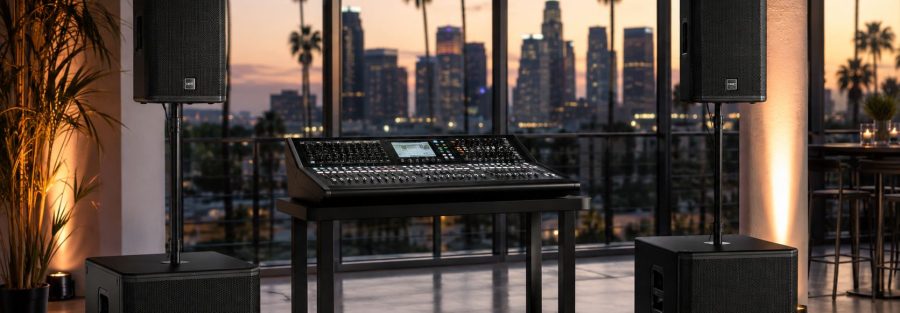
You've got the date locked, the room looks great on paper, and the last thing you want is to spend the first ten minutes of the reception waving at a mic that keeps feeding back. In Los Angeles, that's usually how audio problems show up, not as a total failure, but as a handful of small misses that make people lean in, talk over speeches, or stop dancing because the music never felt right in the room.
sound system rental Los Angeles is really a coverage decision. A good rental plan doesn't just bring speakers, it matches the room, the crowd, and the program so every table hears the toast, every panelist sounds clear, and the music has enough body to feel complete without drowning out conversation.
Why LA Events Live or Die by the Sound System
A downtown loft wedding and a Beverly Hills corporate panel can look equally polished from the planner's side. Then the doors open, the room fills up, and the wrong audio choice turns both events into the same problem, music that feels thin, speeches that disappear at the back, and a host who keeps asking for “just a little more volume.” That's the reality of audio in Los Angeles, the venue can be beautiful and still fight you on every reflective wall, ceiling height, or awkward room shape.
The market matters too. The U.S. audio and visual equipment rental industry is a mature but still growing sector, with 2,372 businesses operating nationwide and projected revenue of $10.6 billion in 2026, while IBISWorld projects a 2.5% CAGR from 2020 to 2025 (IBISWorld industry profile). For LA planners, that scale means you're not shopping in a tiny niche, you're dealing with a dense, competitive supply base where availability, labor, and logistics all shape the final quote.
Practical rule: if people need to speak, present, or listen closely, sound quality matters more than raw loudness.
What good sound delivers is simple. Voices stay intelligible, music feels full instead of harsh, and no one at the edge of the room gets punished with a blast while the center tables still can't hear the host. In a city full of weddings, fundraisers, brand launches, and hotel conferences, the win is a system that disappears into the background because it's doing its job.
That's why sound should sit at the planning table early. It isn't a finishing touch, it's part of the room design.
The Three Building Blocks of Any Rental PA
Think of a rental PA like a restaurant kitchen. The mains are the line cooks, they handle the main output people hear. The subs are the prep station that handles the heavy lifting below the surface. The monitors are the expo window, helping performers and speakers hear what's happening so they can stay on tempo, on pitch, and on message.

Mains carry the room
In rental language, you'll hear people call them tops, main speakers, or just mains. These are the boxes that project speech and music into the audience area, and for most LA events they do most of the visible work. A clean pair of powered tops can cover a small cocktail room beautifully if the room isn't fighting you.
Subs give the system weight
A dedicated subwoofer takes low-frequency energy away from the mains, which is why even speech-plus-music events feel more polished when there's a sub in the package. That engineering split matters because it reduces cone excursion and distortion in the mains, while giving the playback more body for entrances, first dances, and DJ sets. A useful reference point for measuring speaker behavior and planning coverage is the Isolate Audio measurement guide, especially if you're trying to sanity-check a quote or understand why one package feels bigger than another.
Monitors help the people on stage
Monitors, often called wedges, are there for performers, speakers, and sometimes a DJ. If the person on mic can't hear themselves, they'll push harder, which usually makes the room worse. That's why a clean rental quote should tell you whether monitors are included, where they'll sit, and who is mixing them.
If a quote lists speakers but skips the mixer, ask how the system is being controlled. That missing line item is where a lot of planning mistakes start.
For wireless mics and speaker coordination, the practical side of the setup is just as important as the boxes themselves, and a useful event-specific overview lives in this wireless microphone for events guide.
Sizing the System to Your Venue and Guest Count
A lot of planners still ask, “How many watts do I need?” That's the wrong first question. The better question is how sound has to cover the room, because a 200-person ballroom with low ceilings behaves very differently from a backyard reception or an outdoor stage with no walls to contain the energy.

Small rooms need controlled coverage
A 100-person backyard wedding usually doesn't need huge boxes. A pair of powered mains with a sub can be enough if the dance area is tight and the speakers are placed so they're not firing straight into glass, stucco, or a fence line. The goal is even coverage, not bragging rights.
Ballrooms and keynote rooms need balance
For a 200-guest hotel reception or a corporate ballroom, I'd rather see a clean two-main-plus-sub setup with the speakers positioned for the room than an oversized system turned down too low. Rooms with width often benefit from coverage patterns like 90° × 45° or 110° × 60°, because dispersion matters as much as output when you're trying to avoid hot spots and dead zones (Hollywood Sound rental speaker coverage options). Those wider patterns help speech stay intelligible across tables without making the front row miserable.
Bigger audiences need geometry, not guesswork
A 500-attendee keynote or a larger outdoor event usually needs more than “louder.” At that point, the question becomes how to throw sound farther while keeping it even. That's where higher-output mains, additional subs, or arrayable systems become practical, because the room or site footprint starts controlling the design.
For an outdoor-specific planning lens, this outdoor event sound system guide is worth keeping nearby when the event moves out of a controlled room.
Working rule: if people in the back are straining, don't just turn it up. Re-check speaker count, aim, and placement first.
For a comparative rental reference outside LA, some planners also look at Cape Town speakers for rent to see how other markets describe room-fit and package size, which is useful when you're comparing like-for-like configurations rather than raw power numbers.
LA Rental Pricing and What Actually Drives the Quote
A Los Angeles audio quote can look straightforward until the line items start showing up. Gear is only one part of the total. Delivery, setup, on-site labor, room tuning, and the time needed to manage the event all change the final number. Two proposals for what sounds like the same sound system can land far apart because the service scope is different.
| LA Sound System Rental Pricing Tiers at a Glance | ||
|---|---|---|
| Event Profile | Typical Gear | Price Band |
| Small meeting or intimate party | Small PA setup with basic mixer and mic support | $300–$500 |
| Mid-sized corporate event | Speakers, sub, mixer, mic package, crew support | $1,000–$3,000 |
| Large concert-style production | Line array or high-output system with support gear | $5,000–$15,000+ |
Those ranges match local market listings that place small PA rentals around $300–$500, mid-sized corporate setups at $1,000–$3,000, and large concert systems with line arrays at $5,000–$15,000+ (Unity Logics LA audio rentals). For a broader reading of package scope and line-item structure, the sound system rental prices guide is a useful reference when you want to compare quotes without getting tripped up by jargon.
What changes the number
A quote usually moves because of labor, logistics, and complexity. A ballroom load-in is easier than a rooftop. A backyard with limited access is harder than a conference room. A DJ with one mic is simpler than a panel with six wireless units and a live band. If a vendor does not ask about stairs, truck-to-room distance, or who is running mic handoffs, the quote is probably incomplete.
The room matters just as much as the gear list. Long cable runs, tight load-in paths, and last-minute layout changes all add time and risk, especially when audio has to cover both a main audience and a remote screen or breakout area. That is why a practical quote should reflect coverage and intelligibility, not just wattage.
What to ask before you sign
- What exactly is included: Ask whether the price covers stands, cables, mixer, subwoofer, delivery, and setup.
- Who is operating the system: Do not assume someone will be there just because the gear arrives.
- What happens if the room changes: Some events get a new layout at the last minute, and the audio plan needs to survive that.
- How much crew is assigned: A small crew can work for a simple event, but not for a live program with multiple speakers.
If the package is built around a hybrid meeting or a room with uneven seating, ask how the vendor handles front-row bleed, back-row clarity, and mic management. Those trade-offs affect the quote because they affect the labor and the gear mix.
Permits, Power, and Venue Rules in Los Angeles
LA events fail in boring ways. The sound system arrives, the venue says the outlet is on a shared circuit, the building has a hard cutoff for amplified sound, and suddenly the event team is improvising before guests even walk in. None of that is glamorous, but all of it is avoidable if you ask the right questions early.
Power is the first check. Outdoor events need a real plan for outlets, cable runs, and sometimes generator support, because speakers and mixers do not care that the view is perfect. Indoor venues can be just as tricky if audio shares a circuit with lighting, catering, or video gear, which is where hum and buzz tend to show up.
Practical rule: if the venue cannot show you the power path, ask for a walkthrough before event day.
Noise rules matter too. Some spaces have strict decibel limits or curfews, and public amplified sound can trigger permit issues depending on location and use. Venue contracts deserve a close read for rigging limits, speaker placement restrictions, and whether the hotel or convention center expects approved crew for load-in.
The contract details that get missed
- Load-in windows: If the venue gives you a short window, your setup has to be compact and pre-rigged.
- Rigging rules: Hanging gear changes everything, and some properties will not allow it without approval.
- Crew requirements: Bigger venues sometimes require approved labor, which affects both cost and timing.
- Placement restrictions: Speakers aimed at a wall, balcony, or glass surface can create reflections that hurt intelligibility.
For planners who want a broader risk lens beyond audio, the complete guide to event risks is a useful companion when you are checking crowd, security, and operational exposure alongside sound.
Renting Gear Versus Booking Full Production Support
A rented PA can work fine for a backyard gathering, a small panel, or a simple playlist setup where one person can stay on top of the room. The minute you add a keynote, a live band, a DJ set, or an auctioneer who has to be heard clearly in every corner, the bigger question is not the speaker model. It is who owns the sound once the doors open.

Gear only works when the event is simple
Renting just the equipment keeps the budget tighter and gives you more say over the layout, but it also puts the technical work on your team. Wireless mic coordination, gain staging, troubleshooting, and live level changes all land on whoever is managing the room. If a mic starts ringing during vows or a presenter walks too far from the coverage pattern, there is no built-in crew to catch it unless you arranged that separately.
That can be fine for a small, predictable setup. It becomes risky when the room has multiple speakers, moving parts, or guests who expect every word to land cleanly.
Full production is for higher-stakes rooms
A full production team handles setup, operation, and strike as one job, which matters once the event has live performance, video playback, or several speaking segments that cannot stumble. It also changes the failure point. Instead of handing the gear to a client or planner, you hand the room to people who already know where the weak spots are and can react before the audience notices.
For planners weighing the broader consequences of a technical miss, the complete guide to event risks is useful because audio failures usually sit inside a larger chain of operational problems, not by themselves.
The decision usually comes down to three questions
- How high are the stakes: If a failed mic would throw off the program, do not treat audio as a side task.
- How many moving parts are in the room: The more speakers, sources, transitions, and live cues, the more you want crew on site.
- Who is accountable at showtime: If nobody on your team wants to run the mixer and watch the room, the answer is already clear.
A practical way to compare the two approaches is to look at AV equipment for events alongside the labor that goes with it. The gear list is only half the quote. The other half is whether you are paying for boxes, or for someone who knows how to keep the sound intelligible when the room gets loud, echoey, or unpredictable.
Your Week-of-Event Sound Checklist
Seven days out is when audio problems are easiest to fix. By then, the room should be known, the run-of-show should be close to final, and the venue should be able to tell you where power lives, where guests will sit, and where the speakers are going.

The checklist below is the one I'd hand to a venue coordinator or planner when sound really matters.
- 7 Days Out, Confirm Venue Power Map: Make sure you know which outlets are available, which circuits are shared, and where cables can safely run.
- 7 Days Out, Walk Through the Audio Path: Talk through mic locations, speaker placement, and where the DJ, band, or presenter will stand.
- 3 Days Out, Lock the Run of Show: Confirm who speaks first, when music cues hit, and whether there are live transitions between segments.
- 3 Days Out, Schedule Sound Check Time: Don't leave this vague. Put a real window on the calendar.
- 1 Day Out, Charge Wireless Mics: Replace weak batteries and label spares so nobody is hunting through a bag five minutes before doors.
- 1 Day Out, Pack Essential Cables: Bring backups for the lines that fail most often.
- Event Day, Arrive Early for Setup: Give yourself time to test every source before guests hear it.
- Event Day, Perform Sound Check: Test speech, music, and transitions at actual event volume.
A few problems show up again and again. Feedback usually means a mic is too close to a speaker, so move the speaker or the mic before touching the volume. Hum often points to a shared power issue, so isolate the circuit or reroute the gear. If music is too loud for conversation, the fix is usually speaker placement or level control, not more volume.
For a visual reference on setup and coordination, this embedded walkthrough pairs well with the checklist above.
The cleanest sound check is the one that happens before the room is full.
If you want the audio plan to survive real-world load-in, print the layout, label the inputs, and keep one person responsible for the sound decision on event day.
How 1021 Events Handles Sound for Weddings, Corporate, and Charity Events
For planners who want audio built into the production plan instead of treated like a separate rental problem, 1021 Events folds professional sound systems into the rest of the room setup, along with Pro DJ/MC services, uplighting, videography, photo booths, cold sparks, and monogram Gobo projections. That approach matters in Los Angeles, where sound changes with the room, the guest flow, and whether people need to hear vows, a keynote, or an auctioneer clearly. A system that looks fine on paper can still fail if it is not matched to the space.
A 150-guest wedding in an LA hillside venue usually needs a tighter system, careful mic placement, and a crew that can handle ceremony-to-reception transitions without dead air. A 300-attendee corporate gala puts more weight on coverage consistency, clean speech intelligibility, and smooth handoffs between speakers. A charity fundraiser with an auctioneer and a live band needs coordination that keeps the room moving without fighting the program. The right rental choice depends on the event's complexity, and the dedicated wedding sound system rental page shows how that gets translated into a practical package.
In practice, the trade-off is usually between carrying enough system for the room and keeping the setup lean enough that it does not take over the venue. Too little coverage leaves dead zones at the back or under balconies. Too much speaker for a small room makes speech sharp and tiring, and it can make a wedding feel louder than it should. A crew that has worked hundreds of LA rooms knows when a compact PA is the right call and when the room needs more deliberate placement.
If you want one team handling the room, the music, and the production layers around it, use 1021 Events to ask for a sound plan that fits your guest count, venue, and run of show. The point is to treat audio as part of the event design, not an accessory that gets dropped in at the end.
If you are planning a wedding, corporate program, or fundraiser in Los Angeles, book the sound early and give the room a real audio plan. Reach out to 1021 Events for a setup built around your venue, your audience, and the way the event runs.