
You know, when most people hear "disco floor," they probably picture John Travolta in Saturday Night Fever on a floor of flashing squares. That was cool for the 70s, but today's lighting has come a long way.
We're talking about turning an ordinary floor into a living, breathing centerpiece for your event. Think of it less as just "lighting" and more like an interactive digital canvas that moves and breathes with the music, the energy, and the overall vibe of the room.
Beyond the Flash: The Evolution of Event Flooring
Let's ditch that old, static image of a disco club. Modern event flooring is all about creating an unforgettable experience. It's what separates a pretty good party from an event where the venue itself feels like part of the entertainment. The tech has jumped from simple blinking lights to sophisticated LED systems you can program to create wild patterns, spell out names, or even react when people step on them.
This shift has made the dance floor a key player in event design. It's not just a place to dance anymore; it’s an active participant. It can set a breathtakingly romantic mood for a wedding's first dance, splash a company logo across the floor for a corporate launch, or pulse with high-energy visuals that get everyone hyped at a private party. It adds a layer of polish and a "wow" factor that's hard to get any other way.
From Novelty to Necessity
Everyone wants their event to be the one people talk about, right? The demand for unique, Instagram-worthy moments is what's really driven the boom in advanced lighting. An interactive floor is a huge visual hook—guests can't resist taking photos and videos of it, which instantly gets your event shared all over social media.
The numbers don't lie. The market for just portable LED dance floors was already valued at around $306.8 million in 2023, and it's expected to more than double by 2033. You can read more about this explosive growth over on datahorizzonresearch.com. This tells you that planners and hosts are all-in on high-impact tech that’s flexible and easy to set up.
The best modern lighting setups don't just light up a room; they create an atmosphere. The floor becomes an extension of the music and the energy of the crowd, making everyone feel like they are part of the show.
A truly great setup doesn't just focus on the floor, either. It’s about building a complete, cohesive visual experience. The floor lighting should work hand-in-hand with other elements, like strategic uplighting that paints the walls with color and gives the whole room depth. By combining floor effects with this kind of ambient lighting, you create something truly immersive. If you want to dive deeper into how that works, check out our guide on what DJ uplighting is and how it can transform your event space. This kind of integrated strategy makes sure every visual piece, from the walls to the floor, is working together to create one stunning picture.
What Are The Different Kinds of Disco Floors?
Picking the right disco floor lighting is like being a film director choosing the perfect score—it sets the entire tone for the scene. This isn't a one-size-fits-all kind of decision. The tech you choose will literally shape how your guests feel, turning a plain room into an electrifying space.
Let's dive into the most common types of disco floors, minus all the confusing jargon. We’ll look at four main options to help you find the perfect match, whether you're going for retro vibes, a futuristic feel, or just timeless elegance.
Classic LED Light-Up Panels
When you hear "disco floor," this is probably what pops into your head. Classic LED light-up panels give you that iconic, glowing grid look straight out of Saturday Night Fever. Each tile is its own self-contained light, and they all connect to create one seamless, illuminated dance floor.
But don't mistake classic for old. Modern versions of these floors are incredibly flexible. A lighting technician can program them to do way more than just flash one color. Think mesmerizing checkerboards, pulsing waves of light, or solid colors that perfectly match your event’s theme.
- Best For: High-energy parties, retro-themed events, sweet sixteens, and any occasion that needs a fun, visually stunning centerpiece.
- Vibe Created: Energetic, nostalgic, and impossible to ignore. This floor practically dares your guests to get up and dance.
Interactive Pixel Floors
Ready to blow some minds? Interactive pixel floors are the super-smart cousins of classic LED panels. The easiest way to think of them is as giant, touch-sensitive screens laid out on the ground. These floors are kitted out with sensors that react to pressure, motion, and where people are standing.
This means the floor responds to your guests in real-time. Imagine ripples of light flowing out from every footstep or playing a giant game of Pong on the floor during a corporate cocktail hour. The possibilities are huge, turning the floor from just a surface into an active part of the entertainment.
An interactive floor completely changes the guest experience. It's no longer just a place to dance; it becomes a playground, an art installation, and a conversation starter all in one.
This type of disco floor lighting is a surefire way to create those "wow" moments people will be talking about long after the party wraps up.
This concept map breaks down how all the modern lighting elements can work together.
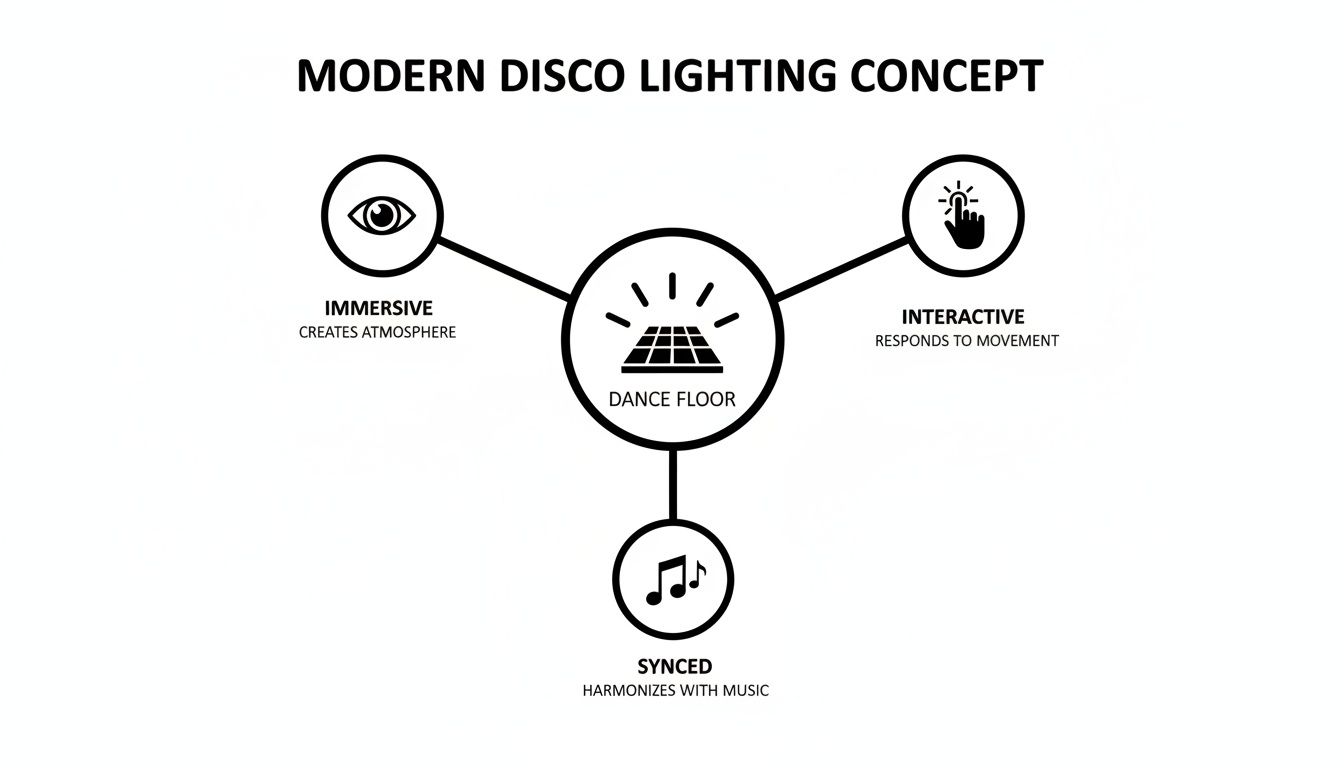
As you can see, the best lighting setups today are all about creating an experience that's immersive, interactive, and perfectly synced to the music and energy of the event.
Disco Floor Lighting Options at a Glance
Feeling a bit overwhelmed by the options? It's totally understandable. Here’s a quick comparison of the most common disco floor lighting types to help you choose the best fit for your event's vibe and budget.
| Lighting Type | Best For | Vibe Created | Complexity Level |
|---|---|---|---|
| LED Panels | Retro parties, high-energy events | Fun, Classic, Nostalgic | Medium |
| Pixel Floors | Tech events, brand activations, wow-factor parties | Futuristic, Interactive, Immersive | High |
| Mirror Ball | Weddings, elegant galas, first dances | Romantic, Magical, Timeless | Low to Medium |
| Wash & Moving Heads | Concerts, nightclubs, versatile venue spaces | Dynamic, Energetic, Modern | High |
This table should give you a starting point. Think about the feeling you want to create—is it a wild dance party or a sophisticated, magical moment? Your answer will point you toward the right gear.
The Timeless Mirror Ball Effect
Sometimes, the classics are classic for a reason. The mirror ball (or disco ball) might seem a bit old-school, but its effect is absolutely timeless, elegant, and just plain magical. It works by catching light and scattering dozens of tiny, moving beams all around the room, creating a dreamy, starlit atmosphere.
A mirror ball doesn't actually light up on its own. It partners with spotlights—usually called "pinspots"—that are aimed right at it. As the ball rotates, it sends these focused beams dancing across the floor, ceiling, and walls, bathing the whole space in a slow, romantic cascade of light.
This is a much more subtle and sophisticated vibe than a bright LED floor. It's perfect for those moments that need a touch of enchantment, like a first dance at a wedding. You can even combine it with other cool effects; for example, a custom monogram dance floor light can project your initials right into the middle of all those swirling dots.
Wash and Moving Head Lights
Our last category isn't a type of floor at all—it's a way to paint a regular wood or tile floor with light. This is a fantastic option when you want the dynamic feel of disco floor lighting but can't, or don't want to, bring in a physical floor.
- Wash Lights: These are stationary lights that "wash" the floor in a wide, soft field of color. They can shift hues smoothly to change the mood, taking the room from a cool blue to a warm amber in seconds.
- Moving Head Lights: These are the rock stars of the lighting world. They’re robotic lights that can pivot and spin, change colors, project patterns (called "gobos"), and shoot sharp beams that slice through the air and race across the floor.
When a skilled technician gets behind the controls, a mix of wash and moving head lights can create an unbelievable, concert-like atmosphere. They can sync to the music's beat, spotlight key moments, and make any old dance floor feel like the hottest club in town.
Getting Your Setup Right: Key Logistics
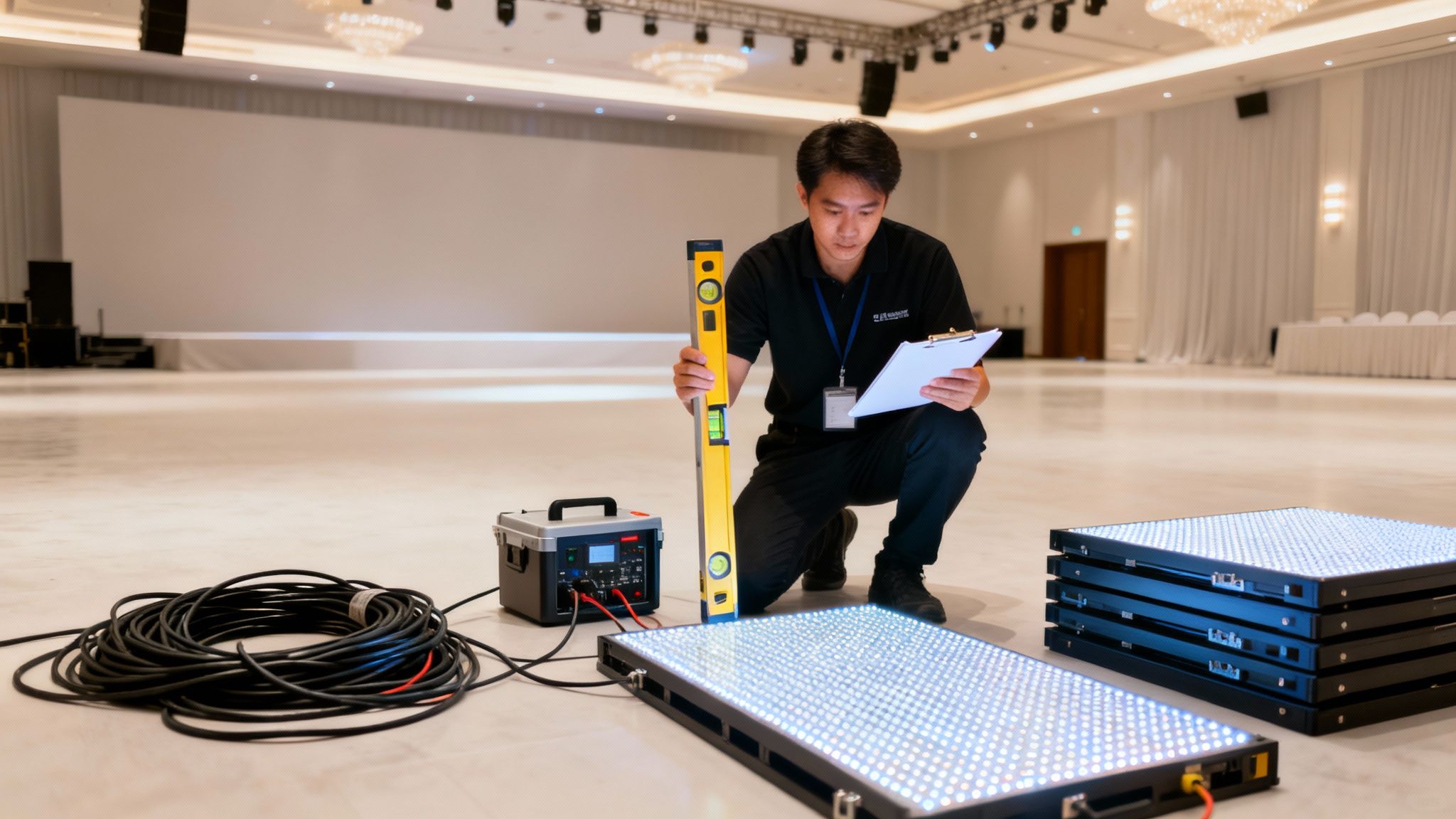
The difference between a jaw-dropping lighting display and a total logistical nightmare often boils down to asking the right questions weeks before the event. Nailing the logistics is your secret weapon for a stress-free setup, making sure your incredible disco floor lighting runs like a dream all night long.
Think of it as your pre-flight checklist. Before you sign any contracts, you need to play detective with both your venue and your lighting vendor. An amazing idea on paper can fall apart in a hurry if the practical stuff isn't sorted out first.
Power: The Lifeblood of Your Lights
The single most common hiccup with ambitious lighting setups? Power. An interactive LED dance floor is a seriously thirsty piece of equipment, and you can't just plug it into the nearest wall outlet and cross your fingers. That's a surefire recipe for a tripped breaker that kills the music and plunges your party into darkness right when it’s hitting its peak.
You absolutely have to find out what the venue can provide. A good move is to ask your lighting company for a "power spec sheet" and send it straight to the venue manager.
- How many dedicated circuits are needed? A typical floor might demand two separate 20-amp circuits all to itself.
- Where are the outlets located? Are they close to the dance floor, or will your team need to run long, safely-taped-down cables across the room?
- Is there a venue electrician on site? Having someone on hand who knows the building's electrical system like the back of their hand is priceless.
For some setups, especially in non-traditional venues, professional electrical help is a must. A qualified provider of residential lighting electrician services can ensure everything is wired safely and correctly.
The Foundation: It Has to Be Solid and Level
An LED dance floor is a pretty sophisticated system. Each panel has to lock together perfectly to create a seamless, stable surface that’s safe for everyone to get down on. That can only happen if the ground underneath it is completely level.
A slightly sloped or uneven floor can cause panels to pop up or sit improperly, creating nasty trip hazards. Before you commit, get your eyes on the venue's floor yourself. If you’re not sure, ask your lighting provider if they can do a quick site visit. They’ve got the experience to spot potential issues a mile away.
A great lighting company won’t just drop off the gear; they’ll check out the space to guarantee a safe and flawless installation. Their expertise in evaluating power, surfaces, and rigging is just as valuable as the lights themselves.
And if you're planning to use overhead effects like a classic mirror ball or moving head lights, professional rigging isn't just a good idea—it's a critical safety requirement.
Overhead Rigging: Safety First, Always
Anything you hang above your guests' heads has to be installed by a certified professional. Period. Venues are extremely strict about what can be attached to their ceilings and who is allowed to do it.
Here are the non-negotiable questions you need to ask:
- Does the venue have existing rigging points? These are certified anchor points built specifically to handle heavy loads.
- What’s the weight capacity of these points? Your lighting vendor needs this number to make sure their equipment is a safe match.
- Who is allowed to do the rigging? Most venues will insist on using their in-house team or a pre-approved, insured vendor.
Planning these details ensures every part of your lighting design is secure. To get the full picture of what’s possible, check out a complete range of event lighting rental options to match the right equipment to your venue's capabilities. Tackling these logistics early transforms potential day-of disasters into a smooth, seamless, and spectacular experience for everyone.
How Lighting and Music Create Event Magic
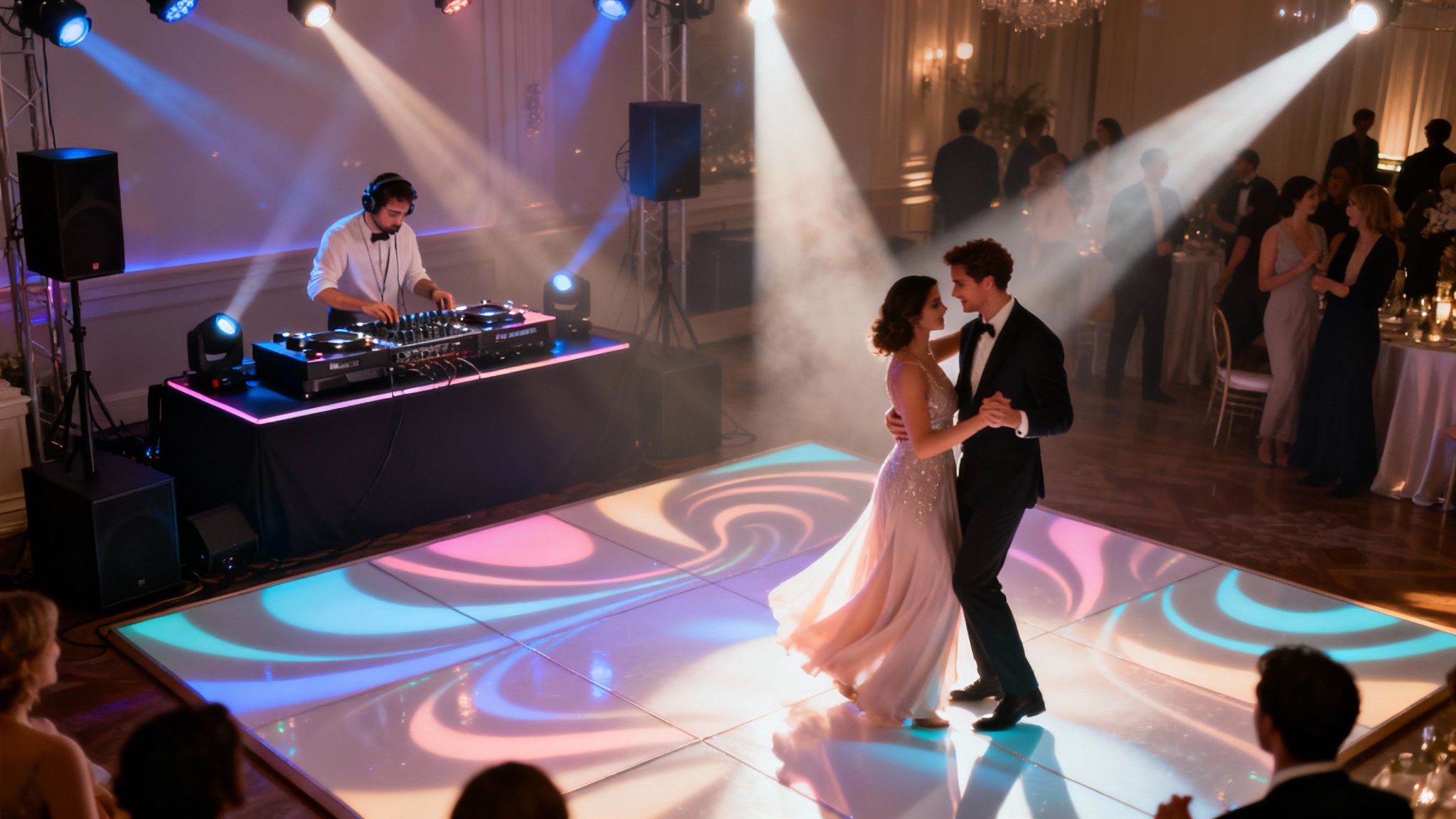
The best parties have a certain magic to them, don't they? It's that moment when the music and the lights feel completely connected, like they're one single, powerful force driving the energy of the room. That synergy doesn't just happen by chance—it’s the result of perfectly synchronizing the disco floor lighting with the DJ's set to create an experience that feels totally immersive.
You can almost think of the lighting technician as a "visual DJ." While the actual DJ is crafting the soundtrack for the night, the lighting pro is painting the room with light, matching every beat, drop, and mood shift. This is what takes a party from good to unforgettable.
The Brains Behind the Beat: Sound Activation and DMX
So, how do the lights "know" what the music is doing? It really comes down to two main methods, each with its own vibe.
The easiest way is through sound-activated mode. A lot of modern lights have a tiny microphone built right in. This little mic picks up the beat and makes the lights react automatically—flashing, changing colors, or moving in time with the music. It’s a fantastic plug-and-play option for smaller get-togethers where you just want some easy, high-energy fun.
But for a truly professional, custom-tailored show, you need DMX (Digital Multiplex). DMX is basically the language that lets a central controller, like a lighting board or a laptop, talk to every single light individually.
This is where the real artistry comes in. With DMX, a lighting tech can:
- Pinpoint a single spotlight on a couple for a dramatic entrance.
- Create slow, graceful color fades that drift across the floor during a ballad.
- Blast an intense strobe effect at the exact moment the bass drops.
DMX control is the difference between lights that just react to the music and lights that perform with it. It’s all about creating intentional moments and telling a visual story that complements the soundtrack.
The Pre-Event Huddle: Getting the DJ and Lighting Crew on the Same Page
The secret to a flawless show? Teamwork. The most important work happens well before anyone hits the dance floor, in a detailed planning session between the lighting team and the DJ or MC.
Think of this as the game-plan huddle. The DJ will share their setlist and point out the big moments—the peaks, the valleys, the emotional cues. The lighting designer then maps out visual cues to match that flow. A killer playlist is the foundation, and if you're looking for ideas, checking out the best party music playlist can get the creative juices flowing for everyone involved.
This coordination is what makes sure the lighting is always enhancing the moment, never distracting from it.
Painting Key Moments with Light
Once there's a solid plan, the lighting can turn specific parts of the night into core memories for your guests.
Picture this:
- The First Dance: The DJ puts on a slow, romantic classic. On cue, the lighting operator dims everything else, bathes the dance floor in a soft, warm amber glow, and turns on a slow-rotating mirror ball. Suddenly, the couple is dancing under a canopy of slow-moving stars.
- The Energy Peak: An hour later, the DJ drops a massive dance anthem. In a split second, the LED floor erupts in fast-paced, vibrant patterns, and moving head lights start slicing through the air, all perfectly timed to the thumping beat.
- The Grand Finale: As the last song of the night fades out, the lights build into one final, brilliant crescendo—a rapid-fire sequence of colors and movement—before snapping to a dramatic blackout right as the music stops.
When you have this level of detail, the disco floor lighting becomes more than just decoration. It becomes an active part of the story, guiding your guests' emotions and making every moment feel cinematic and special.
Deciding Whether to Hire or Buy Your Lighting
So, you're sold on the magic of a show-stopping disco floor. Awesome. Now for the million-dollar question—or at least the several-thousand-dollar question: should you hire a pro to handle it, or does it make more sense to buy your own gear?
This isn't just about the price tag. It's a bigger decision that really boils down to how often you'll use it, your technical comfort level, and whether you've got somewhere to stash it all. Getting this right from the start can save you a world of headaches and a boatload of cash.
For a one-off event like your wedding or a big corporate party, hiring is almost always the no-brainer. But if you're a venue owner, a busy mobile DJ, or someone who throws major events all the time, buying your own setup might be a surprisingly smart long-term move.
When Hiring Is Your Best Bet
For most people planning a single event, hiring a full-service lighting company is the way to go. It’s like renting a limo for prom night—you wouldn't buy the whole car just for one epic evening, right? You hire the car, the driver, and the peace of mind. The same logic applies here.
Hiring is the clear choice if:
- It's a one-time thing. Planning a wedding, a milestone birthday, or a single company gala? There’s just no financial sense in dropping thousands on equipment you’ll never touch again.
- You're not a tech wizard. Pro lighting isn't just plug-and-play. It involves power grids, complex DMX programming, and safely rigging heavy gear. A good rental company brings the equipment and the experts who make it all work flawlessly.
- You don't have a warehouse. An LED dance floor isn't something you can just slide under the bed. The panels are heavy, bulky, and need a ton of secure, dry space when they're not in use.
When you hire, you get access to the coolest, latest tech without the massive upfront investment or the ongoing headache of maintenance. If this sounds like your situation, checking out some trusted event production companies near me is a great way to find a reliable partner.
The real value of hiring is the peace of mind. You aren't just renting lights; you're buying expertise, reliability, and the freedom to actually enjoy your event instead of wrestling with a tangled mess of cables.
When Buying Makes Financial Sense
On the flip side, for some businesses, buying your own disco floor lighting can be a fantastic investment, especially with the growing demand for immersive, unforgettable experiences.
The global market for these interactive LED dance floors hit about $412 million in 2024 and is projected to explode to over $1.02 billion by 2033. That growth is being driven by forward-thinking venues—nightclubs, hotels, and convention centers—that are investing in their own high-impact lighting to keep guests coming back.
Buying your own setup is a solid move when:
- You're a venue owner or run events constantly. If you’re using the floor dozens of times a year, you’ll quickly start seeing a return on that initial investment.
- You’re a mobile DJ or event professional. Owning your own floor means you can offer it as a premium add-on service. Hello, new revenue stream!
- You have a dedicated crew and storage space. You'll need people who can be trained to set it up, run it, and fix it, plus a safe spot to keep it all.
And remember, a great event isn't just about the visuals. As you plan, don't forget to cover all your bases, including practicalities like security for event hire to ensure everything runs smoothly and safely.
Hiring vs. Buying Disco Floor Lighting
To make the choice even clearer, let's break it down side-by-side. Think about your specific needs as you look at this table—it'll help you see which column you fall into.
| Consideration | Hiring/Renting | Buying |
|---|---|---|
| Upfront Cost | Low. Pay per event. | High. Significant capital investment required. |
| Technical Expertise | Included. Experts handle setup, programming, and teardown. | Your responsibility. Requires trained staff. |
| Storage & Transport | None. The company handles all logistics. | Significant. Requires secure, dry storage and transport. |
| Maintenance | Not your problem. The provider maintains their own gear. | Your responsibility. Includes repairs and updates. |
| Equipment Quality | Access to the latest, high-end technology. | Limited to what you purchase; can become outdated. |
| Best For | One-off events (weddings, corporate galas, private parties). | Venues, mobile DJs, event companies with frequent use. |
Ultimately, hiring gives you flexibility and expertise without the long-term commitment, while buying is a strategic asset for businesses that can make it pay for itself over time.
A Quick Budget Snapshot
So, what does hiring actually cost? To give you a rough idea, here are some ballpark figures. Prices can swing quite a bit depending on your city, the size of the floor, and how fancy you want to get with the programming.
- Classic LED Light-Up Floor (15'x15'): You're likely looking at $800 – $2,000 for the event.
- Interactive Pixel Floor (15'x15'): This is a bigger investment, often starting between $2,500 – $5,000+ because of the advanced tech involved.
- Mirror Ball & Pinspots: A much more budget-friendly classic, usually running $200 – $500 as part of a larger lighting package.
The beauty of these rental prices is that they almost always include delivery, professional setup, and teardown. When you weigh that against the purchase price of a new floor—which can easily climb past $10,000—it becomes much easier to see which path makes sense for your event and your wallet.
Got Questions About Disco Floor Lighting? We've Got Answers.
Even with the best-laid plans, a few questions are bound to pop up as your event gets closer. That's completely normal. When you're bringing in high-impact tech like a professional disco floor, it pays to have every detail ironed out.
Think of this section as your personal FAQ cheat sheet. We're cutting through the jargon to give you straight-up, clear answers to the most common questions we hear from everyone—from wedding planners and couples to corporate event hosts. Let's tackle the practical stuff so you can lock in your decisions with total confidence.
What's the Real Cost to Rent an LED Dance Floor?
This is always the first question, and the honest answer is: it really depends. The final price tag for an LED dance floor rental is a mix of its size, the tech you choose (classic vs. interactive), and where your event is happening.
But let's talk numbers so you can start budgeting. For a standard 12×12 foot light-up LED panel floor, you can generally expect to land somewhere in the $500 to $1,500 range for a one-night event. That price point usually gets you that classic, vibrant grid that brings instant energy to a party.
Want to level up? If you're eyeing a more advanced interactive pixel floor—the kind that reacts to your guests' moves—the investment climbs. These floors often start around $2,500 to $5,000, and sometimes more, for a similar size. That extra cost covers the sophisticated sensors and custom programming that create those jaw-dropping moments.
Here's a pro tip: always ask what's included in the quote. A reputable company’s price should be all-inclusive, covering delivery, a full installation by trained techs, operation during the party if needed, and the complete takedown and removal afterward.
Always get an itemized quote. That way, you'll know for sure there won't be any surprise fees for things like travel, extra hours, or a tricky setup.
Can I Actually Use a Disco Floor Outdoors?
Yes, you absolutely can bring the magic of a light-up dance floor to an outdoor event! But there's a huge catch: the gear must be specifically designed and rated for outdoor use. You can't just drag an indoor floor outside and cross your fingers.
Outdoor-rated LED floors are built tough. They're weather-resistant, sealed up tight to protect all the sensitive electronics from moisture, humidity, and even a surprise rain shower. This isn't just a nice feature; it's a critical safety requirement.
Beyond the floor itself, a few other things need to be locked in for an outdoor setup:
- A Perfectly Flat Surface: You can't lay these panels on grass, sand, or a bumpy patio. Your lighting vendor will need a solid, level foundation, which often means installing a subfloor or stage platform first.
- Weatherproof Power: Every single electrical connection, from the generator to the floor, has to be protected from the elements. This prevents short circuits and keeps everyone safe.
- A "What If" Plan: What happens if the weather takes a turn? Talk to your venue and lighting provider about a backup plan, whether that's having a tent on standby or an indoor space ready to go.
Have a direct conversation with your rental company about your outdoor vision. They'll tell you if their gear is up to the task and walk you through the specifics for a safe and flawless installation.
How Much Power Does This Thing Actually Need?
This is the one detail everyone forgets but is absolutely crucial: power. An LED dance floor is a serious piece of equipment that draws a lot of electricity—way more than a standard wall outlet can handle.
A typical 16×16 foot LED floor might need one or, more likely, two dedicated 20-amp circuits. "Dedicated" is the key word here. It means nothing else can be plugged into those circuits. Not the DJ's speakers, not the caterer's warming trays, nothing. Trying to run it all off one power strip is a guaranteed way to trip a breaker and kill the party.
You absolutely have to communicate the floor's power specs to your venue manager or event electrician well before the big day. They need to confirm the building can handle the load.
Never just assume the venue has you covered. A quick phone call weeks in advance can save you a massive headache later. Your lighting company will give you a tech sheet—just forward that to the venue to get everyone on the same page.
Is an LED Dance Floor Safe for My Guests?
One hundred percent. When you work with a professional company using high-quality, commercial-grade gear, an LED dance floor is just as safe as any other dance floor you've ever been on. These things are engineered from the ground up with safety in mind.
First off, the surface itself is designed to be tough and non-slip. It's usually made from a durable, textured acrylic that can handle spilled drinks and wild dance moves without turning into an ice rink. The panels are also built to hold the weight of dozens of people dancing at once.
Plus, the lights themselves are completely safe. The floor uses low-voltage LEDs that generate virtually no heat, so the surface stays cool to the touch all night long. No need to worry about it being uncomfortable, even for guests who kick off their shoes.
The real key is professional installation. A trained crew makes sure every panel is locked together, every cable is taped down and out of the way, and the entire floor is perfectly level. When it's done right, your glowing dance floor is the safest and most exciting place to be.
At 1021 Events, we're all about turning good parties into unforgettable experiences with our professional DJ services, stunning uplighting, and high-energy dance floors. Let's work together to create the perfect vibe for your celebration.
Find out more about our event production services at 1021events.com
Considering disco-floor lighting for an event in Fort Atkinson, Southern Wisconsin, or Northern Illinois? 1021 Events can coordinate dynamic dance-floor lighting with professional DJ/MC entertainment, uplighting, custom monograms, and other enhancements. Explore our lighting and event services, then send an inquiry through EMP DJ to discuss your venue and date.