
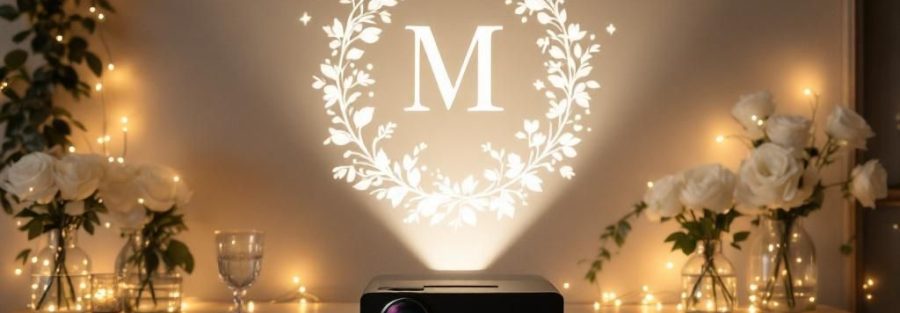
Picture this: You walk into your wedding reception, and there on the dance floor, shimmering in the light, is a beautiful monogram with your initials. That's the magic of gobo lighting. It’s like a high-tech, super elegant version of a slide projector, letting you splash custom designs anywhere you want—your names, your wedding date, or even a romantic pattern—across the dance floor, a wall, or the ceiling.
It's a surprisingly simple trick that adds a huge "wow" factor and makes the space feel completely yours.
What Exactly Is Wedding Gobo Lighting?
So, how does it work? At its heart, gobo lighting is pretty straightforward. You have a special, powerful light fixture (a gobo projector) that shines a beam through a small disc. This little disc is the "gobo," and it's basically a custom-made stencil.
The gobo blocks parts of the light, so only the shape you want—like your initials or a floral design—shines through. The result is a crisp, clear image projected onto any surface, instantly creating a stunning focal point.
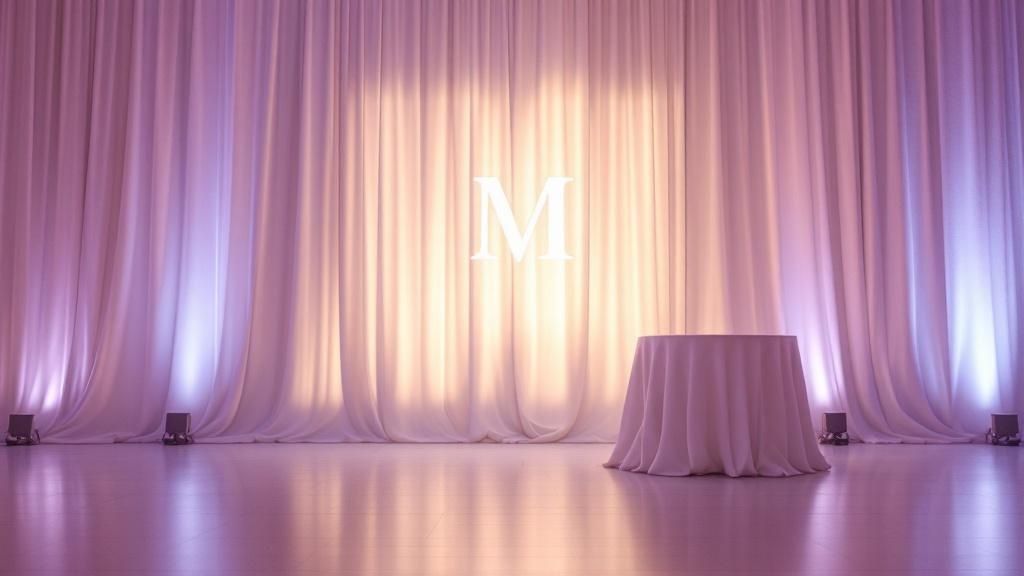
While the technology itself isn't brand new, using it for weddings has become a total game-changer for couples who want a unique vibe. Its simplicity is what makes it so brilliant. You can take a plain old dance floor or a boring wall and turn it into a custom piece of art that’s all about you and your story.
The Rise of Personalized Lighting
These days, everyone wants a wedding that feels personal, and that’s why gobo lighting has exploded in popularity. It's a big deal in the decorative lighting industry, which was already worth an incredible $41.6 billion in 2024. You've probably seen it all over social media—those gorgeous wedding photos with a glowing monogram on the dance floor are everywhere.
Of course, a gobo is just one piece of the puzzle. When you're planning your big day, it's good to know all your options. You can always check out other event lighting rental solutions to see how everything can work together to create the perfect atmosphere.
Key Takeaway: Think of a gobo as a custom stencil for light. It lets you project personal designs, making it one of the easiest and most effective ways to customize your wedding venue and leave a lasting impression on your guests.
What's great is that this one small detail delivers a massive visual impact without you having to completely redecorate the entire venue. It’s an elegant touch that creates that "wow" moment everyone will be talking about long after the music stops.
Choosing Between Metal and Glass Gobos
Alright, so you’re sold on getting a custom gobo for your wedding—fantastic choice! Now you’ve hit the first real decision point: should you go with a metal or a glass gobo? It sounds technical, but it’s actually pretty straightforward. Think of it like choosing between a classic black-and-white photo and a vibrant, full-color print. Both are amazing, but they create a completely different feel.
The right one for you really boils down to your design, your budget, and the "wow" factor you're aiming for.
Metal Gobos: The Classic & Crisp Choice
Metal gobos are the tried-and-true standard in the event world, and for good reason. They are essentially thin steel discs with your design precisely cut out of them. Light shines through the cutouts, projecting your pattern.
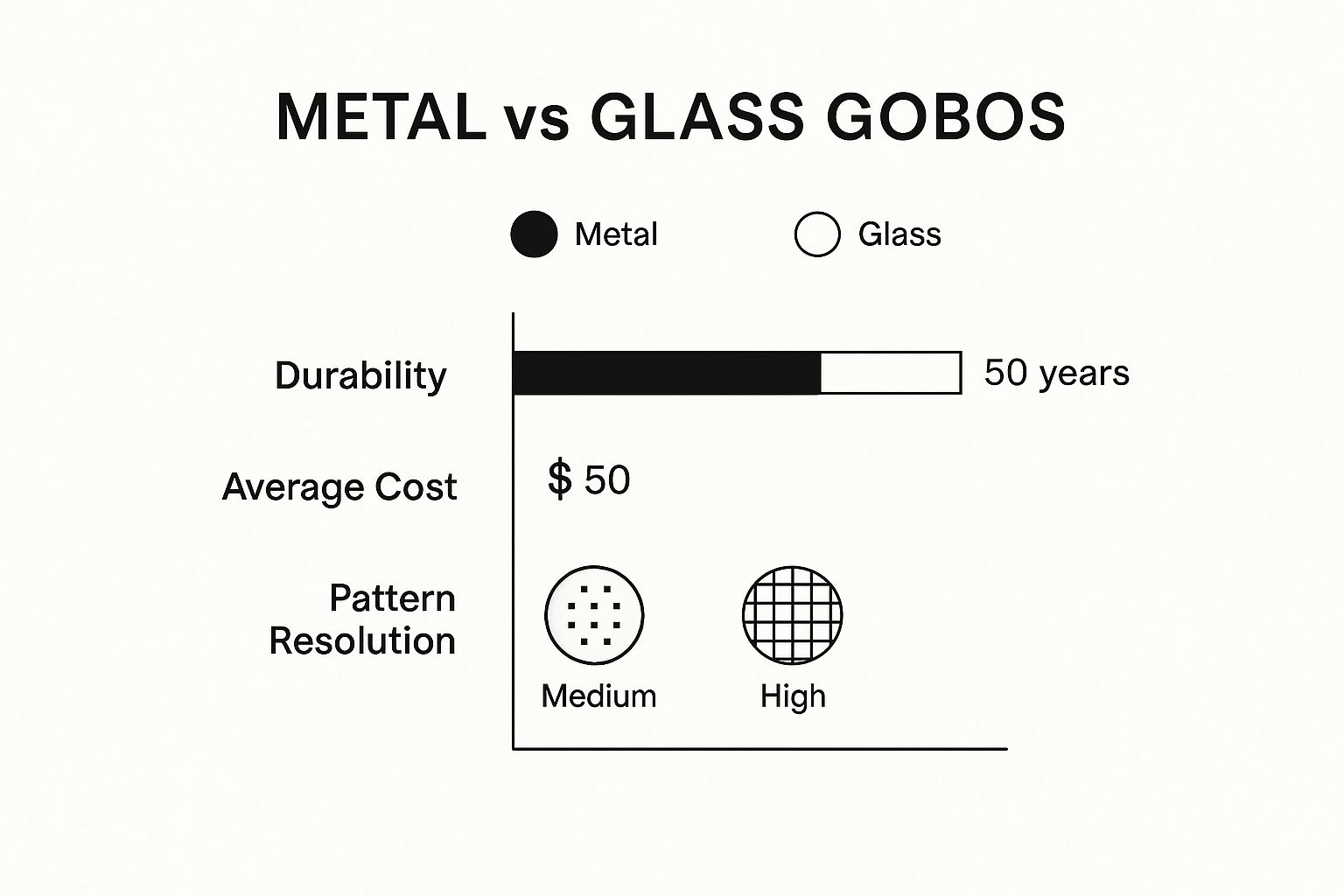
This makes them absolutely perfect for sharp, single-color designs. If you’re picturing a clean, elegant monogram of your initials and wedding date shining on the dance floor, a metal gobo is a fantastic—and budget-friendly—way to do it. They’re durable, reliable, and get the job done beautifully for bold text and simple patterns.
Glass Gobos: For High-Definition Detail
Now, if your design is a bit more ambitious, you'll want to look at glass gobos. These are the high-definition, premium players. Instead of being cut out, your design is laser-etched or printed onto a special piece of transparent glass.
This process allows for an incredible level of detail. Want to project your intricate, full-color family crest? Or maybe a delicate floral pattern that matches your invitations? If your design has gradients, overlapping elements, or multiple colors, a glass gobo is the only way to make it happen. You can even project photo-realistic images with them.
The quality and versatility of glass gobos haven't gone unnoticed. The market for them is booming, projected to hit around $150 million globally by 2025. This surge is all thanks to couples wanting that next-level image quality and the stunning multi-color effects that only glass can provide. It's a testament to how popular they've become in modern wedding design. You can dig into the findings of the glass gobo market to see the full trend.
Expert Tip: The easiest way to know which you need is to look at your design. If any part of your design is "floating" (like the center of the letter 'O') or has multiple colors, you’re in glass gobo territory. A simple, connected monogram is a perfect candidate for metal.
Metal Gobo vs. Glass Gobo at a Glance
Feeling a little stuck? No worries. This quick table breaks down the key differences to help you see which option aligns best with your wedding vision and budget.
| Feature | Metal Gobo | Glass Gobo |
|---|---|---|
| Best For | Simple monograms, text, bold patterns | Complex logos, photos, multi-color designs |
| Color | Single color (usually white) | Full color, gradients, and grayscale |
| Detail Level | Good for bold shapes, limited detail | Excellent, photo-realistic detail is possible |
| Cost | More budget-friendly | Premium, higher cost |
| Design Limits | No "floating" elements, less intricate | Virtually no design limitations |
At the end of the day, both types create a beautiful effect. The table just helps you match the tool to the task.
So, Which One Is Right For You?
Let’s boil it all down. Your decision rests on three things: how complex your design is, what your budget looks like, and the final vibe you want.
Here’s a simple cheat sheet for your conversation with a lighting pro:
- Choose Metal if: You want a classic, elegant monogram or a simple pattern in a single color. It’s a timeless look that’s also easy on the wallet.
- Choose Glass if: Your design has any color, fine details, shading, or is a photograph. It’s the only way to capture that level of complexity and bring a truly custom vision to life.
- Always Discuss Budget: Glass gobos do cost more than metal ones. Be upfront with your lighting vendor about your budget so they can help you find the perfect fit without any surprises.
No matter which path you take, a custom gobo is one of those special touches that guests always remember. By understanding the difference between metal and glass, you can pick the one that will best tell your story in light.
Inspiring Design Ideas for Your Gobo
Alright, this is where the real fun begins. A custom gobo is your shot to turn a simple beam of light into a personal statement, something that tells your story. Sure, a classic monogram is a go-to for a reason, but the possibilities are so much bigger than that. Let's look past the basics and dig into some creative ideas that will really make an impression.
Think of your gobo as more than just another piece of decor—it's a storytelling tool. What symbol, phrase, or image actually captures who you are as a couple? This is your chance to share it with everyone in a way they won't forget.
Timeless and Elegant Monograms
Let's start with the classic: the monogram. There’s a reason it’s so popular. Projecting your intertwined initials, new last name, or wedding date is just undeniably sophisticated. It’s clean, it’s personal, and it instantly makes the dance floor or a feature wall feel completely and totally yours.
You've got tons of styles to play with:
- Classic Script: A flowing, romantic font for your initials.
- Modern Block: A bold, clean look for a more contemporary vibe.
- Crest Style: A cool design that puts your initials inside a custom crest or emblem.
Honestly, you can't go wrong here. It’s a guaranteed way to add a touch of class and get that perfect shot during your first dance.
Patterns and Textures
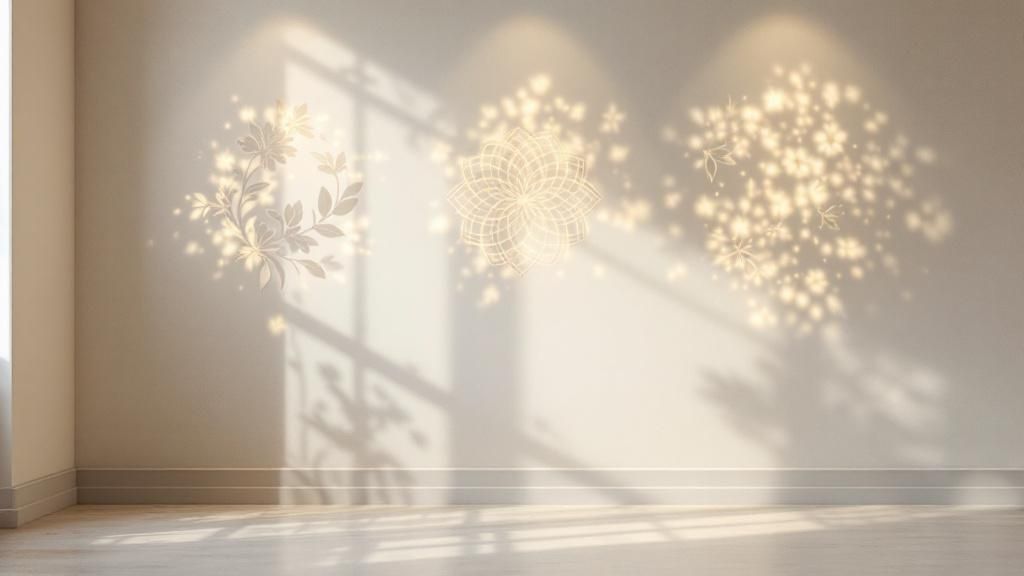
Who says a gobo has to be letters or a logo? Projecting a pattern or a texture across a wall or ceiling can completely transform the feel of your venue. This is such a cool way to tie your lighting design into the rest of your wedding theme.
A gobo can do more than just display your name; it can immerse your guests in an experience. By projecting a pattern, you can make a large, plain room feel intimate and thematic, turning a blank canvas into a work of art that surrounds your celebration.
Imagine projecting a subtle pattern that echoes the lace on a wedding dress, a cool geometric design from your invitations, or even a dreamy wash of stars across the ceiling. This approach is less about creating a single focal point and more about building a whole mood. Pair this with some uplighting, and the effect is just breathtaking. For more on that, check out our guide on wedding uplighting ideas that play perfectly with gobo projections.
Deeply Personal and Unique Ideas
Ready to get really creative? Your gobo can be a canvas for something that’s deeply personal and reflects your unique journey. This is how you make a gobo that is 100% you.
Here are a few ideas to get you started:
- A Meaningful Quote: A short line from a favorite poem, song, or even your vows.
- Custom Illustration: A simple line drawing of the two of you, your beloved pet, or a sketch of your venue.
- City Skyline: The silhouette of the city where you first met, got engaged, or are getting married.
- A Shared Hobby: Are you both hikers? Project a simple mountain range. Love to travel? What about a subtle world map?
The goal is to pick something that gets people talking and makes your friends say, "That is so them!" When you think outside the box like this, your gobo becomes more than just light—it becomes a memory.
Finding the Perfect Spot to Project Your Gobo
So, you've got this amazing gobo design ready to go. Now for the big question: where do you put it? A gorgeous design needs the perfect canvas to really pop. Deciding where to place your wedding gobo lighting is a huge part of the overall effect—it can totally change the vibe of your reception and create a jaw-dropping focal point.
Sure, the middle of the dance floor is a classic for a reason. It's front-and-center, especially during your first dance. But that's just the beginning. Thinking outside the box can create some seriously cool moments that your guests won't see coming.
High-Impact Placement Ideas
Take a good look at your venue's layout. What are its best features? Where do you naturally want people to look? A well-placed gobo does more than just look pretty; it directs the flow of the entire evening.
- The Head Table Wall: Placing your monogram or a pattern on the wall right behind the head table is a fantastic move. It creates a stunning, ever-present backdrop for you and your wedding party, and it looks incredible in photos during all the speeches and toasts.
- The Ceiling: This one is a showstopper. Projecting a pattern across the ceiling above the dance floor or dining tables creates an immersive, almost magical feeling. Imagine a "starry night" or a soft floral pattern washing over the room—it can turn a plain ceiling into a breathtaking canopy of light.
- The Building Exterior: Want to make an impression before anyone even steps inside? Project your gobo onto the venue’s facade. As guests arrive, they'll be greeted with this super personal and elegant touch that sets the tone right from the start.
Expert Tip: Think about the surface itself. A smooth, light-colored wall or a polished dance floor will give you the sharpest, brightest image. Darker or heavily textured surfaces, like brick walls or deep wood paneling, can soak up the light and make your design look a little muddy.
Evaluating Potential Gobo Locations
Once you've got a few spots in mind, it's time to get practical. The best location isn't just about what looks good; it's also about logistics and how the space will be used all night. You're aiming for maximum "wow" with minimum disruption.
Thinking through these little details is what makes your gobo a seamless highlight instead of a logistical headache. It’s all part of creating a cohesive design, something we dive into deeper in our guide to wedding reception lighting.
Factors to Discuss with Your Vendor
When you talk to your lighting pro, bring your ideas to the table. They’ll do a site visit to check out the space, figure out the technical side of things, and help you lock in the perfect spot. Here’s what they’ll be looking for:
- Foot Traffic: Is your projection going to be in a busy walkway? A dance floor gobo is meant to be part of the action, but a projection on a main thoroughfare could get blocked by guests all night.
- Ambient Light: How bright is the area already? A gobo placed right next to a big, bright window or directly under the venue’s house lights might look faded or washed out.
- Projection Angle: This is a big one. The lighting fixture needs a clear, straight shot to the surface. Your vendor will look for the best place to mount the projector so it's safely out of the way and doesn't have anything blocking its path.
At the end of the day, picking the perfect spot is a team effort between your vision and your vendor's know-how. By brainstorming creative placements and thinking through the practical stuff, you can make sure your custom gobo is the stunning centerpiece you dreamed it would be.
How to Design a Flawless Custom Gobo
Alright, you’ve got some amazing ideas swirling in your head. Now for the fun part: turning that vision into a real design that will look absolutely incredible projected on the wall or dance floor. Designing a gobo is part art, part science. Some designs look fantastic on paper but just don't translate well when they're turned into light. A few key tips will make sure your final projection is sharp, clear, and totally perfect.
Creating custom monograms and unique patterns is a massive part of the wedding gobo lighting world. It's a big deal! The global metal gobo market was valued at around $150 million back in 2022 and is on track to hit $230 million by 2027. That growth is all thanks to couples wanting those one-of-a-kind, personal touches at their events.
Font and Readability
When your gobo includes any text—your initials, the date, your names—readability is king. What looks beautiful on your computer screen can easily turn into a blurry mess from across a big reception hall. This is where bold, clean fonts become your secret weapon.
- Go Bold: Seriously, pick fonts with thicker lines. Super delicate, wispy scripts tend to get washed out or become impossible to read, especially if they’re projected onto a textured surface like brick or curtains.
- Keep it Simple: The best designs are often the simplest. High-contrast works wonders, meaning the lines of your design are clear and distinct.
- Think Big: The different parts of your design need to be large enough to be seen from the back of the room. Your lighting pro will be a huge help here, advising on the right size for your specific venue.
The Technical Stuff (Don't Worry, It's Easy)
Working closely with your lighting company is the best thing you can do, but knowing a little bit about the technical side will make everything go so much smoother. This is especially true if you’re trying to design the gobo yourself. Let’s talk about "bridging" and vector files.
What is Bridging? Think of a metal gobo like a classic stencil. If you have the letter 'O' or 'B,' the center part would just fall out, right? Bridging is the simple fix: it’s the process of adding tiny, almost invisible connecting lines to hold those "islands" in place. This ensures your letters project perfectly.
The Best File Type for the Job
When you're ready to send your masterpiece to the lighting company, they will almost certainly ask for a specific file format. Sending the right one is the key to getting that crisp, high-quality projection you're dreaming of.
- Vector Files (.ai, .eps, .svg): These are the gold standard, no question. Vector files aren't made of pixels; they're built with math. That means you can scale them up to the size of a building without them ever getting blurry.
- What to Avoid (.jpg, .png): A regular JPG or PNG might look okay on your screen, but it will almost always lead to a fuzzy or pixelated projection. These files just don't hold up when they’re enlarged.
At the end of the day, great communication with your lighting vendor is what brings it all together. Share your ideas, listen to their expert advice, and make sure you provide the right file types. Our guide on using a wedding monogram projector has even more tips to help you get ready.
Finding and Hiring the Right Lighting Pro
Let's be real: the secret to a jaw-dropping gobo projection isn't just the cool design. It's the pro behind the light. Hiring the right wedding lighting vendor is what makes the difference between a crisp, stunning monogram and a blurry, sad-looking blob on the wall. They handle all the techy stuff so you can just soak in the magic.
Your first step? Go deep into their portfolios. Don't just glance at the pretty pictures—really look at the clarity of their previous wedding gobo lighting projects. Are the initials sharp? Are the patterns crisp, even in photos from the back of the room? A solid portfolio is your best proof of their skill.
A weak or non-existent portfolio is a huge red flag. If they can't show you clear examples of what they do, it's time to walk away. You should also be cautious if they're cagey about pricing or hesitate to answer your nitty-gritty questions.
Essential Questions to Ask Potential Vendors
Once you've got a shortlist of vendors with impressive work, it's time for a little interview. This is where you figure out if they truly know their stuff and are the right fit for your wedding day. A real pro will be happy to answer everything you throw at them.
Here are a few questions you absolutely have to ask:
- Is the custom gobo design process included in your price? You need to know if design work is bundled in or if it's an extra charge that will pop up later.
- Do you perform a site visit to find the best placement? This is a great sign. It shows they’re dedicated to finding the perfect spot for the gobo to shine.
- What is your backup plan for technical issues? Stuff happens. A true professional always has a Plan B for equipment failure.
- How do you coordinate with other vendors, like the DJ? Lighting and sound are a power couple. For more on this, check out our guide on what to look for in a wedding sound system rental to see how beautifully these two can work together.
Key Takeaway: A great lighting pro does way more than just plug in a light. They’re a consultant who helps you pick the best placement, tweaks your design for incredible clarity, and handles all the technical headaches so you don't have to.
Hiring an expert is really an investment in your own peace of mind. They’ll manage everything from checking out the venue beforehand to breaking it all down at the end of the night, making sure your custom gobo looks absolutely perfect. This leaves you free to relax and focus on, you know, getting married
Got Questions About Wedding Gobos? We've Got Answers.
Okay, let's get down to the nitty-gritty. When you're planning a wedding, every detail matters, and it's totally normal to have a few questions about something as unique as gobo lighting. Getting the practical stuff sorted out early helps you plan your budget and your timeline without any last-minute stress.
Here are a couple of the most common things couples ask us about.
How Much Do They Cost and When Should I Book?
This is usually the first question on everyone's mind, and for good reason! The price can shift a bit depending on your lighting vendor and whether you choose a simpler metal gobo or a more detailed glass one. Generally, you can expect a full package—which usually covers the projector rental, the custom-made gobo disc, and the setup—to land somewhere between $250 and $600.
To give your designer enough time to create and test your custom gobo, it's a smart move to book your lighting pro about 3 to 6 months before your wedding day. If you're getting married during peak season, sooner is always better!
Can I Use a Gobo Outside? And Can I Keep It?
Absolutely! A gobo can look incredible outdoors. As long as you have a good surface to project onto (like the side of a tent or a building) and the projector is shielded from any potential rain, you're good to go.
One of my favorite questions is whether couples can keep the gobo disc after the wedding. The answer is a resounding YES! It’s such a cool and unique keepsake from your big day.
Think about it—you get to take home a little piece of the magic, a tangible memento of your wedding decor.
Ready to light up your celebration? 1021 Events is all about creating unforgettable vibes with custom gobo projections, amazing DJ services, and gorgeous uplighting. Let's work together to make your wedding absolutely glow. Find out more at 1021events.com.