

An event planning contract is much more than just a piece of paper; it’s the blueprint for a successful event and the foundation of your relationship with a client. This document spells out every single detail of your agreement—from the scope of work and payment terms to what happens if things go wrong.
Essentially, it's your professional playbook for every project, designed to prevent misunderstandings and protect your business from a world of financial and legal headaches.
Why a Solid Contract Is Your Secret Weapon

Before you jump into finding a template, let’s get one thing straight: a rock-solid contract is completely non-negotiable for any serious event planner. It's not just legal fluff. It's the bedrock of a professional relationship and your ultimate safety net when things inevitably go sideways.
Think about this all-too-common scenario: you pitch a killer proposal for a 100-person corporate gala, and the client loves it. Fast forward two months, and they're suddenly asking you to tack on a pre-event cocktail hour and wrangle five extra vendors—with no mention of bumping up the budget. That’s scope creep in its purest form. Without a contract clearly defining what you agreed to do, you’re stuck in a really tough spot.
Setting Clear Expectations From Day One
A great contract isn't about showing mistrust; it's about creating crystal-clear clarity. It takes all those casual phone calls and email chains and turns them into concrete, actionable commitments. Putting everything in writing right from the start means no one is left guessing, and you and your client are on the exact same page.
Here’s what a good contract really does for you:
- Defines Your Role: It spells out precisely what services you’re providing and, just as importantly, what you’re not providing.
- Manages the Money: It locks in the total cost, payment schedule, and any late fee policies. No more awkward conversations about money down the road.
- Protects Everyone Involved: It includes clauses for cancellations, postponements, and those "act of God" moments, giving both you and the client a clear path forward when the unexpected happens.
A contract is the ultimate communication tool. It forces you to have the important, sometimes difficult, conversations upfront, which builds a foundation of trust and respect with your client.
Let’s not forget that the global events industry is a beast. It was valued at around $1.135 trillion back in 2019 and was on track to hit $1.553 trillion by 2028. That explosive growth means more moving parts, more vendors, and more complexity—all of which demand a legally sound agreement to keep things running smoothly.
Your Professional Shield and Business Blueprint
Think of your contract as a badge of professionalism. It instantly shows clients that you're organized, thorough, and serious about what you do. It’s there to protect your time, your bottom line, and frankly, your sanity. When a last-minute demand pops up or a vendor drops the ball, your contract is the first thing you’ll reach for to find a solution.
To really get why this document is so critical, it helps to have a basic grasp of the legal side of things. If you want to dig a little deeper, I'd recommend reading up on understanding the fundamental principles of contract law.
And while you're fortifying your business with a great contract, don't forget the other keys to success. Check out our guide on 9 essential event planning tips for a flawless 2025 for more strategies to help you crush it.
Anatomy of a Bulletproof Event Contract
A solid event planning contract is so much more than a list of rules. Think of it as the roadmap for your entire project. It's where you break down every non-negotiable part of your agreement, spelling out not just what you’ll do, but why each part is there to protect both you and your client.
Let’s get beyond the generic boilerplate and really dig into the components that make an agreement truly bulletproof. When you understand these inside and out, you can walk clients through the terms with confidence, ensuring everyone is on the same page before any ink hits the paper.
Identifying the Parties and Event Basics
First things first, your contract has to be crystal clear about who is involved. This isn't just a formality—it's what establishes legal accountability. Get specific. You need full legal names, business names (if it’s a corporate gig), addresses, and the best contact info for both you (the planner) and your client.
Next, you have to nail down the core event details. There is zero room for ambiguity here.
- Event Name: Something official like "The Smith & Jones Wedding" or "Acme Corp Annual Summit 2025."
- Event Date(s) and Time(s): Don't forget to include start and end times, plus any pre- or post-event activities you’re on the hook for.
- Venue(s): List the full, official name and address of every single location involved.
This is the "who, what, where, and when" of your agreement. Getting this right from the jump prevents a world of headaches later on.
The Scope of Services: Your Ultimate Defense Against Scope Creep
Pay attention, because this is probably the most important part of your entire contract. If your service descriptions are vague, you're essentially sending a written invitation for scope creep—all those little "can you just…" requests that quietly turn into hours of unpaid work.
The goal here is to be relentlessly specific.
Instead of a generic line item like "Vendor Management," you need to break it down. For example:
- Research and present three (3) pre-vetted options for each vendor category (catering, floral, etc.).
- Schedule and attend up to two (2) meetings per selected vendor.
- Review all vendor contracts before the client signs.
- Create and manage a master vendor contact sheet and timeline.
This level of detail makes it painfully obvious when a new request is outside the original agreement. That gives you a solid, contractual foundation to either say "no" or, more likely, issue a change order for the additional work. Mastering this is key, especially when you learn how to plan corporate events like a pro, since business clients often have needs that evolve mid-project.
Here's a pro tip: Explicitly state what is not included. A simple line like, "This package does not include managing travel arrangements for guests," creates a powerful boundary that protects your time and your bottom line.
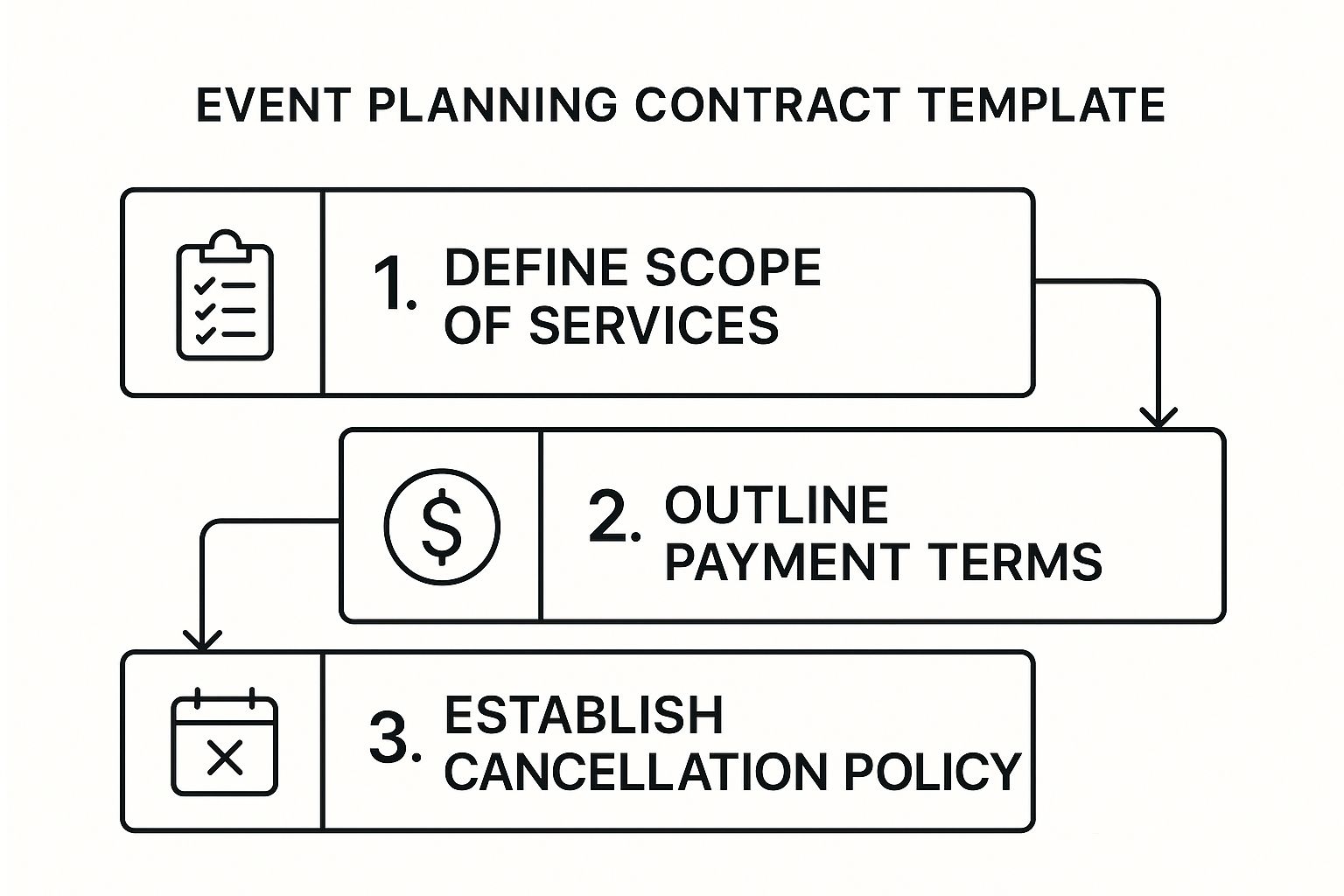
Payment Schedule and Fees
Nothing will sink your business faster than a messy payment structure. Your contract must detail every dollar with absolute precision. Don't just list the total price; map out the entire financial journey from start to finish.
- Total Fee: The full, all-in cost of your services.
- Retainer/Deposit: Clearly state the non-refundable amount needed to book your services and lock in the date. 50% is a common industry standard.
- Payment Milestones: Break down the rest of the balance into easy-to-follow installments with firm due dates. (e.g., "25% due 90 days before the event date").
- Final Payment: State the absolute deadline for the final balance, usually about 14-30 days before the event.
- Late Fees: You have to include a clause outlining the penalty for missed payments, like a percentage of the overdue amount or a flat fee.
This structure ensures you have the cash flow to book vendors and cover expenses without having to finance your client's event out of your own pocket.
Cancellation and Postponement Policies
Life happens. We all know it. Events get canceled or postponed for reasons that are completely out of anyone's control. Your contract needs a policy that’s fair to the client but also firm enough to protect all the work you’ve already poured into their event.
You have to clearly define the terms for cancellation, whether it's initiated by you or them. A good, standard approach is to link the amount owed to how close the cancellation is to the event date.
Here's a common example:
- Cancellation by Client >90 days out: Client forfeits the non-refundable retainer.
- Cancellation by Client 30-90 days out: Client forfeits the retainer and is also responsible for 75% of the total fee.
- Cancellation by Client <30 days out: Client is responsible for 100% of the total fee.
This tiered system ensures you're compensated fairly for your time, any costs you've incurred, and the other potential business you turned away to hold their date. You should also include a clause for postponement that outlines any rescheduling fees and explains how payments will be applied to a new date.
Now, let's tie these crucial elements together. The table below breaks down the must-have clauses for any event planning contract. Think of this as your cheat sheet for building an agreement that truly protects your business.
Key Clauses for Your Event Contract Template
| Clause Name | Purpose | Key Details to Include |
|---|---|---|
| Parties & Event Details | To legally identify who is in the agreement and what the event is. | Full legal names, business names, addresses, contact info, event name, date(s), time(s), and venue(s). |
| Scope of Services | To define exactly what you will and will not do. This is your defense against scope creep. | A detailed, itemized list of all services. Also, specify services that are explicitly not included. |
| Payment Terms | To ensure you get paid on time and maintain healthy cash flow. | Total fee, non-refundable retainer amount, payment milestone dates and amounts, final payment deadline, and late fee policy. |
| Cancellation Policy | To protect your invested time and lost income if the client cancels. | A tiered refund/payment schedule based on when the cancellation occurs (e.g., 90/60/30 days out). |
| Postponement Policy | To outline the process and any fees associated with moving the event date. | Conditions for rescheduling, any applicable fees, and time limits for choosing a new date. |
| Termination Clause | To define how either party can legally end the contract for non-performance. | Conditions for termination (e.g., breach of contract, non-payment) and the required written notice period. |
| Indemnification | To protect you from legal liability for things outside your control (e.g., vendor no-show). | Language stating the client will hold you harmless from third-party claims arising from the event. |
| Force Majeure | To excuse non-performance due to unforeseeable "acts of God." | A list of qualifying events (hurricanes, pandemics, etc.) and what happens to payments/services in such a case. |
Having these eight pillars in place is non-negotiable. They form the backbone of a professional contract that lets you focus on what you do best: creating amazing events.
Customizing Your Contract for Any Event
A solid event planning template is a lifesaver, but it's just the starting point. One of the biggest mistakes I see planners make is treating their contract like a one-size-fits-all document. The reality is, the meticulous details for a wedding are worlds away from the high-stakes logistics of a corporate summit. Your contract has to reflect that.
When you hand a client a generic agreement, it quietly suggests you haven't really dug into their specific needs. A customized contract, on the other hand, shows you're more than a planner—you're a strategic partner who gets it. Let's get into the nitty-gritty of how to adapt your base template for different gigs.
Tailoring for Weddings and Private Parties
Weddings are personal, emotional, and often come with a lot of… family opinions. This means your contract needs to be both firm and understanding. You'll want to add some specific clauses that manage the unique dynamics of private celebrations.
Scope creep is a huge risk, often fueled by well-meaning family members. To get ahead of this, your contract must identify a sole point of contact. This one clause can save you from being pulled in a dozen different directions. Make it crystal clear that all final decisions and approvals come from the designated client(s), period.
Vendor management is another big one. Your contract should spell out exactly how you handle these relationships.
- Vendor Communication: State that you are the primary go-between. This prevents vendors from getting mixed signals from the client, the mother-of-the-bride, and everyone else.
- Final Approvals: Clarify that you'll recommend vendors, but the client is the one who signs on the dotted line and hires them.
- Day-Of Coordination: Detail your role in managing vendor arrivals, setup, and breakdown. Setting these expectations upfront is key.
Adjusting for Corporate Events
Corporate events are a completely different animal. They're driven by ROI, brand image, and tight deadlines. Your contract needs to speak that language—less emotion, more professional accountability.
Confidentiality is almost always a top concern. I always include a Non-Disclosure Agreement (NDA) clause, especially when dealing with sensitive company info, unannounced product launches, or private attendee lists. It’s a simple addition that protects your client and shows you’re a pro.
Another must-have is a clause on brand usage and guidelines. The contract should state that the client will provide all official brand assets and that you’ll follow their guidelines to the letter on everything from email invites to event signage.
For corporate clients, it's a power move to connect your services directly to their business goals. I often add a section outlining how my team will help them hit their KPIs, whether that's maximizing attendee engagement or capturing a certain number of qualified leads.
Thinking outside the box can also help you land these clients. If you need some fresh inspiration, check out these unique corporate event ideas for 2025 to propose concepts that can be backed by a rock-solid contract.
New Frontiers: Hybrid and Virtual Events
The boom in hybrid events adds a layer of tech complexity that your standard contract probably doesn't cover. This is new territory for a lot of us, and being incredibly specific in your contract is the only way to avoid expensive mistakes.
Your hybrid event clauses need to address a few key areas:
- Tech Platform Management: What are you actually responsible for? Define if you're sourcing the platform, managing the live stream, or just coordinating with the client's in-house tech team.
- Digital Content Ownership: Who owns the session recordings after the event ends? Your contract needs to clearly state the intellectual property rights for all digital content created.
- Attendee Data Privacy: You have to outline how attendee data will be collected, stored, and used. This is crucial for staying compliant with privacy laws like GDPR or CCPA.
By taking the time to customize your contract, you transform from just another service provider into an indispensable expert. It's a proactive step that builds incredible trust and, most importantly, protects your business for whatever event comes next.
Handling the Hard Stuff Before It Happens
Let's be honest, thinking about everything that could go wrong is nobody's favorite part of the job. But this is precisely where the pros separate themselves from the amateurs. The clauses you draft here are your safety net, your insurance policy against chaos. They’re what let you sleep at night, knowing you’ve protected your business and set clear expectations.
This isn't about being pessimistic; it's about being a prepared, professional planner. You're simply getting ahead of potential problems to protect both yourself and your client from the stress and confusion of an unexpected crisis.
The Modern Force Majeure Clause
Not too long ago, "Force Majeure" felt like some dusty legal term for things you’d only see in a disaster movie, like a freak hurricane or an earthquake. But after 2020, every single planner I know understands this clause on a gut level. A generic "acts of God" line just won't cut it anymore. You have to get specific.
Your Force Majeure clause today needs to explicitly list a much wider range of potential show-stoppers. Go beyond the weather and think about real-world scenarios:
- Pandemics and public health emergencies
- Government-mandated shutdowns or travel restrictions
- Widespread civil unrest or protests
- Sudden venue unavailability (think fire, flood, or even a burst pipe)
The clause can't just stop there, though. It has to spell out exactly what happens next. Does the event get postponed? Are deposits rolled over to a new date within a certain timeframe? Or is the contract terminated, and if so, how are those non-refundable vendor payments handled? Laying it all out prevents panic and finger-pointing when a crisis actually hits.
Decoding Liability and Indemnification
I know these two words can sound a little intimidating, but their job is actually pretty simple: they draw a firm line in the sand around what you are—and are not—responsible for. Think of them as your professional boundaries, just written down in ink.
Liability is all about limiting your financial exposure for things you can't possibly control. For instance, if a wedding guest slips and falls on a wet floor that the venue's staff just mopped, your liability clause should shield you from being held financially responsible for that injury.
Indemnification is your backup. It essentially means your client agrees to cover your legal fees if you get sued because of something they or their guests did. It ensures you're not left holding the bag for someone else's mistake.
These clauses aren’t about dodging responsibility for your own work. They are about making it crystal clear that you aren’t liable for the actions of third-party vendors, the venue, or the guests themselves. That distinction is crucial.
And just as a solid contract gets you ready for anything, having a comprehensive crisis communication plan template is a lifesaver for managing those unexpected bumps in the road.
Navigating Termination and Cancellation
While a Force Majeure clause handles the truly uncontrollable stuff, a Termination clause deals with situations where someone wants out for other reasons. This section needs to be brutally clear about the consequences.
Your termination clause should break down two key scenarios:
- Termination for Cause: This is for when one party doesn't hold up their end of the bargain (for example, the client misses a major payment). The clause should outline the steps, like sending a written notice and giving them a short window to fix the problem before the contract is officially off.
- Termination without Cause: This gives the client an out if they simply change their mind. Your contract must detail the financial repercussions, which should absolutely scale up as the event gets closer. This compensates you for the work you've already done and the other business you've turned away.
This is more important than ever. Recent studies show that nearly 30% of planners are struggling with rising vendor costs, and 23.2% are dealing with shrinking client budgets. That kind of financial pressure means your cancellation and refund policies have to be ironclad.
Having clear policies is a sign of a well-run business, a principle we dive into in our guide on how to plan a corporate event. By tackling these tough subjects directly in your contract, you're not just covering your bases—you're showing clients that you're an experienced professional who has thought of everything.
Your Downloadable Event Planner Contract

Alright, let's get down to business. We’ve walked through all the must-have clauses and smart ways to tailor your agreements. Now it's time to give you a head start with a solid foundation.
I’ve put together a comprehensive event planning contract template based on years of experience. This isn't some generic, flimsy document. It’s a robust starting point, complete with annotations to explain what each section does and why it’s there. The goal here is to save you time and a hefty legal bill.
How to Make This Template Your Own
Think of this template as high-quality clay, not a finished sculpture. It’s meant to be molded to fit your business and the unique needs of each client. Just download the document and start filling in the highlighted fields. It's that simple.
You’ll see obvious prompts for plugging in the basics:
- Client & Planner Details: Full legal names, business info, addresses, and contact details.
- Event Specifics: The official event name, date, time, and venue.
- Your Unique Service Packages: A spot to drop in an itemized list of your specific deliverables.
Spend some real time on the "Scope of Services" section. This is where you put everything we talked about into practice. Get granular. The more detail you include here, the fewer headaches you'll have later.
My Two Cents: Before you ever hit 'send' on a contract, read it one last time and ask yourself, "Is there any way this could be misunderstood?" If the answer is even a hesitant "maybe," you need to tighten up the language until it's ironclad.
A Must-Have Tool in a Growing Field
Having a rock-solid contract is non-negotiable these days. The event industry is booming. The US Bureau of Labor Statistics clocked in around 149,000 event planners and expects a 7% jump in jobs between 2023 and 2033. You can see the full event planning industry growth outlook for yourself.
As more people jump into the field, a professional, thorough contract is what separates the pros from the amateurs. It immediately signals your expertise and shows clients you mean business. This growth also means you'll be juggling more complex events, making a precise agreement absolutely critical.
Tailoring it to Your Niche
Remember, the best contracts are never one-size-fits-all. They reflect the specific kind of work you do. While this template gives you the universal essentials, you'll want to add clauses that speak directly to your specialty.
For instance, if you’re the go-to planner for charity galas, you’ll probably need to add language about managing silent auctions or handling donor privacy. Our guide on the planning a charity event checklist is a great resource for spotting those unique needs.
Think about adding sections to cover things like:
- Specialized Vendors: If you’re coordinating with pyrotechnics teams or live animal handlers, you’d better have clauses addressing their specific risks.
- Intellectual Property: For corporate gigs, you need to be crystal clear about who owns the event branding, content, and any recordings.
- Guest Management: If handling RSVPs and guest lists is part of your package, define exactly where your responsibility begins and ends.
By personalizing this template, you're not just creating a legal safety net. You're building a clear roadmap for a successful partnership with your client. It’s the first step in establishing trust and transparency, which is exactly how you want to kick off any project.
[DOWNLOAD YOUR EVENT PLANNING CONTRACT TEMPLATE HERE – .DOCX]
[DOWNLOAD YOUR EVENT PLANNING CONTRACT TEMPLATE HERE – PDF]
(Disclaimer: This template is for informational purposes only and isn't a substitute for real legal advice. I strongly recommend having a qualified attorney review your final contract to make sure it complies with all local, state, and federal laws and is fully customized for your business.)
Got Questions About Your Event Contract? We've Got Answers.
Even with a rock-solid template in hand, you’re bound to run into questions. It happens to everyone. Let's walk through a few of the most common contract curveballs event planners face.
Getting comfortable with these scenarios will give you the confidence to handle the legal side of your business like the pro you are.
Do I Really Need a Lawyer to Look at This?
I get this question all the time, and my honest answer is always the same: yes, it’s a really, really good idea. A great template is a fantastic head start—it can save you a bundle on legal fees—but it's not a substitute for advice from a real-life attorney.
Think about it: every event business is different, and local laws can change dramatically from one state, or even one city, to the next.
A lawyer brings a few crucial things to the table:
- Keeps You Compliant: They’ll know the specific business laws in your area and make sure your contract is up to snuff.
- Tailors It to Your Niche: Planning high-risk events like festivals or complex multi-day corporate summits? A lawyer can add clauses to protect you from the unique liabilities that come with that territory.
- Helps You Sleep at Night: Seriously. Knowing an expert has vetted your most important business document frees you up to focus on what you do best—creating amazing events.
Consider a legal review an investment in your business's health. It’s a small price to pay to dodge a much bigger, more expensive headache later on.
What's the Best Way to Get My Contract Signed Digitally?
Forget the old print-scan-email routine. Digital signatures are the standard now—they're quick, secure, and legally binding. The best way to do this is with a dedicated e-signature platform.
Tools like DocuSign, PandaDoc, or HelloSign are designed for exactly this. They create a secure, verifiable paper trail that shows who signed, when they signed, and from where. That's way more professional (and defensible in court) than just pasting a picture of your signature into a document.
The whole process is incredibly simple. You just upload your final contract, drag and drop the signature and initial fields where they need to go, and shoot it over to your client's email. The platform does the rest, alerting you the second it’s signed and giving both of you a finalized, legally recognized copy.
A Client Wants to Negotiate Terms… Now What?
First off, take a deep breath. This is completely normal. A client wanting to discuss a term in the contract doesn't mean they're going to be difficult. It usually just means they're reading it carefully and taking the commitment seriously—which is a good thing!
Here's how I handle it:
- Just Listen. Start by asking them to walk you through their concerns. What part of the clause is making them uneasy? Getting to the "why" behind their request is the first step to finding a solution that works for everyone.
- Know Your Deal-Breakers. Before you ever send a contract, you need to know which terms are your non-negotiables. Things like your payment schedule, liability limits, and cancellation policy are there to protect your business. Be clear on where you can bend and where you have to stand firm.
- Explain Your Reasoning. Often, a client just needs some context. Calmly explain why a particular clause exists. For instance, you can explain that your cancellation policy is in place because you have to pay non-refundable deposits to vendors or have already turned away other potential clients for their date.
- Look for a Creative Solution. If a client pushes back on your 50% retainer, don't just cave. See if you can find another way. Maybe you could do a 30% payment upon signing and another 20% payment in 30 days. This shows flexibility without putting your own cash flow at risk.
And one last thing: always, always get any changes in writing. Update the contract, have both you and the client initial right next to the change, and then re-sign the final document. This makes sure there’s no confusion down the line and keeps your agreement airtight. Handling negotiations with grace actually builds trust and can set a fantastic tone for the whole project.
Ready to turn these insights into unforgettable events? The team at 1021 Events combines creativity, professionalism, and state-of-the-art technology to transform your vision into a seamless and memorable occasion. From Pro DJ services and stunning uplighting to innovative cold sparks and custom photo backdrops, we handle the details so you can enjoy the moment. Let us help you create an extraordinary experience.
Explore our services at https://www.1021events.com.