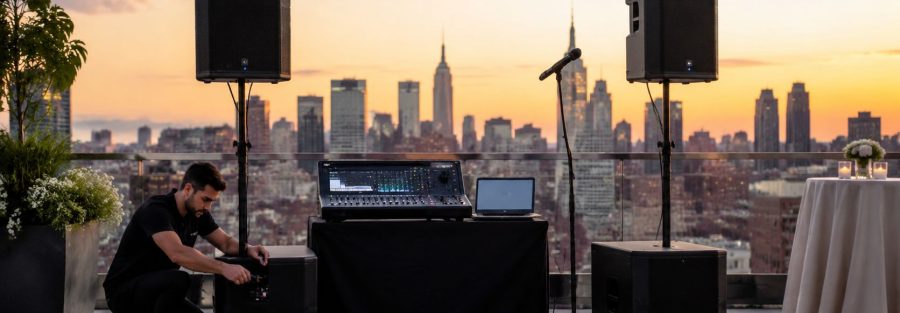
You've probably handled the visible parts of your event first. Venue. Catering. Run of show. Decor. Then audio lands on the list late, usually as “rent a couple speakers.”
That's where a lot of New York events go sideways.
In NYC, bad sound doesn't just mean a weak playlist. It means the vows get swallowed by room echo, the CEO's keynote sounds thin and harsh, or the DJ can't get clean input because nobody asked the right questions before load-in. And in this city, the technical problem often isn't even the speaker. It's the freight elevator, the curbside window, the union rule, the walk-up, or the fact that the room looked great in photos but behaves terribly once people start talking.
Great Sound Doesnt Happen By Accident
A planner books a beautiful Manhattan loft. The room has high ceilings, exposed brick, and a wall of windows. It photographs perfectly. On paper, the audio looks simple: a mic for speeches, background music during dinner, then a dance set. Somebody says, “We just need a speaker and a microphone.”
Then guests arrive.
The room is louder than expected. Glass reflects everything. Staff noise from the bar competes with speeches. The DJ wants a feed. The officiant wants a wireless mic. The client has a video to play from a laptop. Suddenly that “simple” setup isn't simple at all.
That's the reality behind sound system rental in NYC. You're not renting boxes. You're managing coverage, clarity, input count, access, setup time, and the guest experience all at once.
The reason rental matters is bigger than one event. The global AV equipment rental market was valued at USD 14.3 billion in 2025 and is projected to reach USD 25.0 billion by 2035, reflecting a 5.8% CAGR, according to Wise Guy Reports' AV equipment rental market outlook. That growth tracks with what event producers already know. Clients would rather rent the right specialized gear than buy equipment they won't know how to deploy properly.
If you're planning a wedding, gala, private party, or corporate function, audio needs to be treated as production, not as an afterthought. A clean system setup has to support the entire arc of the event, from arrival music to the last toast. That's why experienced planners often coordinate sound together with broader sound and entertainment services instead of isolating it as a standalone line item.
What guests notice first
Guests rarely compliment a mixer model. They notice whether they can hear.
They notice when a mic drops out during a speech. They notice when dinner music is blasting near one table and barely audible at another. They notice when transitions feel clunky because the laptop, DJ, and wireless mic weren't organized into one workable signal flow.
Practical rule: If your event includes spoken words that matter, audio is part of hospitality.
What works and what fails
What works is planning sound around the room and the program.
What fails is the plug-and-play mindset. That approach can survive in a backyard or a conference room. It usually doesn't survive in a dense NYC venue with reflective surfaces, tight access, and multiple stakeholders asking for last-minute changes.
Sizing Up Your Event's Audio Needs
Before you ask for a quote, get clear on what the system has to do. Not what gear you think you need. What outcome you need.
A wedding ceremony and a dance floor can have the same guest count and completely different audio requirements. A nonprofit breakfast may need speech clarity above everything else. A brand event might need music impact, handheld mics, playback from video, and clean transitions between presenters.
Start with the room, not the wattage
NYC rental inventories often separate smaller powered speakers from larger-format systems. One common example is the QSC K8, listed as a 1000-watt powered speaker with an 8-inch woofer, while some providers also stock high-end systems such as d&b audiotechnik. As noted by Sound House NYC's speaker rental listings, that distinction matters because wattage alone doesn't tell you whether a system will suit the room.
A narrow gallery, a low-ceiling private dining room, and a raw industrial venue can all punish the wrong speaker choice in different ways.
Ask yourself:
- What does the room do to speech? Hard surfaces, glass, and brick usually make intelligibility tougher.
- Where are people standing or seated? A scattered cocktail crowd needs different coverage than rows of chairs.
- Is the event speech-led or music-led? Those are different design problems.
- Will guests stay in one zone or move between spaces? One compact setup may not cover the event flow.
Build the brief like a producer
A usable rental inquiry should describe the run of show in plain language. That gives the vendor something real to design around.
Try this checklist:
Program moments
List every part of the event that creates an audio need. Ceremony, cocktail hour, remarks, panel, DJ set, slideshow, live performance.Playback sources
Count the devices and people that need to connect. Laptop, phone, DJ controller, wireless mic, podium mic, house feed.Audience expectation
Decide whether guests need light ambience, strong dance-floor energy, or pristine speech reinforcement.
If you can describe when people need to listen and when they need to feel the room move, you're already asking better questions than most renters.
Match the system to the event type
For smaller social and corporate events, a compact package may be enough. For a party-first event, the speaker choice shifts quickly because low-end support and consistent coverage start to matter more.
That's why browsing a focused party sound system rental option can be useful early in planning. It helps frame the difference between “we need announcements” and “we need a room that can carry music.”
Common planning mistakes
Some mistakes show up over and over in NYC:
Choosing by brand only
A recognizable speaker name doesn't solve poor room coverage.Ignoring audience density
An empty room and a full room don't behave the same way acoustically.Combining unlike uses into one simple ask
“Speech, video playback, and dancing” sounds concise. In practice, it can require a very different package than “background music and one mic.”
When the brief is vague, the quote is vague. And vague audio planning usually gets expensive on event day.
Choosing Your Sound System Gear
The basic pieces of a PA system are easy to understand once you stop looking at them as tech jargon and start looking at them by job.
This visual breaks down the core categories.

Speakers carry the room
Your main speakers project sound to the audience. In a basic setup, they handle speech, light music, and general playback.
For a small meeting or ceremony, that may be enough. For a lively reception or branded event with a DJ, mains alone can feel thin if they're asked to cover both intelligible speech and full music energy at the same time.
The mistake I see most often is people treating all speakers like interchangeable boxes. They aren't. Placement, coverage pattern, and how the room reflects sound matter more than a spec sheet someone barely understands.
Subwoofers change the feel
Subwoofers handle low-frequency energy. If the event is about dancing, a sub usually moves from “nice to have” to “probably necessary.”
For speeches, panels, and straightforward presentations, subs can be unnecessary bulk. In NYC, that matters. Extra gear means more load-in complexity, more floor space used, and more coordination with venue access.
Use subs when the room needs body and impact. Skip them when clarity is the entire point.
Mixers are where small mistakes become big problems
The mixer is the traffic controller. It balances microphones, playback devices, DJ outputs, and any other sources entering the system.
A common baseline rental package in NYC includes 2 powered speakers, 2 stands, and a 5-channel mixer, according to Pro AV Rentals' Essential PA package. That can work well for basic speech-focused events. It can also get used up fast.
Here's how that happens:
- One channel for a wireless microphone
- One channel for a second mic or backup
- One channel for a laptop
- One channel for DJ or playback feed
- One channel for another source you forgot until the final run-through
Now you're out of room. Then someone asks for a phone connection, a ceremony mic, or a recorder feed.
Don't ask only how many microphones are included. Ask how many total sources need to hit the mixer at the same time.
Monitors are for the stage, not the audience
Monitor speakers let performers, speakers, or DJs hear themselves. They're easy to skip in a quote when the planner isn't dealing with the talent directly.
That's fine for simple announcements. It's not fine when a singer, emcee, panel moderator, or live act needs reliable feedback from the system. Without monitors, people strain, over-project, or ask for constant adjustments.
What a practical package looks like
A sensible audio package is built around use case, not around showing off a long equipment list.
For many events, the core question is whether you need:
| Event use | Usually enough | Usually worth adding |
|---|---|---|
| Ceremony or speech event | Main speakers, mixer, microphones | Backup mic, playback connection |
| Dinner with announcements | Main speakers, mixer, speech mic | Zoned coverage if the room is spread out |
| DJ-driven party | Main speakers, mixer | Subwoofers, monitors, technician |
| Live performance | Main speakers, mixer, mics | Monitors, more inputs, expanded control |
If you're comparing proposals, it helps to look at complete audio visual equipment for events rather than pricing single items in isolation. The individual speaker isn't the whole story. The signal path, accessories, stands, microphones, and operator plan often decide whether the setup works smoothly.
Budgeting for Your Sound System Rental in NYC
NYC is one of the easier markets to price-check because many providers publish entry-level rates. That's useful, but it can also create false confidence if you assume the lowest posted number reflects the full event cost.
A visible baseline exists. One provider lists a 1-day rental at USD 165 for a package that includes a professional sound system, speaker, microphone, and mixer, while individual powered speakers are listed at USD 65, as shown on Ashley Audio Visual's NYC rental listings. That tells you the market is competitive and relatively transparent at the entry level.
It does not mean every event that needs sound can be handled at that rate.
What the low end usually buys you
Entry-level pricing is most useful for:
- Small meetings with limited coverage needs
- Simple ceremonies with one mic and one playback source
- Private gatherings where expectations are modest and the room is easy
The moment you add setup complexity, multiple audio zones, music impact, or on-site support, the quote usually changes because the job changed.
Why quotes climb
The biggest cost drivers are usually operational, not glamorous:
| Package Type | Best For | Typical Components | Estimated Cost (1-Day) |
|---|---|---|---|
| Basic speech package | Meetings, toasts, small ceremonies | Speaker, microphone, mixer | From USD 165 based on a posted complete package |
| Single speaker rental | Supplemental coverage, simple playback | Powered speaker | Around USD 65 based on a posted speaker listing |
| Music-focused event package | Receptions, parties, DJ support | Speakers, mixer, likely expanded system | Pricing varies by configuration |
| Full-service event audio | Complex venues, multiple cues, staffed operation | Complete PA, mics, setup, strike, support | Pricing varies by scope and logistics |
Where planners under-budget
The common mistake isn't overspending on premium gear. It's budgeting for equipment only and forgetting execution.
A quote can rise because of:
Delivery and access time
If the crew has a narrow load-in window or difficult building access, labor increases.Setup and strike
Drop-off is not the same thing as deployed, tested, and ready for a live event.Technician coverage
If the run of show has live cues, speeches, playback, or talent changes, an operator may matter more than a gear upgrade.
Cheap gear with no plan is usually more expensive than a properly scoped rental.
How to read a quote without getting burned
A good quote tells you what's included operationally. Not just the hardware list.
Look for clarity on delivery, setup, strike, staffing, microphones, playback support, and any assumptions about venue access. If those details are fuzzy, the number may be low because the scope is incomplete.
That's especially true in New York, where logistics often decide the actual cost long before the first mic check.
Mastering NYC-Specific Rental Logistics
The hardest part of sound system rental in NYC usually isn't the sound system.
It's getting the system into the building, setting it safely, powering it correctly, and getting it back out without blowing up the schedule.
Many online guides obsess over gear lists. That misses the key pressure point. In New York, feasibility often comes down to freight elevator hours, walk-up access, union building rules, and curbside unloading windows. Those are exactly the constraints highlighted in ETC Rental's New York audio rental page, and they're often the difference between a smooth show and a chaotic one.
This checklist is where planners should spend more time.

Load-in decides a lot more than people think
A venue can be perfect on the guest side and terrible on the production side.
A few examples:
- A sleek building lobby may require freight-only access for equipment.
- A rooftop may involve a service elevator with strict operating hours.
- A brownstone event may look small enough for a quick setup, then turn into multiple flights of stairs with no staging area.
None of those issues are audio problems on paper. They become audio problems fast when setup time gets compressed.
The best rental package for Manhattan is often the package that fits the building, not the package with the biggest speakers.
The venue questions you need answered early
Before contacting vendors, get hard answers from the venue. Not “should be fine.” Actual answers.
Ask these questions:
When can vendors load in and out?
Time windows matter. If access starts late, soundcheck time shrinks.Is there a freight elevator, and is it reserved?
Shared freight access can slow a simple setup into a long queue.Are there union rules or house labor requirements?
Some venues have labor policies that affect who can move gear or where equipment can be placed.Where can vehicles unload?
Midtown curbside reality is very different from a suburban ballroom dock.What are the building's sound limits or curfews?
Some venues care less about your speaker inventory than about when amplified sound must stop.
Noise, permits, and neighborhood realities
Not every event needs permits, but many planners assume “indoor event” means “no outside logistics.” That isn't always true. Street-level load-in, staging, exterior activations, and neighborhood restrictions can all affect the audio plan.
Noise control is also more practical than people expect. If the event is in a mixed-use building, a hotel, or a residential-adjacent venue, the strongest system isn't automatically the smartest one. Clean coverage at the right level usually beats brute-force volume.
That's one reason some planners compare regional options like sound system rental near New Jersey and NYC venues when they're balancing staffing, delivery routes, and venue geography across boroughs and nearby markets.
What works in practice
Strong NYC execution usually looks like this:
Advance the venue early
Confirm access rules before the gear list is finalized.Design lean when access is tight
Fewer pieces, properly chosen, often outperform a bulky package that strains the timeline.Protect setup time
Don't schedule production as if New York traffic and building restrictions are theoretical.Assign one decision-maker
On event day, somebody needs authority to answer placement, volume, and cue questions quickly.
The wrong assumption
The wrong assumption is that logistics can be “figured out later.”
They can't. In this city, logistics shape the system, the staffing, the schedule, and sometimes whether the job is viable at all.
How To Choose the Right AV Partner for Your Event
By the time you're requesting quotes, the real question isn't “Who has speakers?” Plenty of companies have speakers.
A critical consideration is who can translate your event into a workable production plan without leaving hidden risk on your side.
That means choosing a partner who understands signal flow, sure. But also venue behavior, setup sequencing, labor expectations, and what happens when the client changes a cue an hour before doors.

Questions that tell you who knows the job
Ask direct questions. The good vendors won't be annoyed by them.
Have you worked in this venue or one like it?
Familiarity with NYC access patterns matters.What assumptions are built into this quote?
You want to know what could trigger a change order.Who handles setup, testing, and strike?
Don't assume labor is included just because equipment is listed.What happens if we add another mic or playback source late?
This exposes whether the system has any flexibility.Will someone be on site during key program moments?
If the event has cues, speeches, or transitions, this matters.
Red flags worth taking seriously
Some warning signs are easy to miss because they can sound confident in an email.
Watch for:
| Red flag | Why it matters |
|---|---|
| Vague gear list | You can't tell what problem the system is solving |
| No questions about venue access | They may be pricing the job without understanding the real work |
| No interest in run of show | Audio success depends on timing and transitions |
| Overfocus on wattage or brand | That often signals a shallow approach to design |
| Unrealistically simple quote | Missing labor or logistics usually shows up later |
A reliable AV partner asks almost as many questions as you do.
DIY versus managed support
DIY can work for very simple events. One room, one speech mic, one playback source, easy access, no timeline pressure. Beyond that, DIY gets risky quickly.
The moment your event includes multiple microphones, a DJ or performer, client-facing cues, or a difficult NYC venue, the value shifts from gear ownership to operational control. That's where a full-service team can be useful. For example, 1021 Events' creative event production services include event production support alongside sound-related event services, which is relevant when audio has to coordinate with the broader show flow rather than sit alone as a drop-off rental.
What the right partner actually does
A strong partner narrows failure points.
They confirm access before arrival. They map inputs before doors. They know when to scale up, when to stay lean, and when a bigger package would only create more friction. They make the event feel easy for the client because they've already handled the hard questions backstage.
That's what you should be buying.
If you're planning an event and need a practical audio setup that works with real NYC venue conditions, 1021 Events can help coordinate sound system rental, event production support, and on-site execution for weddings, corporate events, parties, and charity functions.