You're probably doing what many others do when they start shopping for an event photo booth rental. You open a few tabs, compare a handful of packages, and immediately get hit with the same promises. Unlimited photos. Fun props. Instant sharing. Attendant included.
That’s fine, but it’s also where a lot of bad decisions start.
A photo booth can be one of the busiest spots at a wedding, a strong content engine at a brand event, or a dead corner that looked better on the proposal than it did in the room. The difference usually isn’t the camera. It’s how well the booth fits the event itself.
After managing photo booths across weddings, company parties, fundraisers, and private celebrations, one pattern keeps showing up. The booth performs better when it’s treated like part of the production plan, not a last-minute add-on. Placement matters. Lighting matters. Traffic flow matters. The style of the booth has to match the energy in the room. A sleek mirror booth at a black-tie gala feels very different from a roaming booth at a packed holiday party.
First Things First Defining Your Photo Booth Vision
Before you compare booth types or rates, define the job you need the booth to do.
That sounds obvious, but a lot of clients skip it. They ask for pricing before they’ve decided whether the booth is supposed to entertain guests, create branded content, collect leads, fill downtime, or become part of the decor. Those are different jobs, and they usually point to different setups.
The industry has grown because booths now do more than print strips. The market is projected to reach $1,255.9 million by 2032, and 96% of units now include digital innovations like AR filters and social sharing, while the business and entertainment segment drives 94% of usage, according to Photo Booth Supply Co.'s industry statistics. That growth matters because it changed expectations. Guests don’t just want a snapshot. They expect an experience.

Start with the event goal
A wedding booth usually succeeds when it gives people an easy, flattering, low-pressure way to make memories together. A corporate booth often needs to do more. It may need branded overlays, data capture, fast sharing, and a cleaner look that matches the company’s visual identity. A birthday or private party can lean harder into novelty, props, and spontaneity.
Ask yourself a few plain questions:
What do I want guests to do there
If the answer is “laugh and pile into photos,” an open-air setup with a roomy backdrop often works well. If the answer is “create polished brand-friendly content,” you’ll probably want tighter control over lighting, background, and screen graphics.What should the booth feel like
Elegant, loud, playful, modern, nostalgic, black-tie, nightclub, minimalist. Those words matter more than people think because they shape booth design, backdrop choice, attendant style, prop selection, and even where the booth should sit in the room.What happens to the content after the event
Some hosts care most about printed keepsakes. Others care about digital sharing, a branded gallery, or a simple guestbook. Decide that early and everything gets easier.
Think about your guest mix
The right booth for one crowd can be wrong for another.
A wedding with lots of family groups, older relatives, and kids usually benefits from a setup that’s intuitive and stationary. People can see it, approach it, and understand it quickly. A younger crowd at a high-energy party may be more excited by motion content, boomerangs, and social-first formats.
Corporate crowds can go either way. Some groups jump right in. Others need a little structure. At conferences and brand activations, the booth often works better when it’s given a clear purpose such as a branded moment, team photo station, or sponsor activation.
Practical rule: If you can’t describe the booth’s role in one sentence, you’re not ready to book it yet.
Match the booth to the room, not just the mood board
Venue limitations shape success more than Instagram does.
Low ceilings, awkward corners, patterned carpets, mirror walls, mixed lighting, and tight timelines all affect booth performance. So do room transitions. If the booth is in the cocktail area but your guests move to a ballroom after dinner, usage can drop unless the flow is planned.
A booth also has to fit the rest of the production. If you already have uplighting, DJ lighting, custom signage, and lounge furniture, the booth shouldn’t look like it got dropped in from a different event. The best setups feel intentional. The backdrop, print design, screen start page, and nearby lighting all belong to the same visual language.
If you’re building from scratch, it helps to review examples of custom photo booth design options before talking with vendors. That narrows down whether you need a simple branded overlay or a full environment with matching backdrop and decor treatment.
Write a short booth brief
This doesn’t need to be fancy. A few lines will do.
Try something like this:
Event type and tone
“Formal wedding reception with modern decor and warm lighting.”Main goal
“Create a fun guest experience and collect candid group photos for the couple.”Secondary goal
“Printed keepsakes that don’t look cheesy.”Non-negotiables
“Backdrop must match the room, props should be curated, booth must not block the dance floor.”Nice-to-haves
“Guestbook add-on, custom template, digital gallery after the event.”
That short brief will save you from comparing random packages that don’t solve the right problem.
Comparing Popular Event Photo Booth Options
Most booth types sound interchangeable until you’ve seen them in real rooms with real guests. Then the differences become obvious fast.
Some booths pull people in naturally. Some need more encouragement. Some create a clean visual moment. Others create motion and noise. None of them are automatically “better.” They just perform differently depending on the venue, crowd, and event pace.
A few technical requirements matter more than clients expect. For example, Print A Party’s event tech guidance notes that AI photo booths need 5600K daylight-balanced lighting for quality facial recognition, professional setups often need three dedicated 13-amp power circuits to avoid resets, and 360 booths require a minimum 3-meter diameter swing zone for safe use.

The classic booths
Enclosed booths still appeal to clients who want privacy and a nostalgic feel. Guests step inside, close themselves off a bit, and usually get sillier because they’re not performing for the room. That’s useful at weddings and social events where some people don’t want a crowd watching them pose.
The trade-off is throughput and presence. Enclosed booths tend to hide the fun. People don’t always notice them from across the room, and larger groups can’t always fit comfortably.
Open-air booths are the opposite. They feel visible, social, and easy to approach. They’re also much easier to style because the backdrop becomes part of the decor. For most mixed guest events, open-air booths are the most flexible choice.
The newer formats
A 360 booth creates energy fast. It’s active, theatrical, and highly shareable. It also takes more space, needs clear safety boundaries, and can become a bottleneck if too many guests want their turn at once. I like 360 setups when the event wants a “featured attraction” rather than a simple photo station.
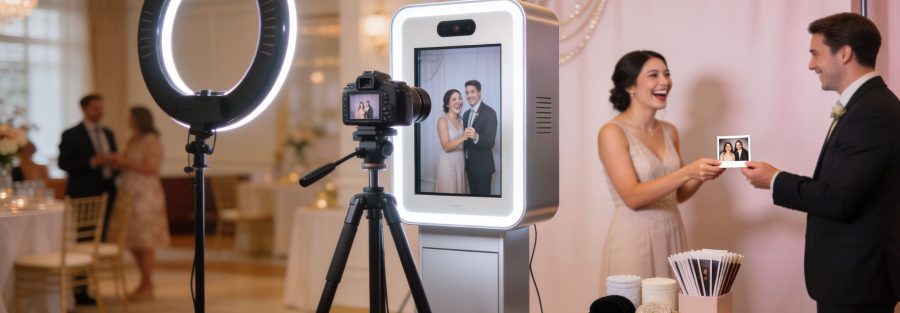
A Magic Mirror booth works well when presentation matters. It feels polished, interactive, and a little more premium than a standard tablet-on-stand setup. It tends to fit formal weddings, galas, and branded events where the hardware should look intentional.
A Roamer booth or roaming photo experience solves a different problem. Instead of waiting for guests to come to one station, the booth or operator goes to them. That’s useful for cocktail hours, outdoor receptions, and packed corporate events where guests spread out.
Photo Booth Type Comparison
| Booth Type | Best For | Typical Footprint | Key Feature |
|---|---|---|---|
| Enclosed Booth | Nostalgic weddings, private guest moments | Compact dedicated area | Privacy |
| Open-Air Booth | Weddings, parties, galas, mixed-age crowds | Backdrop area plus guest standing space | Flexible styling |
| 360 Booth | Social-first parties, launches, high-energy events | Larger active zone with safety clearance | Motion video content |
| Magic Mirror Booth | Formal receptions, galas, upscale branding | Moderate footprint near clean backdrop | Interactive full-length interface |
| Roamer Booth | Cocktail hours, conferences, large floorplans | Minimal fixed footprint | Mobility |
What works and what doesn’t
Here’s the practical version.
Enclosed booths work when guests want freedom to be goofy without an audience. They don’t work as well when the event wants the booth to add visible energy to the room.
Open-air booths work when design matters and you want more people in a frame. They don’t work if the background behind the setup is ugly and no one budgeted for a proper backdrop or lighting treatment.
360 booths work when the event can give them enough room and enough time in the schedule. They don’t work when the planner tries to squeeze them next to a dinner table cluster or in a narrow hallway.
Magic Mirror booths work when elegance matters and guests will appreciate a polished interaction. They don’t work if the event is rough, crowded, and better served by something faster and more casual.
Roaming booths work when guests are scattered. They don’t work if the host really wants a branded photo destination with a fixed backdrop moment.
A booth should fit the traffic pattern of the event. If guests have to hunt for it, step around cables, or wait in a cramped aisle, the experience drops fast.
Ask for a floorplan, not just a package list
One of the best ways to choose the right booth is to place it on your floorplan before you sign.
That immediately reveals whether the room can support a 360 setup, whether the open-air booth has enough background clearance, or whether a roamer would solve more problems than a static station. It also helps coordinate nearby lighting, speaker placement, and guest movement.
If you’re comparing styles, a quick review of different types of photo booths can help narrow your shortlist before you get into production details with a vendor.
Elevating the Experience With Smart Add-Ons
A booth by itself is rarely what people remember most.
People remember the whole moment around it. The backdrop looked like it belonged at the event. The lighting was flattering. The props didn’t feel like leftovers from a school carnival. The DJ made a timely announcement, so the line picked up right as the dance floor opened. The monogram projection nearby tied the whole corner into the room.
That’s the difference between a rental item and an experience.
A useful industry signal backs this up. A 2025 EventMB finding summarized by Hit The Angles 360 says 68% of event planners seek integrated AV and photo services to cut coordination time by up to 40%, yet only 15% of providers talk about bundling with DJs, lighting, and other production elements. That gap shows up in real events all the time. The booth gets booked, but nobody plans how it should live inside the atmosphere.

Backdrops should belong in the room
A backdrop does more than hide a wall. It sets the tone of the photos and decides whether the booth feels integrated or random.
For weddings, I’d rather see one strong backdrop that matches the palette than a generic sequin panel that has nothing to do with the room. At corporate events, simple often wins. A clean branded step-and-repeat, a custom graphic wall, or a modern texture can look stronger than an overdesigned print.
Props need the same discipline. Curated props usually outperform giant bins of mixed novelty items. If the event is elegant, the prop collection should be minimal or skipped entirely. If the event is playful, build around the theme instead of dumping in every plastic hat available.
Lighting and sound need to work together
This is the part many photo booth companies undersell.
If the booth sits in a dark corner while the rest of the room has warm uplighting and a polished stage wash, guests feel the disconnect. If the booth’s screen brightness fights with nearby DJ lighting, photos can look inconsistent and the area feels visually messy.
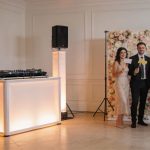
The better approach is to treat the booth zone like a mini set. Coordinate nearby lighting color, keep speaker placement from overpowering the interaction, and make sure the booth isn’t competing with a subwoofer stack or a server station. If the event includes uplighting, cold sparks, custom Gobo projection, or a DJ facade, the booth area should be designed in the same language.
Integrated production teams simplify things. For example, photo booth rentals with prints make more sense when the print design, backdrop, and surrounding event lighting are planned together instead of by separate vendors who never compare notes.
Worth remembering: Guests don’t separate “the booth” from “the event.” They experience the whole environment at once.
Add-ons that actually change the result
Some upgrades are cosmetic. Some meaningfully improve the guest experience.
The useful ones usually fall into a few buckets:
Custom graphic layer
This includes print templates, digital overlays, start screens, and branded galleries. It matters because every asset looks intentional instead of default.Guestbook or print station
Good for weddings and milestone parties, especially when someone is actively helping guests place a copy and leave a note.Matching decor treatment
This can be a custom backdrop, floral surround, lounge vignette, or branded wall treatment. It turns the booth into a destination.Content extras
If the event wants motion-based storytelling, tools that animate still imagery can extend the life of event content. For teams exploring that angle, this resource on Photo for Video animation is a practical look at how still photos can become more dynamic after the event.
One mention here is enough. 1021 Events handles photo booths alongside DJs, uplighting, sound, and visual effects, which is useful when a client wants one production plan instead of disconnected rentals.
How to Vet Vendors and Understand Pricing
A polished booth setup means very little if the vendor can’t execute under pressure.
The easiest way to get burned on an event photo booth rental is to shop only by package title and price. Two quotes can look similar on paper and deliver completely different event experiences. One vendor sends a trained attendant, arrives early, tests the printer, and knows how to work with your planner and DJ. Another shows up late, plugs into the nearest outlet, and hopes nothing jams.
Pricing matters, but what’s inside the package matters more.
For corporate work especially, the booth may need to do more than entertain. According to Kande Photo Booths’ industry overview, corporate events are the fastest-growing segment, with usage up 150% in recent years, and modern lead-generation systems can deliver 92% accuracy while integrating with CRM platforms. The same source notes standard rental pricing typically falls between $600 and $1,000 for a four-hour event.
Questions every vendor should answer clearly
A reliable vendor should be able to answer these without getting vague:
Who will be onsite
Ask whether an attendant is included, what that person does, and whether they know the specific booth model being used.What is included in setup and teardown
You want the timing, access needs, and strike plan in writing. If the vendor needs early access, freight elevator time, or a dedicated loading area, that should be discussed before event week.What happens if equipment fails
Printers jam. Cables fail. Software freezes. Good vendors have a backup plan and can explain it in one sentence.What do you need from the venue
Power, space, internet if required, load-in access, and placement restrictions should all be addressed early.What files do we receive after the event
Clarify whether you get a full gallery, branded assets, raw captures, prints only, or selected edits.
What pricing usually hides
The most common pricing problem isn’t that a vendor charges too much. It’s that clients compare incomplete scopes.
One company may quote a low base package that excludes custom overlay design, setup labor, premium backdrop options, travel, or print volume. Another includes those items and looks more expensive until you compare line by line.
Watch for these contract details:
| Area | What to confirm |
|---|---|
| Hours of service | Whether setup time counts toward rental time |
| Prints | Whether they’re unlimited, limited, or charged by volume |
| Customization | Whether overlay design and branding are included |
| Staffing | Whether an onsite attendant is part of the price |
| Overtime | How additional time is billed if the event runs late |
| Travel and access | Whether distance, parking, stairs, or venue restrictions add fees |
A few red flags worth taking seriously
These don’t always mean the vendor is bad, but they should slow you down.
They can’t show a recent full-event gallery
A few polished promo shots aren’t enough. You want to see consistency.Their contract is thin
If there’s no detail about service window, deliverables, or liability, expect confusion later.They don’t ask about the room
Good vendors ask about floorplan, power, guest count, timing, and nearby activities because those details affect performance.Everything is an upsell
Some customization is normal. But if basics like attendant support, setup, and a standard backdrop are all extra, the quote may be designed to climb.
Ask vendors how they handle the boring stuff. Load-in, testing, printer issues, placement conflicts, and teardown discipline tell you more than the glam photos do.
Don’t skip consent and usage details
This matters more for corporate events, school functions, charity galas, and any event where photos may be reused in marketing.
If guests will be photographed and images may appear in promotional materials, get your policy clear ahead of time. This guide on photo release consent is a useful reference for what event hosts should think through before the event goes live.
If you want a cost baseline before comparing line items, a page on photo booth rental cost factors can help you frame what affects pricing beyond the headline number.
Your Day-Of Guide for Flawless Photo Booth Fun
The booth can be perfectly booked and still underperform if the day-of execution is sloppy.
Most event problems with photo booths aren’t dramatic. They’re small decisions that pile up. The booth is too close to the bar. The line spills into a catering path. Nobody announces it early. The attendant is passive. Guests don’t realize prints are available. By the time people notice the setup, the formal program has moved on.
The broader market supports why this matters. The global photo booth rental market is projected to generate $3.5 billion in revenue in 2024, with rental services making up about 63% of the industry, and weddings and corporate events representing 30% and 45% of market share respectively, according to Accio’s photo booth industry trend data. Booths are no longer side entertainment. They’re expected parts of major events.
Put the booth where people naturally pass
The best location is visible, accessible, and slightly off the main collision zones.
That usually means near cocktail flow, lounge areas, or the edge of the reception energy. It usually does not mean directly beside the bar pickup point, the venue entrance choke point, or the narrow path servers use all night. Guests need enough room to gather, react, and move away without backing up the room.
A simple placement review using a photo booth setup guide can help planners catch obvious issues before load-in starts.
Give the booth a launch moment
Don’t assume people will discover it on their own.
A quick mention from the DJ or MC helps. So does opening the booth at the right time. Cocktail hour, post-dinner transition, or the first stretch of open dancing often works well. If you open too early while guests are still arriving or too late when the room is already thinning out, participation can lag.
Work with the attendant like part of the team
A good attendant does more than stand nearby. They invite hesitant guests, reset props, keep prints moving, explain sharing options, and maintain energy without being pushy.
Have your planner, DJ, or venue lead point them to the event timeline. They should know when speeches happen, when dinner starts, and when the dance floor opens. That helps them avoid dead periods and capitalize on the best windows.
The most successful booths feel easy. Guests shouldn’t have to figure out where to stand, what to tap, or whether they’re allowed to jump in.
Plan the handoff after the event
Before the night ends, confirm who receives the gallery, when digital files are delivered, and whether guestbook items or leftover prints need to be packed with gifts or decor.
That last ten minutes saves a lot of next-day confusion.
If you want a photo booth that feels like part of the event instead of a separate rental, 1021 Events can help plan it alongside your lighting, DJ, sound, and visual details so the whole room works together.