

Before you even think about picking up the phone, the real heavy lifting of vendor negotiation has to happen. Honestly, the most successful deals I've ever closed were pretty much decided before the first conversation even started. It all comes down to the prep work.
Jumping into a negotiation without a solid plan is a recipe for disaster. It’s like trying to bake a cake by just throwing ingredients in a bowl—you’ll end up with an expensive mess. The goal is to build a rock-solid foundation for the discussion.
Getting Your Ducks in a Row
This isn't just about having a number in your head for what you want to spend. It’s about creating a detailed, line-item budget that gives you total clarity on where every single dollar is going. When you know your numbers inside and out, your budget stops being a limitation and becomes your most powerful tool. It’s what gives you the confidence to know exactly where you can be flexible and where you need to stand your ground.
Must-Haves vs. Nice-to-Haves: The Ultimate Sorting Hat
Every great negotiation begins with some ruthless prioritizing. You've got to draw a clear line in the sand between what’s absolutely essential for your event and what would just be a cool bonus.
- Must-Haves: These are your non-negotiables, the things that define the event. For a wedding, maybe it's that one specific photographer whose style you’ve been obsessed with for years. Or for a corporate event, it's a venue with lightning-fast Wi-Fi. These are the hills you’re prepared to die on.
- Nice-to-Haves: This is where you have wiggle room. That upgraded floral arrangement is stunning, but would the standard one still look beautiful? Sure. Those custom-monogrammed cocktail napkins are fun, but are they worth sacrificing an hour of the open bar? Probably not.
This simple exercise becomes your strategic map. When a vendor’s quote comes in high, you can instantly pivot: "Okay, to get closer to my budget, what if we swapped out the premium linen for the standard option?" It shows you’re a serious, prepared partner, not just someone looking for a handout.
If you're just starting to think about all the moving parts, a good wedding vendor checklist template can be a lifesaver for organizing your thoughts.
Know the Market, and Know Your Walk-Away Point
Your two best friends in any negotiation are solid data and a good backup plan.
First, do your homework. Research the going rates for the services you need in your city. This isn't about lowballing; it’s about grounding your requests in reality. With event costs jumping by a whopping 19% since 2019 thanks to inflation, showing up with data is more important than ever. Instead of a vague "can you do better?" you can approach it as a joint problem-solving exercise.
Pro Tip: Try saying something like, "I've seen the market rates, and I understand costs are up. My budget has a hard stop at X amount for this service. Is there a creative way we can work together to get there, maybe by adjusting the package?"
Finally, and this is crucial, you have to define your BATNA: your Best Alternative To a Negotiated Agreement. What's your Plan B if this vendor just won't budge? Do you have another caterer you've already vetted? A backup DJ who you also liked?
Knowing your walk-away point is a superpower. It completely removes the fear from the conversation and gives you the confidence to ask for what you need, because you know you'll be fine if they say no. A big piece of this puzzle is also reading the room; learning how to effectively analyze your negotiation counterparts can give you a serious edge.
Before you start reaching out, run through this quick checklist. It's the bare minimum you need to have sorted to walk into a negotiation feeling confident and in control.
Your Pre-Negotiation Checklist
| Checklist Item | Why It Matters | Example |
|---|---|---|
| Detailed Budget | Gives you a clear financial map and shows you where you have flexibility. | Instead of a "$5,000 photo budget," you have "$4,200 for 8 hours + $800 for album." |
| Priority List | Separates your deal-breakers from your "nice-to-haves." | Must-Have: A DJ who plays afrobeats. Nice-to-have: A custom monogram light. |
| Market Research | Grounds your asks in reality and prevents you from making unrealistic requests. | Knowing the average 8-hour photography package in your city costs between $4,000-$6,000. |
| Your BATNA | Your walk-away point. This gives you confidence and removes desperation. | "If Venue A won't include chairs, we'll go with Venue B, which is slightly smaller but a better value." |
Nailing these four things will put you in the driver's seat. You'll be negotiating from a position of strength, knowledge, and confidence—and that’s how you get a deal that feels like a true win.
Tailoring Your Approach for Different Vendors
Knowing how to negotiate means understanding who you're talking to. A venue manager and a photographer are playing two completely different games, and a one-size-fits-all script will get you nowhere fast. To really succeed, you have to speak their language and understand what makes their business tick.
Think about it: a venue is dealing in volume. They’re focused on occupancy rates, food and beverage minimums, and maximizing revenue from a physical space. On the other hand, a creative like a DJ or videographer is selling their unique talent and, more importantly, their time. They can only be in one place at once. Once you grasp this core difference, you can start crafting a negotiation strategy that actually works.
Before you ever pick up the phone, though, you need a solid foundation. This is your homework.
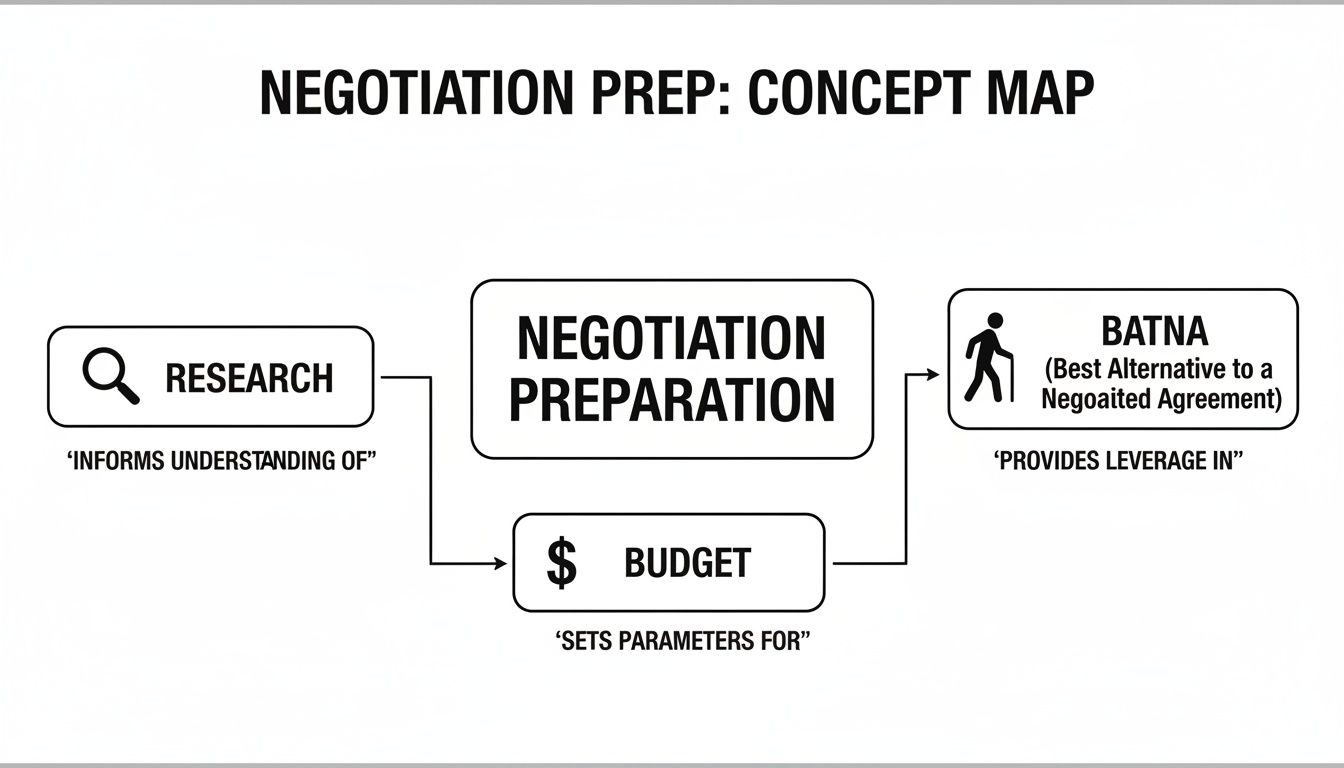
Nailing down your research, budget, and walk-away point is the universal prep work you'll apply to every single vendor conversation.
Talking Turkey with Venues and Caterers
Venues and caterers are juggling high fixed costs—staff, rent, inventory. This usually means the big-ticket items, like the room rental or the per-person price, don't have a ton of wiggle room. So, instead of trying to slash the main price, get creative and target the add-ons where their profit margins are much healthier.
Here are a few things to ask for:
- Waived Fees: Ask them to drop the corkage fee if you bring your own wine, or the cake-cutting fee if you're using an outside baker. These "small" fees can easily add up to hundreds of dollars.
- Complimentary Rentals: Can they throw in the standard linens, basic chairs, or a projector and screen at no extra cost?
- More Time: Negotiate for an extra hour for setup or breakdown. This can save you a bundle on staff overtime pay and reduce a ton of stress.
With caterers, that per-person price is their lifeblood. Instead of asking them to lower it, look at adjusting the menu. Can you swap a pricey beef option for a fantastic chicken or pasta dish? Could a beautifully arranged buffet create the same vibe as a plated dinner for a lower cost? It's all about finding flexibility without devaluing their core product.
Getting Creative with Photographers, Videographers, and DJs
These pros are often solo entrepreneurs. Their inventory is their talent and their time, and it's finite. Because of this, asking for a straight discount can be a tough sell and, frankly, a little insulting to their craft. This is where bundling is your best friend.
When you're talking to a creative vendor, shift your mindset from "How can I pay less?" to "How can I get more for my money?" This shows respect for their work while still helping you stick to your budget.
Let’s say a photographer's eight-hour package is pushing the limits of your budget. Instead of asking for 10% off, ask if they'd be willing to include a complimentary engagement shoot or a small album credit. For a DJ, maybe they can add uplighting or a photo booth to their standard package for a small bundled price—which is almost always cheaper than hiring a separate company for those services.
This strategy helps you walk away with more value, and the vendor feels like their primary service is being properly compensated. It's a true win-win.
Mastering Your Communication and The Ask
Alright, you've done your homework. You know your budget, your priorities, and what you'll do if a vendor says no. Now comes the part that makes most people sweat: actually talking to them. This is where the magic happens, and it's less about hardball tactics and more about turning a potential confrontation into a creative conversation.
Let’s be real, nobody likes hearing, "Your price is too high." It's a dead-end statement that puts vendors on the defensive. But what if you framed it differently? Try something like, "This is a bit beyond what we've budgeted. How can we work together to get this closer to our target?" See the difference? You've just opened the door for partnership instead of slamming it shut.
That simple shift in language transforms the entire vibe. You’re not haggling over a used car; you're building a team to pull off an incredible event.
Crafting the Perfect Email Inquiry
Your first email is your first impression. It needs to be clear, respectful, and show you're a serious professional, not just kicking tires. This is your chance to stand out from the crowd of generic inquiries.
Here’s a simple flow that I've found works wonders:
- Start with a genuine compliment. Don't fake it. Find something you truly admire. "I’m a huge fan of the energy you brought to the Miller wedding last fall…" or "I've been following your floral designs on Instagram for months, and they are stunning."
- Give them the key details. Be concise. They need the date, venue, guest count, and a general idea of what you’re looking for.
- Open the budget conversation collaboratively. Frame it as a puzzle you're solving together. "Our budget for DJ services is around $X. Is this something that falls within your typical package range, or are there ways we could customize a package to meet that?"
This approach shows you respect their value while being upfront about your own financial reality. It invites a helpful conversation from the get-go. If you're not sure what details to even ask about, our guide on questions to ask your wedding DJ is a great place to start.
Navigating the Phone Conversation
Once you get a vendor on the phone, your confidence and transparency are your biggest assets. It’s okay to talk about money! The key is to always tie it back to the value you see in their work.
My Two Cents: Treat the negotiation like you're both on the same team, trying to solve a puzzle. The vendor has some pieces, you have the others. The goal is to make them fit together perfectly.
If a proposal comes in higher than expected, don't panic. A great way to respond is, "Thank you so much for putting this together. I absolutely love your vision for the lighting! We're trying to reconcile this with our budget, which is a bit lower. Are there any areas where we might have some flexibility?" This is a soft, non-confrontational way to open the door to options.
The Psychology of a Successful Negotiation
Here's something a lot of people miss: timing is everything. For bigger, more complex agreements, 69% of vendors expect negotiations to take one to three months. If you're trying to book a popular photographer six weeks before a Saturday in June, you have almost zero leverage.
Start these conversations early. Proactive planners who initiate these dialogues well in advance convert 35% more proposals into signed contracts, simply because they aren't rushed and can explore all the options. You can read more about how timelines impact deal-making in these procurement negotiation statistics.
Ultimately, a good negotiation isn't about winning; it's about building mutual respect. You're aiming for a fair agreement where the vendor can run a profitable business and you can create an amazing event within your budget. That’s the sweet spot where one-time clients become long-term partners.
Building Vendor Relationships That Pay Off
One of the biggest shifts you can make in your negotiation strategy is to stop thinking about it as a one-time transaction. If you go into a negotiation seeing the vendor as an opponent you have to "beat," you're putting a ceiling on what you can achieve.
Treating them like a partner, on the other hand, can unlock value that goes way beyond a single discount. This isn't just about being nice—it's a smart, strategic move that can pay off for years. A solid relationship might get you better rates down the road, first pick of popular dates, or even a free upgrade when you're in a tight spot. You stop being just another client and become someone they want to help succeed.
From One-Time Client to Valued Partner
So, how do you actually build that kind of rapport? It really starts after the event wraps up. Your follow-up is every bit as crucial as your initial negotiation.
Instead of just ghosting them once the invoice is paid, circle back with genuine, thoughtful feedback. Better yet, become their biggest fan. A detailed, glowing review on Google or The Knot can be pure gold for a small business owner. A personal referral to a colleague? Even better. These things cost you nothing but build a massive amount of goodwill.
This loyalty loop is a powerful tool in your pocket. An Eventbrite 2024 trends report found that while 60% of organizers plan to hike ticket prices to cover rising costs, those with strong vendor relationships are in a much better position to lock in favorable rates and perks. Building these connections is just a good financial decision.
Offering Value Beyond Money
Sometimes, your best bargaining chips have nothing to do with cash. Many vendors, especially creatives like photographers, florists, and designers, are always on the hunt for high-quality content for their portfolios.
Think about what you can offer that doesn't hit your budget:
- Professional Photos: Offer to share a gallery of stunning professional photos from your event that showcase their work in action.
- Prominent Credit: Promise them a logo on event signage, a shout-out on your company's social media channels, or tags in all your event posts.
- A Killer Testimonial: Offer to write a detailed, glowing review they can feature on their website.
By getting a little creative, you can offer value that is low-cost for you but incredibly high-impact for them. This collaborative approach makes vendors want to work with you and find ways to make your budget work.
This is especially true when you're working with full-service event production companies near me, as it lays the groundwork for a long-term partnership. When you show you’re invested in their success, they become just as invested in yours. It’s a simple, human-centered way to make sure you always get their best work and their best price.
Don't Sign Anything Yet: It's Time for the Contract Review
You've done it! You’ve talked through the options, found common ground, and have a verbal "yes" from your vendor. It’s tempting to pop the champagne, but hold on—the most important part is next. All that great negotiation work means nothing if it’s not reflected in the final contract.
Think of the contract as the official rulebook for your event. If a detail you discussed isn't written down in that document, it essentially doesn't exist. Now's the time to get detail-oriented.
The Make-or-Break Clauses to Look For
Before your pen ever touches that signature line, you need to read the contract. And I don't mean skim it. I mean really read it. There are a few key sections that can cause massive headaches and financial pain down the road if you're not careful.
Here's what I always zoom in on first:
- The Payment Schedule: Check the due dates and amounts against your notes. Are they exactly what you agreed to? I always push for the final balance to be due on the day of the event, or even a few days after—never a month before.
- Cancellation & Postponement Policy: Life happens. What are the rules if you have to cancel or move the date? Look for specifics on what happens to your deposit and any other payments. This is where most disputes pop up, so clarity here is everything.
- Liability Insurance: The contract should clearly state that the vendor has their own insurance. This is your safety net. It protects you from being on the hook if an accident or damage occurs.
- Force Majeure Clause: This is often called the "act of God" clause. It covers what happens if something completely out of your control (think major storm, pandemic, etc.) forces a cancellation. Make sure it gives you options like postponement or a fair refund, not just losing all your money.
A review of over 100 event contracts revealed something wild: a staggering 75% didn't include clear performance metrics. Your contract needs to spell out exactly what you're getting, from arrival times to the specific number of photos or menu items.
Giving it One Final Read-Through
Okay, you’ve checked the big-ticket items. Now, do one last pass to make sure every single perk and promise you negotiated made it into the final document. That extra hour the DJ threw in? The waived corkage fee from the venue? If it's not in writing, you can't enforce it.
Before you lock anything in, it's just good practice to make sure you're fully understanding the vendor's terms and conditions.
If you spot something that’s missing or worded strangely, don't hesitate to speak up. Point it out and ask for a revision. Any reputable vendor will want the contract to be accurate and will have no problem making adjustments. If you're looking for a solid starting point, using an event planning contract template can be a huge help. This final check is your best defense against unexpected costs and misunderstandings later.
A Few Common Questions About Vendor Negotiation
Even with the best playbook, you're going to have questions when it's time to talk money. That's totally normal. Think of negotiation as a muscle you build over time—it can feel a little awkward at first, but you get stronger with every conversation.
Let's walk through some of the questions I hear all the time from event planners. Getting clear on these points beforehand can give you a nice little confidence boost right before you make the call. Remember, the goal isn't to "win," it's to find that sweet spot where both you and the vendor feel great about the deal.
Is It Rude to Ask for a Discount?
Honestly, no—as long as you do it with respect. Most vendors, especially small business owners, get it. They know you have a budget to stick to, and many have a little wiggle room built into their pricing. It really all comes down to how you ask.
Instead of a blunt, "Can you do better on the price?" try framing it as a partnership.
- Try this: "We are so excited about the possibility of working with you. Is there any flexibility in this package if we were to adjust the number of hours?"
- Or this: "We're looking to bundle your DJ and photo booth services. Is there a preferred rate for booking multiple services together?"
This shows you value their work while also being upfront about your own financial reality. Just be sure to avoid throwing out a crazy lowball offer. A good negotiation ends when everyone feels the price is fair.
What Else Can I Negotiate Besides the Price?
This is my favorite question because it's where you can get really creative and add a ton of value without actually lowering the vendor's fee. These "extras" often cost the vendor very little but can make a huge difference for your event.
Think about asking for things like:
- An extra hour of service from your photographer or DJ.
- An upgraded lighting package or a cool add-on, like a custom Gobo projection.
- Waiving small fees (cake cutting, corkage, and parking fees are common ones).
- A more flexible payment schedule to help with your cash flow.
For audio needs, you can explore various options and their typical costs in our guide to sound system rental prices, which can help you figure out what non-monetary asks make sense.
When Is the Right Time to Start Negotiating?
The golden rule is this: negotiate before you sign anything. The second your signature is on that contract, your leverage pretty much disappears.
The ideal time to bring up your budget is after you've received a formal proposal and shown genuine interest. This tells the vendor you're serious and not just kicking tires to find the cheapest option. Also, think about timing. A vendor will have a lot more flexibility on a Thursday in February than on a prime Saturday in June.
At 1021 Events, we believe in collaborative planning to bring your vision to life within your budget. From DJ services to stunning visual effects, we partner with you to create unforgettable moments. Learn how we can make your next event extraordinary.