You're probably here because the event itself is already taking shape. The venue is booked, the date is set, and now the audio question has moved from “we'll figure that out later” to “if people can't hear, this whole thing falls apart.”
That instinct is right.
I've seen beautiful ceremonies get flattened because guests in the third row couldn't hear the vows. I've seen strong corporate programs lose momentum because the first microphone squealed, the presenter held it wrong, and nobody on site knew how to fix it fast. Sound usually isn't the part guests compliment first, but they notice immediately when it's bad.
That's why sound equipment rental in Orlando isn't just about finding a couple of speakers. Around here, key decisions usually involve outdoor heat, humidity, power access, delivery windows at busy venues, and whether an equipment-only rental will save money once setup and troubleshooting land on your plate.
Why Great Sound Is Your Event's Unsung Hero
A wedding can have the right flowers, the right lighting, and the right timeline and still feel off if the ceremony audio is weak. The same thing happens at a fundraiser when the auctioneer sounds distant, or at an awards dinner when the CEO's mic drops in and out. Guests may not know the model of speaker in the room, but they know when they're straining to hear.
That's because sound does more than amplify voices. It sets pacing, controls attention, and keeps people connected to what's happening. If guests miss the vows, the punchline, the instructions, or the winner's name, the event loses impact in real time.
Audio problems usually start before the first guest arrives
Most event audio issues don't begin during the event. They start in planning. Somebody assumes a quiet garden won't need much coverage. Somebody picks a cheap speaker package without thinking about the officiant's mic, the musician's input, or the fact that the cocktail hour area is nowhere near the ceremony spot.
Bad sound rarely comes from one big mistake. It usually comes from five small assumptions that nobody checked.
In Orlando, that planning gap shows up a lot because event types vary so much. A ballroom presentation at a resort behaves very differently from a backyard birthday in Dr. Phillips or a lakeside ceremony where wind carries the sound away from the seating area.
A solid provider should help you sort through that before a single cable is unloaded. If you're comparing options, it helps to look at a company's broader sound and entertainment services and see whether they think in terms of guest experience, not just gear inventory.
What people actually need when they search for sound rental
Most clients start by asking for “a sound system.” What they usually mean is one of three things:
- Clear speech coverage for vows, toasts, panels, or presentations
- Music playback that feels full without being harsh
- Managed production support so they don't have to solve technical problems during the event
Those are different jobs. A basic PA can handle one of them well. A more thoughtful setup can handle all three without stress.
Matching Sound Needs to Your Orlando Event
The simplest way to choose the right setup is to think in V.A.V.. That means Venue, Attendance, and Vibe. If you can answer those three clearly, you'll have a much better rental conversation and a much lower chance of paying for the wrong package.

Venue
Start with the room or site, not the guest count.
An indoor ballroom at a hotel near International Drive usually gives you predictable power, climate control, and a defined audience area. That doesn't mean it's easy. Carpet, drape, low ceilings, and packed tables can help absorb sound, while hard walls and glass can create slapback and muddy speech.
Outdoor venues around Orlando change the game. A place like Kraft Azalea Garden feels open and beautiful, but open air doesn't reinforce sound. Wind can push speech off axis, nearby roads create background noise, and there's often no built-in infrastructure where you need it.
Practical rule: Outdoor events always need more coverage and more planning than people expect.
Attendance
Headcount matters, but not in the lazy way people think. It's not just “more guests equals louder speakers.” It's about coverage, sightlines, and how spread out people will be.
Here's a concise way to look at it:
| Event size | What usually works | Common mistake |
|---|---|---|
| Under 50 | Compact speaker setup with one or two microphones | Renting too much system for a quiet room |
| 50 to 150 | Balanced PA with better microphone planning and placement | Underestimating coverage for wide seating |
| 150+ | Multi-speaker coverage, stronger control at the mixer, and cleaner logistics | Assuming one pair of speakers can cover everything |
A seated ceremony with fewer guests can still need careful placement if the layout is wide. A networking event may need less volume overall but better distributed sound so the room doesn't feel uneven.
Vibe
This is the part people forget.
A corporate keynote needs clarity first. Every word should land. A wedding ceremony needs the officiant, vows, and maybe live music to feel natural, not blasted. A dance floor needs body and low-end energy, which is where subwoofers and system tuning start to matter.
For a quick visual on how event style changes the setup, this short video helps:
The broader rental market is large enough that planners have a lot of options. The U.S. audio and visual equipment rental industry had a projected market size of $10.6 billion in 2026 and saw a 5.2% compound annual growth rate in the number of businesses from 2020 to 2025, according to IBISWorld's audio and visual equipment rental industry report. For Orlando clients, that usually means access to modern gear and more specialized service tiers.
If you're sorting through package types, it helps to compare real party sound system rental options against the actual flow of your event, not just the speaker count on a quote.
Decoding the Gear PA Systems Speakers and Mics
A lot of rental conversations get confusing because providers use technical language for what are simple event functions. You don't need to become an audio engineer. You just need to know what each piece does and when it matters.

What a PA system actually is
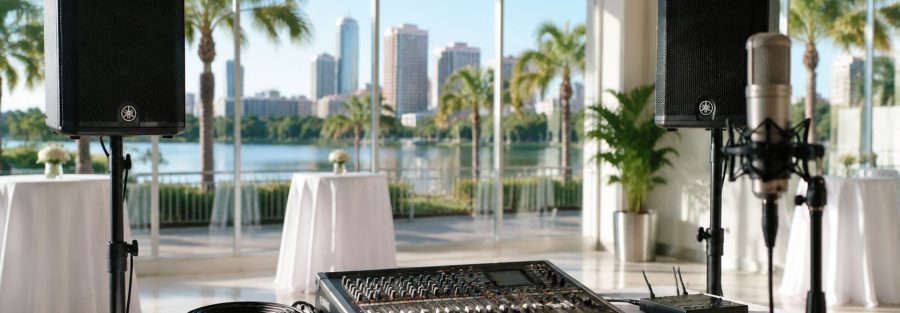
A PA system is the full chain that takes a voice or music source and makes it audible to the audience. That usually includes microphones, speakers, a mixer, stands, cables, and sometimes monitors for performers or presenters.
Think of the mixer as the brain of the setup. It balances levels, shapes tone, and helps prevent one mic from overpowering another. If a ceremony has an officiant mic, a handheld for readings, and music playback for the processional, the mixer is what keeps those transitions clean.
For simple events, the PA can be compact. For more involved programs, the system grows because the event has more moving parts, not just more volume.
Speakers for speech versus speakers for energy
Not every speaker setup is built for the same result.
A pair of speakers on stands often works well for a ceremony, panel, or dinner speech. The goal there is intelligibility. You want the front row and the back row to hear the same words without the system sounding aggressive.
A party or reception usually needs more than that. Once dancing starts, people want the music to feel present, not thin. That's where adding subwoofers changes the experience. Without them, playlists can sound bright and flat. With them, the system has weight and balance.
Here's the common mismatch:
- Speech event with oversized party speakers can feel harsh and distracting
- Dance event with speech-only setup often sounds weak by the first chorus
- Outdoor event with indoor assumptions leaves guests hearing only fragments
For speeches, coverage matters more than raw volume. For dancing, coverage and impact both matter.
Picking the right microphone
Microphones cause more planning mistakes than speakers.
A handheld wireless mic is the workhorse for toasts, Q&A, and audience interaction. It's reliable because speakers naturally understand how to aim it, and a tech can swap users quickly.
A lavalier mic or lapel mic is useful when a presenter or officiant needs both hands free. It looks clean and feels less intrusive, but placement matters. If it rubs against clothing or sits too low, intelligibility drops fast.
A podium mic works when the speaker stays planted. The second they step away from the lectern, the level falls apart. That's why podium mics are best for formal remarks with disciplined presenters, not casual speakers who wander.
A headset mic is the right call when the presenter moves a lot. Fitness events, stage hosts, and energetic emcees usually do better with this than with a lapel.
The gear people forget to ask for
The extra pieces often make the difference between “working” and “working smoothly.”
- DI boxes: Useful when someone wants to connect a laptop, instrument, or playback device cleanly.
- Monitors: Let performers, officiants, or speakers hear themselves when the room is noisy.
- Backup microphones: Important anytime the schedule depends on one person being heard clearly.
- Proper cabling and power routing: Boring on paper, critical in practice.
If you're comparing packages, look at the full scope of audio visual equipment for events rather than just the headline item. The speaker is only one piece of the system your guests will experience.
The Real Cost of Sound Rental Delivery Setup and Support
The cheapest quote is often the most expensive option once event day starts.
That sounds dramatic until you've watched a host borrow a truck, load speakers they didn't realize were that heavy, arrive late because the venue had one loading entrance, and then spend the next hour trying to figure out why the microphone and playlist can't run cleanly through the same system.

What a quote usually includes
A proper audio quote is rarely just the gear. It may include delivery, pickup, setup, teardown, and some level of operation or standby support. Those pieces are where the event either gets easier or much harder.
A bare rental can look attractive if your event is simple and you have someone who knows what they're doing. But many events that seem simple on paper stop being simple the minute there are multiple microphones, a timeline, a ceremony feed, a playlist, a room flip, or an outdoor location.
Where DIY starts to get expensive
DIY makes sense in a narrow lane. Small private gathering. Straightforward room. One microphone, one music source, no venue restrictions, and someone in your group who's comfortable handling setup and signal flow.
It stops making sense when the event has public-facing stakes. Weddings, corporate programs, fundraising events, and anything with a tight run of show usually need more than boxes on the floor.
A useful way to compare the two:
| Rental style | Works well when | Breaks down when |
|---|---|---|
| Equipment only | The setup is simple and the client has capable hands on site | Timing is tight, venue access is tricky, or nobody can troubleshoot |
| Delivery and setup | You want the system installed correctly but don't need active operation | Multiple transitions or user changes happen during the event |
| Full service | The event includes live cues, speeches, or high expectations | Rarely the wrong choice when the program matters |
One Orlando planning challenge is figuring out support level, not just equipment choice. Many listings promise service like “delivery, setup, operate & pickup,” but the key issue is matching support to complexity. Eventective's Orlando AV rental listings and planning context highlight that this is a major decision point, and that a last-minute technician can cost more than building support into the package from the start.
When full service is actually cheaper
If the event has any of these, full service often ends up being the better value:
- Multiple microphones: Handhelds for toasts, a lapel for the officiant, plus backup
- Outdoor logistics: Long cable runs, uneven ground, weather adjustments, power questions
- Strict timelines: Venue access windows, room turns, ceremony-to-reception transitions
- No in-house tech contact: Meaning you can't rely on the venue to solve audio issues
Providers that offer broader production support can make sense. 1021 Events, for example, handles event production services that can include audio as part of the overall setup, which is often more practical than renting gear separately when timing and execution matter.
Before you decide, compare what's really included in local sound system rental prices. A lower equipment line item doesn't always mean a lower event-day burden.
Orlando Specific Challenges You Cant Ignore
Orlando is a strong event market, but that also means the logistics are real. One local operator reports 1,584 events serviced in 2025, averaging more than 4 events per day, with service coverage across Orlando, Tampa, and the rest of Central Florida plus 24-hour, 7-day-a-week availability, according to Miami Sound Rental's Orlando service page. That kind of volume tells you two things. Demand is steady, and planners need to make decisions early enough to avoid avoidable friction.

Outdoor weather changes everything
Summer humidity in Central Florida isn't an abstract concern. It affects comfort, timing, and equipment behavior. Electronics can handle outdoor work when they're deployed properly, but they still need protection from moisture, direct sun, and quick weather shifts.
Rain planning needs to exist before load-in. That can mean tent coverage, a covered backup location, or a firm move-indoor plan with the venue. “We'll decide if it looks bad” is not a sound plan. It's a scramble.
Wind is another factor people underestimate. It doesn't just affect decor. It changes how far speech carries, creates noise around microphones, and can make lightweight stands a problem if they aren't secured properly.
If your event is outdoors in Orlando, ask about weather protection and backup placement before you ask about speaker brand.
Power is often the hidden issue
A lot of attractive venues, gardens, private estates, and park-style spaces don't have convenient power where the event happens. There may be power somewhere on site, but that doesn't mean it's in the right place, on the right circuit, or appropriate for a clean audio setup.
That matters because extension-cord improvisation usually creates a bigger mess. Long runs need planning. Shared circuits can introduce noise. Generators need to be selected for event use, not just raw availability, because loud power sources can become part of the problem.
Local rules and neighborhood realities
Noise expectations vary by venue type and municipality. A resort ballroom near the attractions area operates differently from a residential neighborhood event in Winter Park or a private property setup near Lake Nona. Some communities are more sensitive to late amplified music than others, and some venues enforce their own stricter cutoff policies regardless of local rules.
That doesn't mean outdoor events are hard. It means they need realistic timing and site-specific questions.
A few Orlando-specific checks help:
- Ask the venue about amplification limits: Not just curfew, but volume expectations and speaker placement restrictions.
- Confirm load-in path: Some properties look easy until you realize there's a long walk, stairs, or limited cart access.
- Check shade and cover: Heat affects people first, but gear placement matters too.
- Plan for adjacent spaces: Ceremony lawn, cocktail patio, and reception room often need separate audio thinking.
If your event footprint crosses Central Florida markets, it can also help to look at nearby service patterns such as sound system rental in Tampa because many production teams move across the broader region and structure logistics accordingly.
Your Pre-Event Sound Checklist and FAQs
The final days before an event are where small audio details either get locked in or get forgotten. A short checklist catches most of the expensive mistakes.
Pre-event sound checklist
- Confirm the power source: Ask the venue exactly where usable power is located and whether it's shared with catering, lighting, or other vendors.
- Match the microphone to the speaker: Officiant, presenter, toast giver, panelist, and emcee may each need something different.
- Schedule a real soundcheck: Use the actual microphone, actual playback device, and actual presentation flow whenever possible.
- Verify delivery timing: Orlando venues can be strict about load-in windows, freight access, and elevator use.
- Check outdoor contingencies: Rain cover, wind management, and an indoor backup should already be decided.
- Confirm who is operating the system: If nobody owns that role, the role will fall to the busiest person in the room.
- Keep key contacts handy: Venue manager, DJ, audio tech, planner, and presenter should be reachable without hunting through email.
- Review media inputs: If someone wants to play a video, slideshow, or walk-up song from a phone or laptop, test that exact device and connection.
FAQs people ask right before event week
Do I really need a sound technician for my event
Not always. If it's a small private gathering with a simple setup, maybe not. If the event includes multiple speakers, formal remarks, live cues, or outdoor variables, having a technician usually saves stress fast.
Can I just plug my iPhone into the speakers
Sometimes, but that doesn't mean you should rely on it blindly. Device adapters, app notifications, volume mismatches, and bad cables cause problems all the time. Test the exact playback path before guests arrive.
What's the backup plan if equipment fails
Ask this before booking. A serious provider should be able to explain what happens if a microphone drops out, a speaker has an issue, or weather forces a quick adjustment. Backup gear and on-site support matter more than brochure language.
What if my event also depends on streaming or attendee connectivity
Then audio planning and network planning need to talk to each other. If you're running hybrid elements, registration apps, or live demos, this expert guide to event Wi-Fi for businesses is worth reading alongside your AV plan.
What should I ask on the first call with a rental company
Ask what they need to know about your venue, timeline, power, weather exposure, and speaking format. If the conversation stays focused only on “how many speakers do you want,” keep asking better questions.
If you want a no-pressure conversation about your event, 1021 Events is a practical place to start. Share the venue, guest flow, and whether you need equipment only or managed support, and you'll get clearer answers before audio turns into a day-of problem.