
Before you even think about asking for a single dollar, you need to lay the groundwork. The most effective fundraising campaigns are built on a rock-solid foundation: clear, measurable goals, a story that truly connects with people, and a deep understanding of who you're talking to. This initial planning is your blueprint for success.
Building Your Fundraising Foundation
Every knockout fundraising campaign I've ever seen started long before the first donation came in. It all begins with a strategic foundation—a clear roadmap that guides every decision, from who you ask to how you ask them. If you skip this part, even the most passionate efforts can fizzle out, leaving you with wasted resources and missed opportunities.
Think of it like building a house. You wouldn't just start hammering boards together without a blueprint, right? The same logic applies here. Getting a handle on the basics of What Is Nonprofit Fundraising and how the whole process works is an absolute must. It’s what stops you from just throwing ideas at the wall and hoping something sticks.
Define Your Fundraising Goals
Vague goals like "raise more money" are the enemy of progress. You need to get specific. Your objectives should be what we call SMART: specific, measurable, achievable, relevant, and time-bound. So instead of a generic target, you need something concrete.
For example, a much stronger goal is: "Raise $50,000 by December 31st to provide after-school tutoring for 100 students for one year." See the difference? This is powerful because it connects a dollar amount directly to a real-world outcome. It tells donors exactly what their money will do, making their gift feel personal and incredibly impactful.
A strong, mission-aligned goal does more than just give you a number to chase. It becomes the core of your messaging, a rallying cry for your team, and a compelling reason for donors to join your cause.
Craft a Compelling Case for Support
Your case for support is your "why." It's the story you tell that answers the fundamental question on every potential donor's mind: "Why should I give to you, and why now?"
This narrative needs to be packed with emotion but backed by evidence. And it needs to feel urgent. You have to clearly spell out:
- The Problem: What specific, tangible issue are you trying to solve?
- Your Solution: How does your organization tackle this problem in a unique way?
- The Impact: What measurable change will a donation actually create?
This whole process, from setting a goal to finding your people, gives you a clear path forward.
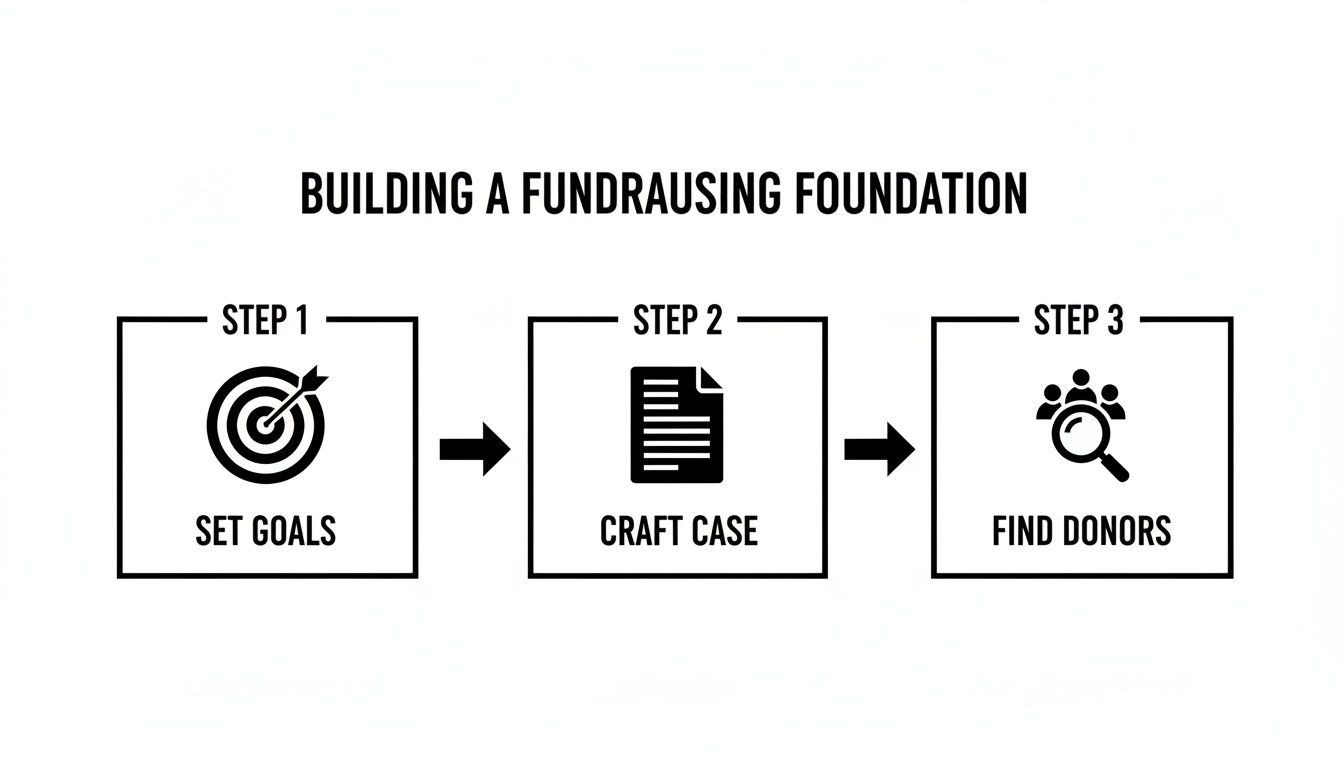
This really just shows the logical flow: your specific goals shape your story, and that story helps you find the right people who need to hear it.
Identify Your Ideal Donors
Let's be real—not everyone is a potential supporter. Your time and energy are precious, so you need to focus on individuals, foundations, and companies that already have a reason to care about your mission.
A great place to start is by looking at your current donors. Are there common threads? Maybe they're all local business owners, or people personally affected by your cause. Creating a few "donor personas" can help you picture these ideal supporters and figure out the best way to reach them. If you want to go deeper, it's worth exploring different nonprofit fundraising strategies.
Putting in this work upfront ensures your efforts are laser-focused and efficient, setting the stage for a campaign that actually gets results.
Picking the Right Fundraising Channels
Alright, you've got your foundation set. Now for the fun part: figuring out how you're actually going to raise the money. Let's be real, there's no magic bullet here. The secret sauce is a smart, diversified fundraising plan that meets your donors where they already hang out.
Trying to do everything at once is a surefire way to burn out your team. The goal is to pick the right mix for your specific audience and resources.
Think about it. If your ideal donor is a 65-year-old philanthropist who clears their schedule for black-tie galas, a TikTok dance challenge probably isn't your best bet. On the flip side, if you're trying to rally college students, a formal direct mail letter is likely headed straight for the recycling bin. You have to match the channel to the donor.
Choosing Your Fundraising Channels
To help you decide, let's break down some of the most common fundraising methods. This table gives you a quick snapshot of what each channel is good for, what it takes to succeed, and what kind of return you might expect.
| Fundraising Channel | Best For | Key Success Factors | Potential ROI |
|---|---|---|---|
| Events | Building community, major donor engagement, creating emotional connection, raising significant funds in one night. | Strong logistics, compelling program, effective "ask," good turnout, professional production. | High, but also high cost and effort. |
| Online Campaigns | Reaching a broad audience, small-to-mid-size gifts, urgent needs, leveraging giving days (e.g., GivingTuesday). | Compelling storytelling, clear call-to-action, targeted digital ads, email marketing, social proof. | High, with lower overhead than events. |
| Peer-to-Peer | Engaging passionate supporters, acquiring new donors, themed campaigns (walks, runs, birthdays). | Easy-to-use platform, motivated fundraisers ("champions"), clear instructions and support. | Very High, as it leverages others' networks. |
| Grants | Funding specific projects, securing large sums, building credibility with institutional funders. | Meticulous research, strong proposal writing, alignment with funder priorities, detailed reporting. | Very High, but can be a long and competitive process. |
| Corporate Sponsorships | Securing major funding for events or programs, building long-term partnerships, in-kind donations. | Clear value proposition for the business, professional sponsorship packages, strong relationship building. | High, and often leads to stable, recurring support. |
This isn't an either/or situation. The most successful nonprofits mix and match these channels to create a year-round fundraising engine that keeps the momentum going.
Events and Online Campaigns: Your One-Two Punch
Fundraising events and digital campaigns are two of the most powerful tools you have, and they work brilliantly together. Events create buzz and community, while online campaigns give you incredible reach.
Fundraising Events
From a glamorous gala to a laid-back community 5K, events bring your mission to life. There's an energy you get from being in a room full of supporters that a "donate" button just can't replicate. It's your chance to tell powerful stories, show off your impact, and let people connect with the humans behind the work. That shared experience is often what inspires someone to make a major gift on the spot.
Online Fundraising Campaigns
Digital is non-negotiable for reaching a wide audience. These can be anything from:
- Email Appeals: A classic for a reason. Hitting your subscribers' inboxes with a personal story and a direct ask still works.
- Social Media Drives: Using platforms like Facebook, Instagram, or LinkedIn for targeted campaigns, especially around big moments like GivingTuesday.
- Crowdfunding: Launching a campaign on a platform like GoFundMe for a specific, tangible project. Think "help us buy a new van" or "fund our summer camp for 50 kids."
The real magic happens when you blend the two. Promote your upcoming gala with a targeted Facebook ad campaign, sell tickets on your website, and livestream a portion of the event for those who couldn't make it.
Peer-to-Peer and Grant Writing
While events and online campaigns cast a wide net, peer-to-peer and grant writing are more targeted. One taps into your supporters' personal networks, and the other goes after institutional funding.
Peer-to-Peer Fundraising
This is where you turn your biggest fans into fundraisers. Think of charity runs where people ask their friends and family to sponsor them. It's so effective because the request is coming from someone they already know and trust. You're not just getting a donation; you're getting an introduction to a whole new network of potential supporters.
Grant Writing
Landing grants from foundations or government agencies is a different ballgame. It's a structured, formal process that requires a ton of research to find funders who care about the same things you do. You'll need a rock-solid proposal detailing your project, budget, and how you'll measure success. It’s a long game, for sure, but a single grant can provide a massive injection of funds.
Don't think of these channels as separate silos. A successful grant for a new community program is the perfect story to feature in your next email appeal or highlight at your annual gala.
Tapping into Corporate Sponsorships
Don't forget the business world. Corporate sponsorships can bring in serious funding, valuable in-kind donations (like free printing or marketing services), and open doors to a whole new audience.
More and more, companies are looking for ways to show they care about their communities, and partnering with a well-run nonprofit is a fantastic way to do that.
The trick is to frame it as a partnership, not just a handout. Create sponsorship packages that offer real business value, like brand visibility at your events or a feature in your newsletter. To get started, you can find a ton of practical tips in our complete guide on how to find event sponsors for your nonprofit. It takes time to build these relationships, but a good corporate partner can become a source of stable, predictable funding for years to come.
Creating Fundraising Events People Actually Want to Attend
Sure, online campaigns and grant proposals are the bread and butter of modern fundraising. But there's a certain magic that happens when you get people in a room together. An event is where your mission stops being an idea on a screen and becomes a real, tangible, emotional experience.
This is where you turn abstract numbers into powerful human stories that stick with people long after they’ve gone home. It's about creating a moment in time, an atmosphere that doesn't just raise money but builds a loyal, fired-up community around your cause.
And this isn't just a hunch. The data tells the same story. While global charitable giving recently hit an incredible $2.3 trillion, a whopping $1.5 trillion of that came from individuals—people looking for a genuine connection. Events are a goldmine for this. Donors who attended events were retained at a 65% rate, which is miles ahead of other donor groups.
Production Quality Isn't Just "Nice to Have" Anymore
Anyone can book a ballroom and serve some chicken. What makes an event unforgettable—the kind people talk about for weeks—is the obsessive attention to production. These details aren't just fluff; they create an immersive environment that screams professionalism and shows you take your mission, and your donors' time, seriously.
Think about that first impression. When a guest walks in, what do they see? A generic hotel conference room, or a space that has been completely transformed to tell your story?
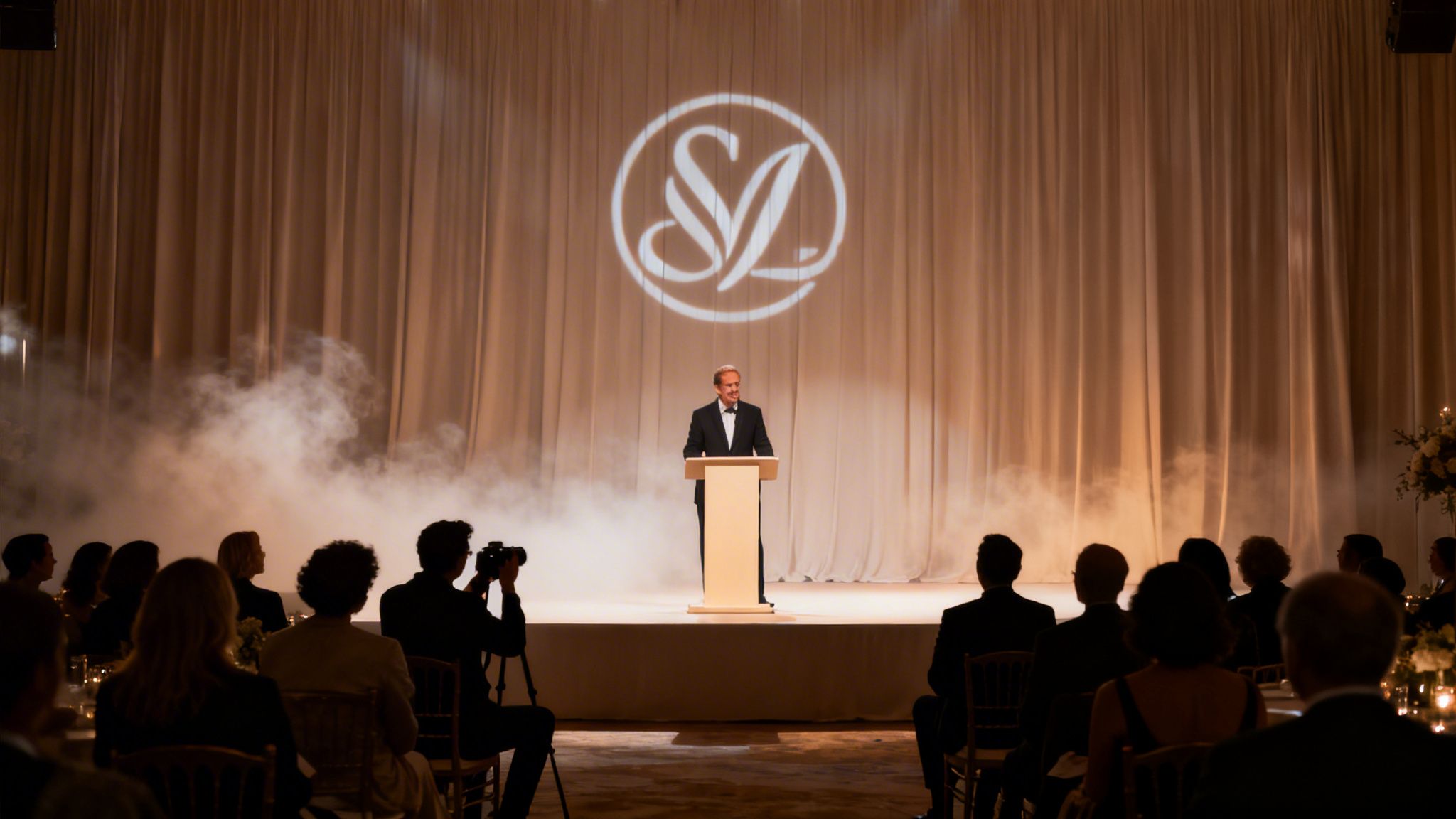
- Custom Gobo Lighting: Imagine your logo projected in crisp, clean light on a feature wall or the dance floor. It’s a simple, sophisticated touch that constantly reinforces who you are all night long.
- Professional Uplighting: The right lighting can single-handedly change the entire mood of a room. Washing the walls in your brand’s colors creates a cohesive, high-end atmosphere that makes the space feel special and intentional.
- Atmospheric Haze: A very light haze in the air is a pro trick. It catches the light beams, adding depth and a touch of drama to the room. It’s a subtle effect that makes your lighting look ten times better and gives the whole event a more dynamic, concert-like energy.
These aren't just flashy extras; they're strategic tools. A well-produced event signals to donors that you're a capable, professional organization worthy of their investment. It tells them you care about their experience from the moment they arrive.
Crafting a Program That Connects
Once you've set the stage, the event's program has to pull guests in and keep them there. I've seen it happen too many times: a clunky, boring program is the fastest way to lose your audience right before you make the big ask.
The secret is a seamless flow, and that almost always comes down to having a professional at the helm.
A great DJ or MC is the glue that holds your entire event together. They aren't just playing music—they are guiding the energy of the room, making critical announcements, and making sure the whole program runs on time. This frees you up to actually talk to your donors.
Think about how these moments build on each other to create momentum:
- The Welcome: Kick things off with upbeat music and a warm, energetic welcome from your MC. This sets an inviting tone as people grab a drink and start to mingle.
- The Story: Use a short, professionally produced video to tell a powerful story of your impact. Show people the difference your organization makes, don't just tell them. This is the emotional heart of the entire evening.
- The Ask: This is the moment everything has been leading up to. Have your Executive Director or MC deliver a clear, passionate appeal for support immediately after the video, when emotions are running high.
- The Celebration: After the fundraising is done, it’s time to celebrate. A good DJ knows how to read the room and get people on the dance floor, ending the night on a genuine high note.
The right host can feel the energy of the crowd, pumping it up when needed and creating quiet, focused moments for the serious parts. That expert guidance is often the difference between just hitting your goal and blowing it out of the water. If you're looking for inspiration, you can find a whole host of nonprofit fundraising event ideas to find a format that feels right for you.
Capture the Moment, Fund the Future
The event shouldn't be over when the last guest heads home. The photos and videos you capture are powerful assets that will fuel your fundraising efforts for months to come.
A professional team knows exactly what to look for—the genuine smiles, the emotional reactions during a key speech, the bidding wars during a live auction. These authentic, high-quality images become the backbone of your marketing for the next year.
Think about adding a few unique angles to make your content really pop:
- High-End Photography: You need crisp, well-lit photos for everything: your website, annual reports, social media, and especially in thank-you notes to sponsors and major donors.
- Drone Video: If you have an outdoor element or a large venue, a little bit of aerial drone footage provides a stunning, cinematic perspective. It's the perfect way to open a highlight reel and show the true scale and energy of your event.
Imagine sending a follow-up email to every attendee with a link to a gorgeous photo gallery or a slick 2-minute video recap. You're not just thanking them; you're reminding them of the incredible experience they had. This makes them feel appreciated and gives them something exciting to share with their own networks, building buzz for whatever you do next. That’s how one night of fundraising becomes a year-long marketing machine.
Crafting Your Message and Making the Ask
Alright, you've got a solid plan and you know which channels you're going to use. Now we get to the heart of it—actually communicating your mission in a way that truly moves people to act.
This is where the magic happens. The "ask" isn't about applying pressure. It’s about creating a connection and inviting people to be part of something incredible. Your message is the bridge between your organization's needs and a donor’s deep desire to make a difference. It absolutely has to be clear, emotional, and feel urgent.
One Message Doesn't Fit All
Let’s get one thing straight: a one-size-fits-all fundraising message is a recipe for failure. The way you talk to a potential first-time donor scrolling through Instagram is worlds apart from how you approach a major philanthropist or a corporate sponsor.
You have to segment your audience. Seriously, this is key.
Think about your different donor groups. What actually motivates them? A brand new supporter might connect with a powerful, gut-wrenching story about a single person you helped. A long-time donor, on the other hand, might be more interested in seeing the big-picture stats that prove their continued investment is paying off.
You can borrow from small business branding tips here to keep your overall voice consistent, but the specific stories and data points you lead with need to be tailored.
- For Social Media: Be quick, punchy, and visual. A stunning photo or a short video clip with a concise, emotional caption and a super clear call-to-action is what you're after. Think: "Give $10 today to provide a warm meal."
- For Email Appeals: Here’s your chance to tell a longer, more intimate story. Hook them in the first sentence, build the emotional case, and then make a very specific, direct request for a donation.
- For Major Donors: These are personal conversations. It’s all about building a genuine relationship, understanding their personal philanthropic goals, and showing them how a significant investment can create lasting, transformational change.
The Anatomy of a Powerful Ask
Making the ask can feel awkward, I get it. But it doesn't have to be. A good ask is confident, crystal clear, and always, always focused on the impact—not just the money.
The most effective asks connect a specific dollar amount to a tangible result. Instead of a vague "Please donate," try this: "Your gift of $25 will provide a backpack full of school supplies for a child in need."
See the difference? This simple shift changes everything. It helps the donor picture exactly where their money is going, which makes giving feel concrete and incredibly satisfying. Don't be afraid to ask for a specific amount. It takes the guesswork out of it for the donor.
Building a Winning Corporate Sponsorship Package
When you're chasing corporate sponsors, you need to switch gears. You're not just asking for a handout; you're proposing a partnership that benefits both of you. Your sponsorship package has to look like a professional business proposal that spells out the value you bring to the table.
There's a reason a tiered structure is the industry standard—it just plain works. It gives companies clear options and makes their decision-making process a whole lot easier.
Sample Sponsorship Tiers
| Tier Name | Investment | Key Benefits |
|---|---|---|
| Presenting Sponsor | $10,000+ | Premier logo placement on all materials, speaking opportunity at the event, dedicated social media features, 10 event tickets. |
| Gold Sponsor | $5,000 | Prominent logo placement on website and event signage, social media mention, 6 event tickets. |
| Silver Sponsor | $2,500 | Logo on website and program, shared social media post, 4 event tickets. |
| Bronze Sponsor | $1,000 | Name listing on website and program, 2 event tickets. |
Always remember to include key details about your event's audience demographics. A company needs to know exactly who they'll be reaching. And when you're putting your package together, don't forget to think creatively about in-kind donations! Some of the best auction items for fundraisers come from these kinds of partnerships. Your goal is to make saying "yes" an easy business decision for them.
Turning Donors into Lifelong Supporters

Here's the single biggest mistake I see nonprofits make: treating a donation like the finish line. It’s not. In reality, that donation is the starting pistol. The second someone gives you their hard-earned money, you’re on the clock to prove it was one of the best decisions they ever made.
This whole process is called donor stewardship, and frankly, it's the secret sauce. It’s how you turn a one-time transaction into a genuine, long-term relationship. It's how you finally break the exhausting cycle of constantly chasing new donors and, instead, build a loyal community that will champion your cause for years to come.
The Power of a Prompt and Personal Thank You
Let’s get one thing straight: an automated email receipt is not a thank-you note. It's a transaction record. While it's a necessary piece of the puzzle, it does absolutely nothing to make your donor feel seen and valued. A real, heartfelt thank you is your first—and most critical—stewardship tool.
Speed is everything. You absolutely have to acknowledge a gift within 48 hours. This quick recognition reinforces the good feelings they have about donating and immediately shows them your organization is on the ball and truly grateful.
But it’s not just about being fast; it’s about being sincere. Ditch the generic template.
- Segment Your Thanks: A first-time donor needs a very different message than a loyal supporter who has given for five years straight. Acknowledge their history with you!
- Handwritten Notes: For larger or particularly meaningful gifts, nothing beats a short, handwritten note from your Executive Director or a board member. It's a simple gesture that has a massive impact.
- Pick Up the Phone: A quick, two-minute thank-you call can be incredibly effective, especially for your mid-level donors. The key is to not ask for more money. Just call to say thanks. You’ll be amazed at the response.
Remember, the goal of a thank-you isn't just to acknowledge a gift. It's to make the donor feel like a hero. This is your chance to start a real conversation and build an actual human connection.
Show Them the Impact
After you’ve said thank you, the real work begins: showing donors what their money actually did. This is how you close the loop and prove their investment made a real, tangible difference. Vague updates just won't cut it. You have to get specific and tell a compelling story.
Think of your donors as investors in your mission—they deserve regular reports on their portfolio. This doesn’t have to be a glossy, expensive annual report (though those can be nice). Simple, consistent communication is far more effective.
For instance, a local animal shelter could send an email with the subject line, "Look Who You Helped, [Donor Name]!" Inside, a short story and a photo of a specific dog that was adopted thanks to recent donations. This approach connects their single gift directly to a life-changing outcome.
Here are a few other ways to share their impact:
- Exclusive Updates: Create a simple monthly or quarterly email newsletter just for donors. Share behind-the-scenes stories and progress on the specific projects they helped fund.
- Impact Videos: Film a quick, two-minute video on your phone featuring someone your organization has helped. Let them tell their own story in their own words. It's raw, authentic, and powerful.
- Annual Impact Report: A visually engaging, one-page report showing key metrics for the year can be incredibly effective. Think infographics and powerful photos, not dense paragraphs of text.
By consistently showing donors the results of their generosity, you’re not just setting yourself up to ask them for money again. You’re inviting them to continue being part of a success story they helped write.
How to Know If Your Fundraising Is Actually Working

You’ve poured your heart into a campaign, and the donations are finally rolling in. It's a fantastic feeling, but the work isn't quite done yet. Now comes the crucial part: figuring out what worked, what fell flat, and how you can knock it out of the park next time.
This is where the real pros separate themselves from the amateurs. It’s about moving past the simple number of total dollars raised. We need to dig deeper to understand if our fundraising is efficient and sustainable. How much did it cost to find each new supporter? Are donors coming back year after year? Answering these questions is how you build a fundraising machine that lasts.
The Metrics That Really Tell the Story
It’s easy to get lost in a sea of data. Instead of tracking everything, let’s focus on a few key performance indicators (KPIs) that give you a real-time health check on your fundraising efforts. Think of these numbers as the story of your relationship with your donors.
Here are the essentials I always keep an eye on:
- Donor Acquisition Cost (DAC): How much did you spend to get each new donor? Just divide your total campaign cost by the number of new donors. If this number is creeping up, you might be spending too much to get too little in return.
- Donor Retention Rate: What percentage of people who gave last year gave again this year? This one is huge. Keeping an existing donor is so much cheaper than finding a new one, making this metric a cornerstone of long-term stability.
- Average Gift Size: A straightforward but powerful metric. It helps you understand your donors' giving capacity and tells you how well your fundraising appeals are landing.
- Fundraising ROI: For every dollar you put into fundraising, how many did you get back? An ROI of 4:1 is a common benchmark, meaning you brought in $4 for every $1 you spent.
A low donor retention rate is a major red flag. It often signals a problem not with your fundraising 'ask,' but with your stewardship 'thank you.' It tells you that donors don't feel valued after their initial gift.
Using Your Data to Make Smarter Moves
Once you start tracking these KPIs, you can begin to fine-tune your strategy. This is where you stop guessing and start making decisions based on real evidence. It’s how you truly master how to fundraise for nonprofits.
A simple place to start is with A/B testing. For your next email campaign, try sending two different subject lines to a small portion of your list. Whichever one gets more opens and clicks, send that version to everyone else. Easy. You can also dig into the details of how to measure event success by sending out post-event surveys to see what really resonated with your attendees.
This cycle of testing, measuring, and refining is the secret sauce. Over time, these small, data-backed adjustments lead to massive improvements in your results. You’ll ensure that every bit of your team's hard work is having the biggest possible impact.
Common Nonprofit Fundraising Questions
Let's dive into some of the questions that pop up time and time again when you're in the fundraising trenches. We've all been there, and these are the practical answers I've found work best.
A big one I always hear is about donor fatigue. Are we hitting up our supporters too often? Honestly, people don't get tired of giving; they get tired of bad, impersonal asks.
If your messages are generic and don't show the real impact of their dollars, they'll tune you out. But if you make them feel like the hero of your story and show them exactly what their support accomplishes, they'll stick with you.
Another classic challenge is getting the board genuinely involved in fundraising. It's a tough one because many board members are downright terrified of asking for money.
The secret is to stop trying to force everyone into the "asker" role. The most successful teams find fundraising jobs that play to each board member's unique strengths and comfort levels.
How Can My Board Help with Fundraising?
Instead of a one-size-fits-all approach, think of it like building a team. You need people in different positions. Give your board a menu of options so they can contribute in ways that feel authentic to them.
Here are a few powerful roles they can jump into without ever having to make a direct solicitation:
- The Connector: These are your "door openers." They can make warm introductions to potential major donors or corporate sponsors they know personally. A simple, "Hey, you two should meet," can be invaluable.
- The Ambassador: Have them share your social media posts, forward email campaigns to their personal contacts, or just talk up your mission at community events. They can be your best storytellers.
- The Gratitude Officer: A personal thank-you call from a board member is pure gold. It makes a donor feel seen and appreciated, which is absolutely critical for keeping them around for the long haul.
What Is the Best Way to Start Fundraising?
If you're just starting out, don't boil the ocean. The biggest mistake I see is trying to launch five different types of campaigns at once.
Start with what you already have: your existing network. It’s the lowest-hanging fruit.
Launch a simple, straightforward online campaign aimed at the people who already know and like you—your email subscribers and social media followers. The goal isn't to break records right away; it's to get a few quick wins on the board. A small, successful first campaign builds momentum and gives you great stories to tell when you're ready to aim for bigger things.
Ready to make your next fundraising event truly unforgettable? At 1021 Events, we provide professional DJ/MC services, custom lighting, and high-end video production to create an experience that inspires generosity and builds community. Let us help you tell your story and exceed your goals. Learn more and book a consultation today!
Produce a Fundraiser That Inspires Support
Planning a nonprofit fundraiser or charity event in Fort Atkinson, across Southern Wisconsin, or Northern Illinois? Explore 1021 Events services for professional DJ/MC support, sound, lighting, photography, videography, photo booths, and event production, then start your fundraising event inquiry.